
Think of topical authority as Google’s way of recognizing your website as a true expert on a subject, whether that’s cybersecurity, cloud management, or anything in between. It’s the difference between having a handful of blog posts and being the definitive, go-to resource on a topic.
For managed service providers, this isn't just a "nice-to-have" marketing tactic. It's the engine that turns your website from a digital brochure into a powerful lead-generation machine.
In a crowded market, a website that says "we do IT" isn't going to cut it. Your potential clients aren't looking for a jack-of-all-trades; they're looking for an expert who can solve their specific, complex business problems. They want a specialist in network security, a master of data backup, or a guide for navigating compliance. This is where building topical authority gives you a serious competitive edge.
Here's a simple way to think about it: if you needed complex heart surgery, would you go to a general family doctor or a renowned cardiac surgeon? The specialist, every time. Google’s algorithms are programmed to think the same way. They want to connect users with the "specialist" websites that have proven their depth of knowledge.
Building this kind of authority isn't some abstract SEO theory, it delivers real, tangible business results. When you consistently publish in-depth, interconnected content around your core services, you send a powerful signal to search engines. That signal says your MSP is the source of truth on that subject, which directly fuels your lead generation and helps you scale.
The benefits are clear:
This strategy has a massive, measurable impact on how quickly your content gets seen. If you're an MSP owner trying to break through the noise for searches like 'managed IT services near me,' topical authority is your secret weapon.
Don't just take my word for it. A groundbreaking 2023 study analyzed 12 different websites and found that pages with high topical authority gained organic traffic 57% faster than those with low authority.
What does that actually mean for you? It means your new blog post on 'AI-driven threat detection' could start attracting qualified eyeballs in weeks, not months. This leaves competitors who are still dabbling with shallow content in the dust. You can discover more insights about these findings on Growth Memo to see the data for yourself.
To put this all together, let's break down how the core pillars of topical authority translate into direct business benefits for an MSP.
Understanding what topical authority is gets you in the game. Knowing how to build it is how you win. This isn't about a single tactic or a quick fix. It's a coordinated strategy built on three core pillars: how you structure your content, how you connect it, and how you prove you're the real deal.
Think of it like building a new headquarters for your MSP. You need a solid blueprint (the architecture), hallways to connect all the important rooms (the links), and a sign out front with your credentials that proves you're a legitimate, expert operation. Each pillar is essential for showing both potential clients and Google that you’re a master of your craft.
First up is the blueprint: your Content Architecture. This is all about how you organize your knowledge on your website. Instead of publishing random blog posts about cybersecurity threats one week and cloud costs the next, you need to structure your content with clear intent.
The best way to do this is with a "hub and spoke" model, often called pillar pages and topic clusters.
This model is brilliant for two reasons. First, it ensures you cover a topic from every conceivable angle, leaving no stone unturned for a potential customer. Second, it creates an organized, logical site structure that search engines can easily crawl and understand, which signals that you are a genuine subject matter expert.
If content architecture is the blueprint, then Strategic Linking is the network of hallways and doorways connecting every room. I'm talking about internal links, the hyperlinks that connect one page on your website to another. They are absolutely critical to your success but are so often an afterthought.
A well-executed internal linking strategy guides both users and search engines through your expertise seamlessly. When your main pillar page on cybersecurity mentions "phishing prevention," you must link that phrase directly to your in-depth article on that very topic. It's so much more powerful than just hoping a visitor stumbles upon it.
By creating a dense web of internal links between related articles, you're not just organizing content. You are demonstrating the relationships between concepts, which is a powerful signal of deep, structural knowledge about a subject.
This approach keeps prospects on your site longer, letting them explore related issues and solidifying your firm as the expert they need. From an SEO perspective, it also distributes authority (or "link equity") across your site, helping your most important pages rank higher. You can improve your linking strategy by getting a firm grip on understanding search intent.
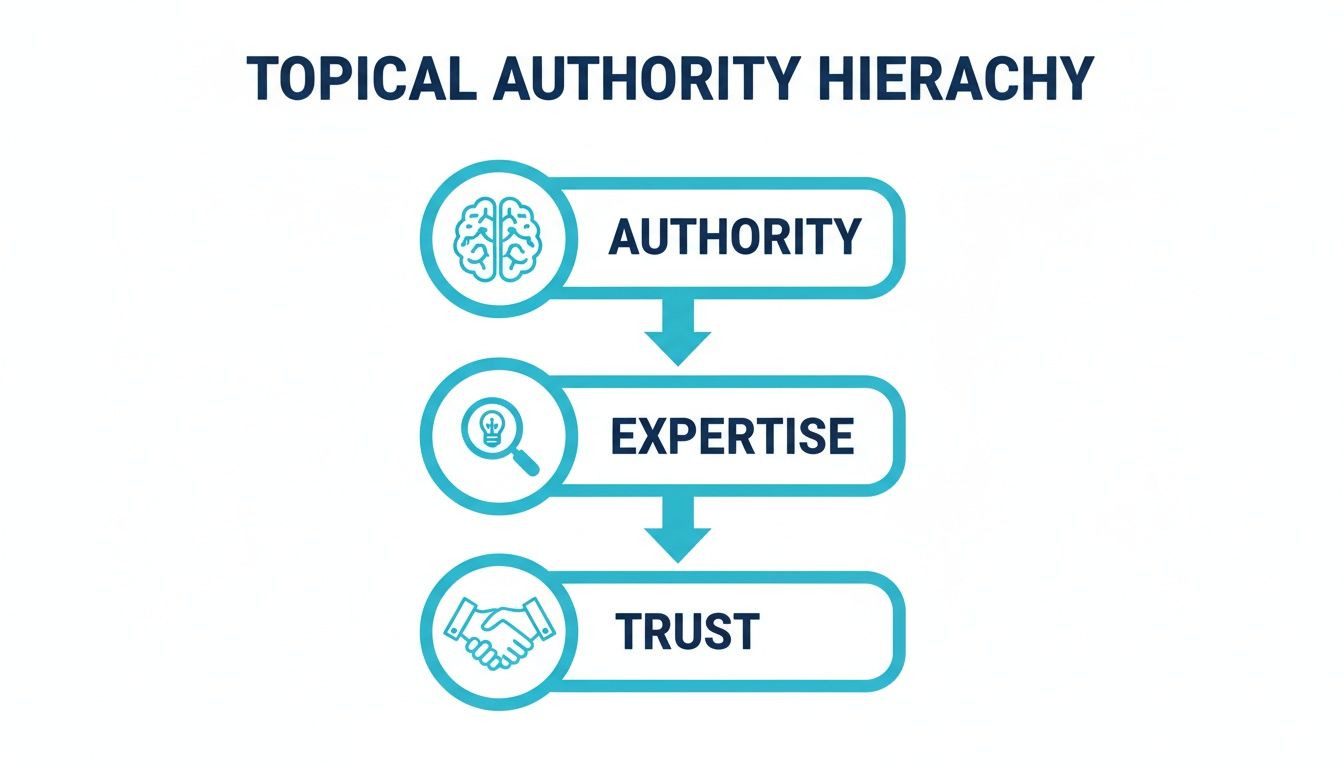
As you can see, building genuine trust is the end goal. That’s only possible after you’ve clearly established your expertise and authority.
The final pillar is all about proof. It’s about showing everyone, clients and Google alike, that you are who you say you are. Google has a framework for this called E-E-A-T, which stands for Experience, Expertise, Authoritativeness, and Trust.
This goes way beyond just what you write. It’s about providing tangible, undeniable evidence of your MSP's qualifications and real-world results. This is where you move from explaining concepts to showing your work.
Here’s how you can demonstrate E-E-A-T and build that crucial trust:
By weaving these credibility signals throughout your website, you give potential clients the reassurance they need to make a decision. At the same time, you're giving Google all the right signals to trust your content and rank it with confidence.
Knowing the theory is one thing, but putting it into practice is what actually generates leads. This isn't about guesswork or just publishing content whenever you feel like it. It’s about following a deliberate, repeatable process to cement your MSP as the go-to expert in your market.

Let’s walk through the exact roadmap, turning these abstract concepts into a concrete action plan that drives real results for your business.
Before you write a single word, you need absolute clarity on what you want to be known for. Trying to be an authority on everything at once is a recipe for failure. Instead, focus laser-tight on the core services that drive your revenue and solve your ideal clients' biggest headaches.
Start by listing out your most valuable offerings. Is it "managed cybersecurity for financial firms," "cloud migration for healthcare," or "IT compliance for law offices?" Get specific. These high-level service categories will become the foundation for your pillar pages.
Think like your best client for a moment. What keeps them up at night? What specific IT challenges are they facing that you are uniquely qualified to solve? Your content has to hit those exact pain points.
By narrowing your focus, you avoid the trap of creating generic, vanilla content that appeals to no one. You start the journey of becoming the recognized specialist in a high-value niche.
Once you have your core topics locked in, it's time to build your content map. This is where you dive into keyword research to uncover every single question, concern, and follow-up query your prospects are typing into Google. The goal is to create an exhaustive web of content around each core service.
This process involves planning two distinct types of content:
This "hub and spoke" model creates a logical, organized structure that search engines absolutely love. Each "spoke" dives deep into a subtopic, creating a comprehensive resource library that fully explores the subject matter from every angle.
With your content map in hand, you can finally start writing. This is the most crucial part of the whole process. Your content must be more than just optimized for keywords; it has to be genuinely valuable and solve real problems for the person reading it.
Don't just rehash what everyone else is saying. Draw on your unique expertise as an MSP. Share real-world examples from your experience, provide actionable checklists, and offer insights your competitors simply can't. You're not just writing for an algorithm, you're writing for a potential client who needs help.
This is also a good time to make sure your website’s technical foundation is solid. To learn more about this, check out our guide on what is technical SEO, which explains how your site's health directly impacts your content's visibility.
The final step is to connect all your content with a smart internal linking strategy. This is the glue that holds your topic clusters together, showing Google the relationship between your ideas. It's how you prove that you don’t just have a few random articles; you have a deep, interconnected body of knowledge.
Every time you publish a new piece of cluster content, you must link it back to its main pillar page. At the same time, your pillar page should link out to all of its supporting cluster articles. This creates a powerful feedback loop that passes authority throughout your site and seamlessly guides visitors to the information they need.
Here’s a simple checklist to guide your implementation:
Building topical authority feels good, but how do you actually prove it’s working? Without the right metrics, your content strategy is just a shot in the dark. You need a way to track your progress, demonstrate a real return on your investment, and show that all this effort is turning your expertise into tangible business results.
Fortunately, measuring topical authority isn't as abstract as it sounds. By zeroing in on a few key performance indicators (KPIs), you can get a surprisingly clear picture of how Google perceives your MSP’s expertise. It's time to move past vanity metrics and start tracking the numbers that genuinely connect to lead generation.
One of the most powerful and refreshingly simple ways to measure your progress is the Topical Authority Ratio. This metric gives you a hard number that represents how much of your website Google actually connects to a specific core service, like "cybersecurity" or "cloud solutions."
The formula is pretty straightforward: divide the number of pages Google associates with a topic by the total number of pages indexed on your site.
Let's break that down. Imagine your MSP site has 96 pages indexed in total. You pop a quick search into Google: site:yourdomain.com "cybersecurity services". The results show only 26 pages. This gives you a Topical Authority Ratio of 0.27 (26 / 96), a clear signal that you’re barely scratching the surface of that topic.
After intentionally building out content clusters, your ratio for a core topic like 'managed detection and response' could jump to 0.96. That's the kind of density that unlocks serious ranking power. This simple calculation instantly spotlights the gaps and opportunities in your content plan. You can learn more about calculating this ratio at Minuttia.com to see how it can guide your strategy.
While the ratio is a fantastic starting point, you need a full dashboard of metrics to get a complete view. Relying on just one number is like flying a plane with a single instrument, you're missing the big picture. To truly understand your performance, you need to monitor a handful of interconnected KPIs that tell the full story.
Here are the essential metrics every MSP owner should have their eyes on:
site:yourdomain.com "your topic" search operator in Google. Tracking the raw number of pages Google connects to your core topics over time is a simple but incredibly effective way to measure your growing content depth.By tracking these specific KPIs, you move from hoping your content works to knowing it does. This data-driven approach allows you to double down on what’s effective and refine what isn’t, ensuring your content investment delivers a predictable stream of qualified leads.
Monitoring these metrics transforms your SEO from a vague expense into a measurable growth engine. It's the proof you need to justify the investment and make smarter, more confident decisions for your MSP. If your current content isn't moving these numbers, it might be time for a tune-up, and a great place to start is with our guide on how to perform an SEO content audit.
Building topical authority is a powerful long-term play, but it demands patience and a solid game plan. Too many MSPs start out strong only to get tripped up by common mistakes that completely undermine their hard work. Knowing what these pitfalls are ahead of time is the best way to make sure your investment in content actually pays off.

Let's walk through the most frequent errors I see and, more importantly, what you should be doing instead to stay on track.
This is easily the biggest mistake: treating content like a random item on a to-do list. An article about cloud costs one month, a post on phishing the next, and then radio silence for 60 days won't build authority. This sporadic approach just creates noise, not a clear signal that you're an expert.
Google rewards patterns and consistency. Without a focused content map guiding your efforts, your articles become isolated islands of information. They never connect or build on each other, leaving you with a random collection of posts instead of a comprehensive library of knowledge.
What to do instead: Fully commit to a topic cluster model. Dedicate your resources to building out one complete subject area at a time before you even think about moving on to the next. This deliberate strategy demonstrates deep expertise and ensures every single piece of content contributes to a larger, more authoritative whole.
In a rush to publish frequently, many MSPs fall into the trap of creating thin content that just parrots basic definitions. An 800-word article titled "What is a Firewall?" that gives a dictionary-style answer does more harm than good. It tells both users and search engines that your knowledge is only skin-deep.
This kind of content doesn't answer the real, nuanced questions your prospects are asking. It fails to showcase your unique experience or solve a meaningful business problem, which makes it instantly forgettable and useless for building trust.
Shallow content is a liability. It tells Google you are a generalist, not a specialist, the exact opposite of what topical authority is designed to achieve. Instead of proving your expertise, you just end up blending in with the thousands of other sites offering the same generic advice.
You could write the most brilliant content on the planet, but if your articles don't link to each other, you're leaving a massive amount of SEO value on the table. Forgetting about internal links is like building a library but not creating a card catalog. All the books are there, but no one can find what they need or see how different subjects are related.
Every new blog post is a fresh opportunity to strengthen your existing content. When you fail to link related articles together, you isolate them. This prevents authority from flowing through your site and makes it incredibly difficult for search engines to grasp the true depth of your expertise.
Finally, a classic mistake is targeting keywords that are far too broad or attract the wrong kind of audience. Trying to rank for a term like "IT services" is not only a monumental task but also brings in traffic with completely unclear intent. You end up with a flood of website visitors who aren't qualified leads, wasting all your marketing efforts.
The goal isn't to get the most traffic; it's to get the right traffic. Here’s what this mistake looks like in the real world:
By focusing on specific, long-tail keywords that align directly with your ideal client's problems, you attract prospects who are actively searching for the exact solutions you provide. This precision is what turns your content into a reliable lead-generation engine.
Let's bring this home. We've walked through a lot, but the core idea is simple. Building topical authority isn't just an SEO tactic; it's a fundamental business strategy. It’s the difference between being another name on a long list of IT providers and becoming the only name that comes to mind when a prospect needs help.
This is how you get out of the lead-chasing grind. When you're the recognized expert, high-quality leads start seeking you out, ready to have a serious conversation. They don't just see a vendor; they see a trusted partner who understands their industry and their problems.
This guide handed you the complete blueprint. You know what topical authority is, why it's critical for MSPs, and the precise steps to build it. From mapping content hubs to measuring ROI, the plan is all here. But a blueprint is just a piece of paper. The real challenge, and the real opportunity, is in the execution.
If you're ready to put this strategy into motion and see tangible results, it’s time to think about bringing in a specialist. Partnering with an agency that lives and breathes MSP marketing ensures your strategy is executed flawlessly. It frees up your time and gets you to your growth goals faster and more efficiently.
Building real authority takes focus, consistency, and a deep knowledge of the SEO game. If you're serious about owning your market, let's have a conversation. We can build a custom strategy that puts these principles into action, driving the qualified leads you need to scale your business.
Ready to make your MSP the undisputed leader? Schedule your free consultation with The MSP SEO Agency today and let's build your plan.
Even with a clear roadmap, questions always come up when you’re putting a new strategy into action. Building topical authority is one of the most powerful moves you can make for your MSP, but it's totally normal to have a few things you want to clarify before jumping in. Let's tackle the most common questions we hear from MSP owners just like you.
This section is all about giving you clear, straightforward answers so you can move forward with confidence.
This is always the first question, and the honest answer is: it’s a marathon, not a sprint. Building real topical authority is a long-term investment in your MSP's growth. It’s not a quick hack for overnight rankings. You are methodically proving your expertise to Google, and that takes consistency and patience.
But that doesn't mean you'll be waiting years to see anything happen. You can often spot the first green shoots of success within 3 to 6 months. These early signs might look like:
Think of it like planting a tree. The initial growth is slow and mostly happens under the surface as the roots take hold. But with consistent care, those strong roots lead to significant, lasting results.
Absolutely. In fact, this is one of the biggest reasons to adopt a topical authority strategy. Your larger competitors often have a higher general Domain Authority, but their content strategy is usually a mile wide and an inch deep. They try to be everything to everyone, which results in a shallow layer of content across dozens of topics. This is your opening.
As a smaller, more specialized MSP, you can go deep where they go wide. By pouring all your energy into becoming the undisputed expert in a specific niche, like "cybersecurity for dental practices" or "CMMC compliance for manufacturers," you can outrank much larger companies for the searches that actually matter to your bottom line.
Topical authority is the great equalizer in SEO. It allows focused expertise to win against generic, big-budget marketing by proving to Google that you are the most relevant and helpful answer for a specific set of problems. You don't have to play on their field. You win by changing the game and becoming the go-to specialist.
This is a common point of confusion, but the difference is crucial. Let's break it down with an analogy: Domain Authority is like your website's general reputation, while Topical Authority is about its specific expertise.
A national news website might have a sky-high Domain Authority, but your MSP can build much higher Topical Authority on "managed IT services for law firms" and outrank them for those valuable searches every single time.
Ready to stop being just another IT provider and start being the go-to authority in your market? The MSP SEO Agency builds custom SEO strategies that turn your expertise into a predictable stream of qualified leads. Let's create your game plan. Schedule your free consultation today.
Understanding topic authority and keyword difficulty is essential for any MSP SEO strategy because it determines where you can realistically compete and win. The smartest MSP SEO agencies focus their clients on building deep topical coverage in specific niches rather than chasing high-difficulty vanity keywords. This approach to SEO for MSP businesses creates clusters of authoritative content that signal expertise to both search engines and AI models. When your MSP SEO services are guided by a clear understanding of where your topical authority is strongest and where the best MSP SEO opportunities lie, every piece of content you publish moves you closer to dominating your target search landscape.
See how targeted SEO delivers measurable impact for managed service providers. Explore our proven strategies and real-world outcomes.