Search intent is simply the "why" behind a Google search. It’s the user's ultimate goal: what they are actually trying to accomplish when they type a query into the search bar. Are they looking to learn, find a specific website, or are they ready to hire an MSP right now?

Think of it like this: search intent is the unspoken question behind every query. When a potential client searches for "cybersecurity services Houston," they aren't just window shopping. They have a real problem that needs a solution, and they are actively looking for a capable MSP to solve it.
Getting this right is the difference between a website that feels invisible and one that becomes a reliable lead-generation machine for your MSP.
For Managed Service Providers, understanding search intent isn't just another marketing task; it's a core business strategy. It helps you align everything you publish, from blog posts to service pages, with the precise needs of potential clients. You stop guessing what people want and start giving them exactly what they are looking for.
Focusing only on keywords is like hearing the words but missing the meaning. While knowing what people search for is still important, understanding why they search for it is where the real power is. Google's entire algorithm is built to reward content that best satisfies the user's underlying goal.
This is especially critical for a local business like your MSP. When you create content that matches intent, it works much harder for you.
In short, search intent is the bridge connecting a prospect's problem to your MSP's solution. When you build that bridge correctly, you create a direct path for high-quality leads to find you. This transforms your website from a simple digital brochure into your most effective salesperson.

Think about your potential clients. A business owner typing "what is ransomware" into Google has a completely different need than one searching for "managed IT support pricing." Getting a handle on that difference is the secret to creating content that actually brings in qualified leads for your MSP.
Every single search query fits into one of four main categories of intent. You can think of these as the four core mindsets of your prospects. When you align your content with these mindsets, your website becomes a magnet for the right clients, no matter where they are in their buying process.
Let's unpack each type with some real-world MSP examples.
When someone has informational intent, they’re looking for answers. They have a question, a problem, or a curiosity, and they just want to learn. They are nowhere near ready to buy anything; right now, they're simply in research mode. This is your top-of-funnel opportunity to step up and be the expert.
With navigational intent, the user already knows exactly where they want to go. They're just using Google as a quick way to get to a specific website or page. Maybe they are looking for your client portal or a specific resource you mentioned in a meeting. You can't really "optimize" for this beyond simply having a website, but it’s a good signal of existing brand awareness.
This is where things get interesting. A user with commercial investigation intent has moved past the initial learning phase and is now actively comparing their options. They know they have a problem, and they are trying to figure out the best way to solve it by evaluating different services or providers.
This is your moment to show them why your MSP is the right choice. They are looking for reviews, comparisons, and the kind of detailed information that helps them make a smart decision. Someone with commercial intent isn't asking "what is a firewall?" anymore. Now, they are asking "which firewall service is best for a small law firm?"
This is the finish line. The user with transactional intent has done their homework, weighed their options, and is ready to pull the trigger. They are looking to hire an MSP, buy a service, or book a consultation right now. These keywords are pure gold for lead generation.
It's critical to realize how dominant Google is here. For instance, according to recent search engine market share reports, going after these high-intent queries is non-negotiable. This traffic often converts much better than other types.
Knowing what search intent is and knowing how to find it are two completely different things. The first part is theory; the second is where you start finding qualified leads. To really own your local market, you need a repeatable process to look at any keyword and know exactly what a potential client is trying to accomplish.
Let's move from theory to action. It's time to stop guessing and start diagnosing. This is your toolkit for decoding search intent using the same clues Google uses to rank pages in the first place.
Honestly, the fastest and most reliable way to figure out a keyword's intent is to just Google it. See what’s already ranking on page one. The Search Engine Results Page (SERP) is a treasure map, and Google has already done most of the heavy lifting for you.
Pay close attention to the types of pages showing up. Are they mostly blog posts and in-depth guides? That’s a dead giveaway for informational intent. Are you seeing a bunch of service pages with "Request a Quote" buttons? That screams transactional intent.
Here are the specific SERP features to watch for:
The little words people add to their main search query are huge clues. We call these keyword modifiers, and they are direct signals of intent. A prospect isn't just searching for "data backup"; they are searching for "data backup services" or "how to choose a data backup solution."
Learning to spot these modifiers is like reading your prospect’s mind. They tell you exactly where someone is in their journey. For example, "cybersecurity" on its own is incredibly vague. But "cybersecurity services for law firms" tells you everything you need to know.
Here are some common modifiers and the intent they usually signal for an MSP:
Often, the best source of truth is the data you already own. Your website's analytics can show you the intent of the visitors who are already finding you. Two free tools from Google, Google Search Console and Google Analytics, are absolute goldmines for this.
First, jump into Google Search Console. The Performance report shows the exact search terms people used to land on your site. Look at what's driving clicks to your most important pages. Is your "Managed Firewall Services" page getting traffic from queries like "what is a next gen firewall"? That's an intent mismatch you need to fix.
Next, open up Google Analytics. Watch how users behave once they are on your site. For a really deep dive, an expert can show you how to conduct an SEO audit to connect these dots. For instance, do visitors who land on a service page from a transactional query leave almost immediately? That’s a clear signal your page isn't giving them what they need.
This is where the rubber meets the road. The real magic happens when you tie search intent knowledge directly to your sales process. This is how SEO stops being just another marketing line item and turns into a predictable engine for generating qualified MSP leads.
Think of your sales funnel as more than just a tool for your sales team. Every piece of content you publish should be strategically designed to guide a potential client from one stage to the next. By mapping their search intent to this journey, you create a smooth, logical experience that builds trust and makes your MSP the obvious choice.
At the top of your sales funnel (ToFu), it's all about awareness. Your potential clients at this stage might not even know they need an MSP. They just know they have a problem or a business challenge that's keeping them up at night. Their searches are purely informational, and your job is to be the trusted expert who gives them the best answer.
This is where you build an audience by creating helpful, no-strings-attached content like:
By satisfying this early-stage informational intent, you get your MSP on their radar long before they’re even thinking about buying.
Once a prospect moves into the middle of the funnel (MoFu), their mindset has shifted. They have gone from being problem-aware to being solution-aware. They now understand the problem they have and are actively researching and comparing potential solutions, including managed IT services.
This is where commercial investigation intent kicks in. They are searching for things like "best firewall services for small business" or comparing solutions. At this critical stage, you must transition from educator to trusted advisor.
To capture this audience, focus on creating content that helps them compare and contrast:
The flowchart below breaks down the clues you can use to figure out which stage a user is in.
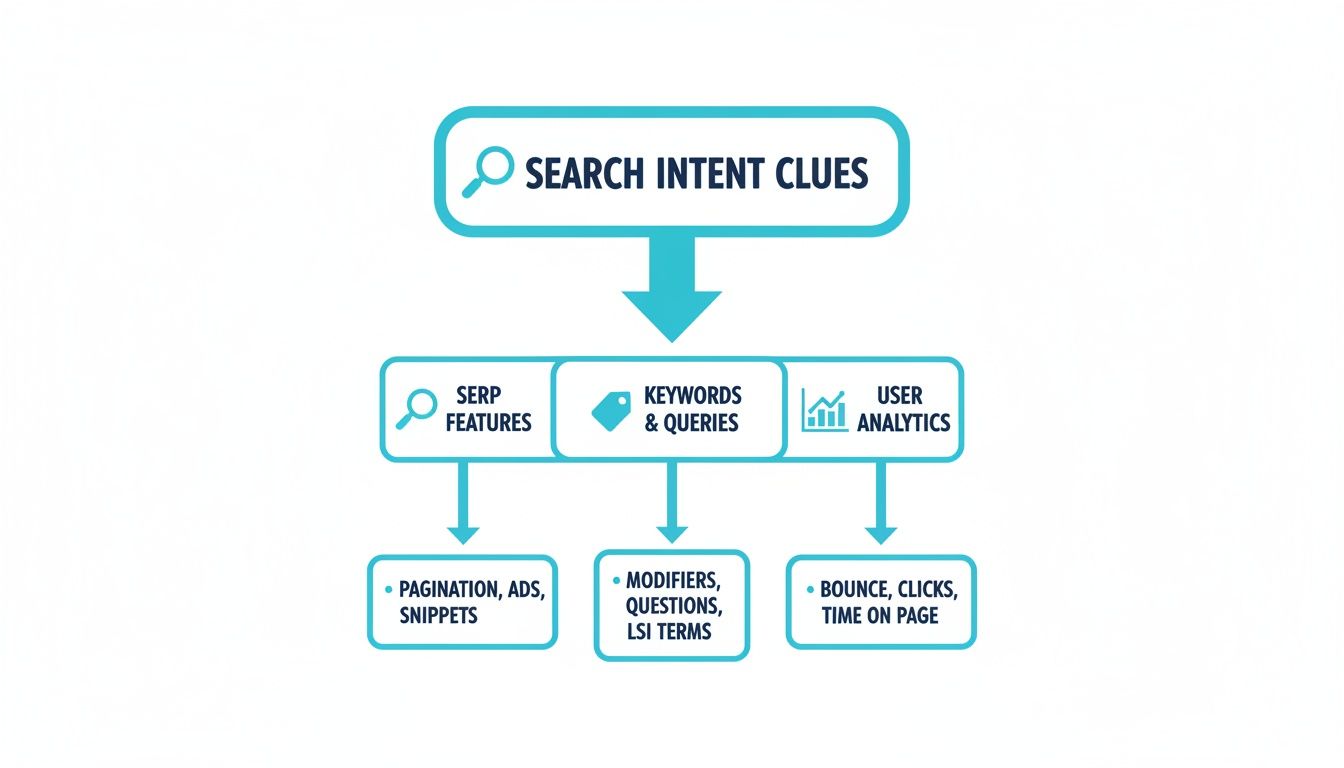
This hierarchy shows that by analyzing search results, keyword modifiers, and user behavior, you can accurately diagnose a prospect's intent and serve them the exact content they need.
The bottom of the funnel (BoFu) is the final decision stage. Prospects here have done their homework and are ready to pull the trigger. Their searches are incredibly specific and carry strong transactional intent. They’re typing keywords like "managed IT support pricing" or "hire MSP in Dallas."
When a potential client uses these terms, they practically have their wallet out. Your only job is to make it dead simple for them to take the next step and become a lead. If you are unsure where a prospect might be dropping off, conducting a thorough SEO content audit can shine a light on any conversion roadblocks.
Content for this high-intent stage should be direct and action-oriented:
So what does this actually look like in practice? That's easy. Keywords.
By deliberately aligning each stage of your sales funnel with the right type of search intent for certain keywords, you create a powerful, cohesive marketing strategy for your MSP.

Figuring out what your potential clients want is only half the battle. Now comes the real work: shaping your website to meet those needs and turning curious visitors into qualified leads. This goes way beyond just sprinkling keywords on a page. It's about structuring your entire online presence to satisfy the user's core motivation.
This process, known as on-page optimization, is how you translate all those valuable intent insights into actual business growth. When you get this right, every single element works in harmony to answer a user's question and gently guide them to the next logical step.
The way you structure each page should be a direct answer to what a user is looking for. Think of your title tags and meta descriptions as your first handshake. They have to be compelling, accurately represent your content, and make a clear promise that your page holds the solution they need.
For instance, a title like "How to Create a Business Continuity Plan | [Your MSP Name]" is a perfect match for someone with informational intent. On the other hand, "Managed Cybersecurity Services in Dallas | Get a Free Quote" speaks directly to a prospect with transactional intent.
Your headlines (H2s and H3s) are just as critical. They break up your content and should anticipate and answer specific questions. A tight alignment between your page and the user's need creates a seamless experience, building trust every step of the way.
Your call to action (CTA) is arguably the single most important element for turning a visitor into a lead. A generic "Contact Us" button is a massive missed opportunity. Your CTAs have to be customized for the specific search intent of the page they live on.
Here’s a quick guide to matching your CTAs to different intents:
Using CTAs strategically means you’re asking for the right thing at precisely the right time, which can dramatically boost your conversion rates.
Beyond the words and images your visitors see, technical elements are working behind the scenes to signal intent to search engines. For MSPs, two areas deserve special attention: Schema markup and Core Web Vitals.
Schema markup is code you add to your site that helps search engines understand your content on a deeper level. You can use specific Schema types to highlight your services and show off client reviews with star ratings right in the search results. You can dive deeper into how this works in our guide on what is technical SEO.
Core Web Vitals are Google's metrics for measuring a page's user experience, including loading speed and stability. A slow, clunky website is a conversion killer. By ensuring your site is fast and responsive, you send a strong signal to both users and Google that you offer a high-quality experience.
Let's get practical. Mastering search intent isn't just a one-off project; it’s a total shift in how you think about digital marketing for your MSP. You have to commit to understanding what your clients need at every single step of their journey. This is your roadmap for building a powerful, intent-driven SEO strategy from the ground up.
Think of it this way: you’re moving from just getting traffic to getting the right traffic. Every blog post, every service page, and every video needs a clear purpose that directly answers what a potential client is trying to do.
To turn these ideas into a real plan, you need to weave intent analysis into your marketing routine. It's truly the most reliable way to turn what you know about your audience into a steady stream of qualified leads.
Here are the essential steps to get started:
This methodical approach transforms your website from a simple collection of pages into a cohesive system designed for one thing: converting prospects into clients.
Even after you get the hang of search intent, a few common questions tend to pop up. As an MSP leader, you need straightforward answers to feel confident putting these concepts to work. Let's tackle some of the most frequent questions we get from IT professionals.
This is a quick debrief to solidify your understanding of search intent and how it translates into actual, measurable results for your MSP.
The short answer? More often than you would think. Search intent isn't static; it can shift based on new tech, major world events, or just evolving customer behavior. A great example is the search "remote work IT setup," which went from an informational query to a transactional one almost overnight.
A good practice is to check the SERPs for your most important keywords at least quarterly. If you suddenly see different types of content outranking what used to dominate, that’s Google telling you that user expectations have changed. It's your signal to pivot your content strategy.
While it’s tempting, you’ll almost always see better results by focusing one page on one primary intent. Your "Managed Cybersecurity Services" page should be all business, built to capture a lead (transactional intent). Your blog post "How to Spot a Phishing Email" should be purely educational, designed to build trust (informational intent).
The main exception is the "pillar page," a massive, comprehensive guide. These are primarily informational but can successfully weave in commercial elements. Even then, the page still needs a single, dominant goal to be effective.
AI-powered search, from Google's SGE to tools like Perplexity, is all about understanding the user's question and answering it directly. This evolution makes high-quality, deeply informative content more critical than ever. To get your MSP featured in these AI-generated summaries, your content needs to be crystal clear and well-structured.
Think of it this way: building out detailed guides, comprehensive service pages, and robust FAQ sections makes your website a go-to source for these AI models. While transactional intent is still the key to landing clients, AI is changing how those prospects find the information that gets them to that decision point.
Ready to stop guessing and start generating predictable, high-quality leads? At MSP SEO Agency, we build intent-driven SEO strategies that put your MSP in front of the right clients at precisely the right time. Schedule your free consultation today to see how we can help you dominate your local market.
Mastering keyword intent is what separates an effective MSP SEO strategy from one that merely generates traffic without leads. When you align every page on your site with the correct intent, whether informational, commercial, or transactional, you create a seamless path from first click to signed contract. The top MSP SEO agencies use intent analysis as the foundation for content planning, ensuring that MSP SEO services cover the full buyer journey. This intent-driven approach to SEO for MSP businesses means your content portfolio naturally captures prospects at every stage of their decision-making process, making your managed service provider the obvious choice when they are ready to act.
See how targeted SEO delivers measurable impact for managed service providers. Explore our proven strategies and real-world outcomes.