When most people in the MSP world hear “SEO,” their minds jump straight to keywords and blog posts. And while that content is crucial, it’s only one part of the story. The other, often-overlooked part is technical SEO: the bedrock of your entire digital presence.
Think of it this way: your content, case studies, and service pages are the beautiful, well-designed rooms in your office. Technical SEO is the foundation, the electrical wiring, and the plumbing. You don't necessarily see it, but without a solid structure, nothing else works. It’s all the behind-the-scenes work that makes sure search engines can actually find, understand, and trust your website.
If your website has a shaky technical foundation, even the most brilliant article about your new cybersecurity service will go unseen. Why? Because search engine crawlers, the automated bots that scour the internet, will run into dead ends, broken links, or confusing signals on your site.
When those crawlers can't properly access, interpret, and index your pages, your MSP effectively becomes invisible online. This means fewer leads, less traffic, and a missed opportunity to connect with businesses actively looking for your solutions.
Imagine a potential client searches for “managed IT services in [Your City].” Google’s entire job is to return the most relevant, reliable, and user-friendly result. It analyzes hundreds of signals to make that decision, and a huge chunk of them are purely technical.
For an MSP, your website is your digital business card. A slow, buggy, or insecure site sends a terrible message. It subtly communicates a lack of attention to detail, the very last thing a company wants from its technology partner.
A technically sound website doesn't just rank better; it builds immediate trust. It shows prospects you value efficiency, security, and a seamless experience, the same qualities they're looking for in an MSP.
So, what does this digital foundation actually look like? It’s not a single fix but a collection of ongoing practices. To make it easier to grasp, we can break it down into three core pillars.
Ignoring these elements is like building a cutting-edge data center but forgetting to install a front door. You might have the best services in the world, but if no one can get in to see them, it doesn’t matter. Getting these fundamentals right is the first and most critical step.
Let's cut right to the chase: a website with technical problems isn't just an IT nuisance; it's a lead-generation killer. For every potential client searching for "managed cybersecurity services" or "IT support in [Your City]," your website is either a wide-open front door or a locked gate. Technical SEO is the key that unlocks it.
Picture two MSPs in the same city. One has a website that's fast, mobile-friendly, and easy to navigate. The other has a slow, clunky site that’s a nightmare to use on a phone. When a decision-maker is looking for help, which one do you think Google will show first? The second MSP is practically invisible, losing the lead before their phone even has a chance to ring.
Your website is often the very first interaction a prospect has with your brand, and a poor technical experience erodes your credibility instantly. Put yourself in a client's shoes: if your own website is slow or broken, why on earth would they trust you to manage their critical IT infrastructure?
This digital first impression sets the tone for the entire relationship. Common technical issues actively turn high-value clients away before they even read about your services. It’s like having a broken phone line; you’re missing calls from qualified leads every single day.
Think of technical SEO as the foundation of your entire marketing strategy. It’s what allows search engines to efficiently crawl, index, and actually understand what your website is about. This is mission-critical for MSPs trying to rank for competitive IT and cybersecurity terms.
With Google handling over 8.5 billion searches every single day, even minor technical flaws can render your MSP invisible. Just auditing your site architecture to ensure search engines can reach your key pages can boost how many of your pages get indexed by 30-50%. You can learn more about the impact of these small changes from recent SEO statistics.
Ignoring your site's technical health is like building a state-of-the-art security operations center but forgetting to connect it to the internet. You have all the capabilities, but no one can access them.
This is exactly where many MSPs stumble. They invest in great content but neglect the technical framework that allows Google to find and reward it. It’s a huge missed opportunity that directly hurts the bottom line.
Technical SEO issues create friction at every step of a potential client's journey. From the moment they discover you to the moment they decide to call, these problems are quietly sabotaging your sales efforts. Here’s a look at how specific failures can stunt your growth:
Each one of these issues is a leak in your sales funnel. Fixing them isn't just an IT task, it's a core business activity that drives growth. Our expert MSP SEO services focus on plugging these technical leaks to build a reliable lead generation engine for your business.
Knowing you have technical SEO problems is one thing, but actually finding them is another challenge entirely. This checklist is built specifically for MSP and MSSP owners. It’s not a laundry list of every technical detail under the sun, but a focused guide on the items that genuinely move the needle for lead generation.
Think of this as a self-assessment to get a quick, clear picture of your website's health. We’ve organized it into practical categories to help you figure out where to start.
This diagram shows just how easily you can lose leads when common technical issues make your website practically invisible to potential clients.
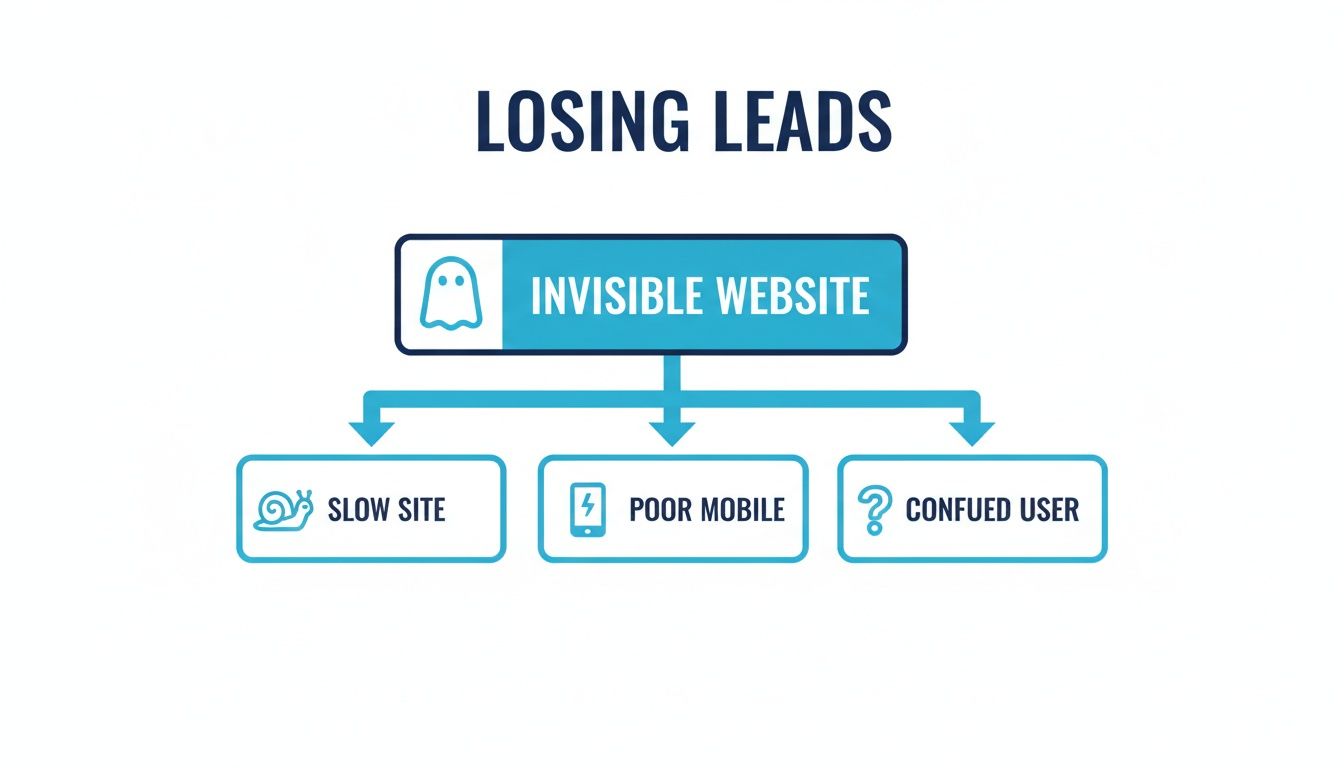
As you can see, a slow website, a clunky mobile experience, or just plain confusing navigation are the main culprits that hide your MSP from the very people you want to attract.
First impressions are everything online, and speed is the first handshake. A slow website isn't just an inconvenience; it's a direct reflection of your MSP's technical skill. If you can't get your own site running smoothly, why would a client trust you with their entire IT infrastructure?
A snappy website doesn't just keep visitors happy. It sends a strong signal to Google that you offer a quality experience, building trust and boosting your visibility in search results.
Well over half of your potential clients will find you on their phone. If that experience is anything less than perfect, you've likely lost them for good. Pinching and zooming to read your service descriptions is a deal-breaker in today's world.
A website that performs poorly on mobile isn't just an inconvenience; it's a statement. It tells prospects you aren't keeping up with modern technology, a fatal flaw for any IT service provider.
Your site must be fully responsive, meaning it fluidly adapts to any screen size. Buttons need to be easy to tap, text must be readable without squinting, and your navigation has to be simple and intuitive on a small screen.
If search engines can't find and understand your website, it doesn't matter how incredible your managed services are. Accessibility is all about making sure Google's crawlers can efficiently navigate your site and index every important page.
Finally, a few technical elements on each page help search engines grasp the context and hierarchy of your content. Getting these right reinforces your expertise on key topics, whether it's cybersecurity, cloud services, or data backup. These signals provide structure, making it easier for Google to connect your solutions with the right client searches.
This checklist gives you a solid foundation to start from. For those ready to dig even deeper, you can learn more about how to conduct an SEO audit in our comprehensive guide.
Okay, you've run through the checklist and found a few issues. Now what? Don't get overwhelmed. The key is to prioritize fixes that will give you the biggest return for your time and effort. This table breaks it down for you.
.tbl-scroll{contain:inline-size;overflow-x:auto;-webkit-overflow-scrolling:touch}.tbl-scroll table{min-width:600px;width:100%;border-collapse:collapse;margin-bottom:20px}.tbl-scroll th{border:1px solid #ddd;padding:8px;text-align:left;background-color:#f2f2f2;white-space:nowrap}.tbl-scroll td{border:1px solid #ddd;padding:8px;text-align:left}Priority LevelTechnical SEO TasksPotential Impact on LeadsHighFix "Not Secure" (HTTPS) errors, repair critical 404 errors, ensure mobile-friendlinessImmediate & Significant: Prevents losing leads due to trust issues and poor user experience.MediumOptimize page speed (especially Core Web Vitals), fix incorrect robots.txt fileStrong: Improves rankings and user engagement, which directly influences lead volume.LowOptimize all title tags/metas, clean up heading structures, add internal linksGradual & Foundational: Builds long-term authority and click-through rates from search.
Start with the high-priority items, the "must-haves" that could be actively costing you business right now. Once those are handled, move on to the medium and low-priority tasks to build a rock-solid technical foundation for your site.
Google's algorithm can sometimes feel like a black box, but they've been pretty open about one thing: they reward websites that give people a great user experience. Core Web Vitals are the specific, measurable metrics Google uses to judge that experience. For a technical crowd like MSP and MSSP leaders, it's helpful to think of them as performance SLAs for your website.
Failing to meet these benchmarks isn't just about annoying a few visitors; it actively damages your search rankings. A poor score signals to Google that your site is frustrating to use, which means fewer qualified leads will ever find you. These metrics are often the difference between showing up on page one and getting lost on page three.

A dashboard like this gives you a clear, at-a-glance view of how your site stacks up against Google's core user experience metrics. For any IT service provider trying to build credibility and capture high-intent search traffic, nailing these scores is non-negotiable.
Largest Contentful Paint (LCP) measures how long it takes for the most substantial piece of content on the page, usually a big image, video, or a large block of text, to become visible. In simple terms, it's Google's way of gauging perceived load speed from a real user's perspective.
LCP answers a critical question: How quickly can a visitor see what they came for? A slow LCP makes your site feel sluggish and unprofessional, causing potential clients to bounce before it even finishes loading.
Your target here is an LCP of 2.5 seconds or less. Anything creeping over 4 seconds is considered poor and will almost certainly drag your rankings down. Common culprits are exactly the kinds of things an MSP can fix: large, unoptimized images and slow server response times.
The global SEO services market is set to skyrocket to $148.86 billion by 2031, largely driven by the growing emphasis on technical factors like these. For MSPs and cybersecurity firms, optimizing for Core Web Vitals isn't optional anymore. In fact, sites that deliver a superior page experience often see traffic lifts of 15-20%, a major advantage in a crowded market. You can explore the numbers in this detailed market analysis.
Interaction to Next Paint (INP) is the new kid on the block, replacing the older First Input Delay metric. INP measures your site’s overall responsiveness by tracking the time from when a user does something, like clicking a button or expanding a menu, to the moment they see a visual response on the screen.
Think of it like a conversation. If you ask a question and have to wait too long for an answer, the interaction feels broken. A high INP does the same thing to your website, making it feel laggy and unresponsive, which quickly erodes a prospect's trust. You need to aim for an INP below 200 milliseconds.
Cumulative Layout Shift (CLS) is all about visual stability. Have you ever tried to click a link, only to have an ad or image pop in and push everything down, causing you to click the wrong thing? That deeply frustrating experience is exactly what CLS measures.
A good CLS score is 0.1 or less. This metric is vital for MSPs because unexpected layout shifts make your site look amateurish and unreliable. It’s a seemingly small technical detail that speaks volumes about your brand's professionalism and attention to detail. The fix usually involves specifying dimensions for images and videos so the browser can reserve the correct amount of space for them while they load.
The ground is shifting in the world of search. For a long time, the mission was clear: get your MSP to the top of Google's classic "10 blue links." But with AI-powered answers from tools like ChatGPT and Google's new AI Overviews, the rules of the game are changing fast. A solid technical SEO foundation isn't just about winning at traditional search anymore, it's your entry ticket into this new AI-driven era.
Think of the technical elements of your site as a kind of universal translator. They take all that fantastic content you’ve written about your services and organize it into a language that AI models can process and understand instantly. This is about so much more than keywords. It’s about clearly and explicitly telling the AI what you do, where you do it, and who you serve.
AI search engines don't browse your website like a person does. Instead, they scan for highly structured information to pull the most direct and authoritative answer to a user's question. This is where your technical SEO becomes a massive competitive advantage.
When you implement structured data correctly, it’s like handing the AI a perfectly organized instruction manual for your business. It allows the models to immediately grasp the relationships between all the different pieces of information on your site.
A well-structured site doesn't leave things to chance. It tells AI engines: "This is an MSP. Our office is in Dallas. We specialize in managed cybersecurity for small businesses." That kind of clarity is precisely what gets your business recommended in an AI-generated answer.
Without that technical foundation, your MSP is just one more website floating in an ocean of unstructured data. With it, you become a recognized authority whose expertise an AI can confidently cite, putting your name directly in front of prospects who are ready to buy.
So, how do you achieve this level of clarity? The main tool in your arsenal is schema markup, which is a special vocabulary of code you add to your website. It's invisible to your human visitors, but for search engines and AI, it adds a rich, contextual layer of meaning.
For an MSP, this is a game-changer. You can use specific schema types to define:
Google's algorithm is in a state of constant motion, with 500-600 updates rolling out every single year. A strong technical foundation is what keeps you stable and visible through all that change. It's no surprise that 92% of marketers are now optimizing for both traditional and AI search, since a technical approach is key to long-term resilience.
For cybersecurity firms, well-implemented structured data can increase the chances of getting featured in rich snippets by 25%, a huge advantage when nearly 60% of all searches end without a single click. If you'd like to dig deeper, you can discover more insights about AI SEO statistics and see where the industry is heading.
This isn't just a defensive tactic; it's a strategic investment in your future. By building this structured, AI-friendly foundation today, you're positioning your MSP to capture the next wave of clients who are turning to AI for recommendations. It’s how you make sure that when someone asks an AI for the best IT provider in town, your name is the one it gives.
Think of technical SEO as the engine in your MSP’s lead generation car. It’s not the flashy paint job or the premium sound system, it's the powerful, meticulously tuned machine under the hood that actually makes the car go. Without it, all your other marketing efforts, from slick service pages to insightful blog posts, are stuck in the driveway, invisible to the people you need to reach.
For any MSP serious about getting a consistent flow of qualified leads online, a solid technical foundation isn't just a "nice-to-have"; it's non-negotiable.
When your website is technically sound, search engines can easily find and understand what you do. More importantly, potential clients who land on your site get a smooth, professional experience, building trust before they even think about contacting you. It future-proofs your digital presence, keeping you competitive as search technology, including AI, continues to evolve.
If you've been nodding along, recognizing issues like slow load times or a clunky mobile site on your own website, you're already ahead of the game. The first step is always awareness. But let's be realistic, most MSP owners don't have the time or specialized expertise to dive deep, diagnose the root causes, and implement the right fixes.
That's where a dedicated partner changes everything. You move from guesswork to a clear, data-driven strategy.
A strong technical SEO strategy isn’t about chasing algorithms. It’s about building a reliable, predictable system that attracts high-value clients to your business, month after month.
The logical next step is to get an honest, in-depth look at where your website stands right now. A comprehensive audit takes you from wondering what's wrong to knowing exactly what to fix, in what order, and why it matters. It’s the roadmap that transforms your site from a static digital brochure into a dynamic lead generation machine.
If you’re ready to stop losing leads to invisible technical problems, it’s time to act. To see how a full analysis works, our guide on performing an SEO content audit is a great place to start, as it shows how your content and technical health are deeply connected.
We talk to MSP owners every day, and a lot of the same questions about the nitty-gritty of technical SEO come up. Let's clear the air on some of the most common ones so you know exactly what this means for your business.
This is always the first question, and the honest answer is, "it depends." If you've got a massive, glaring issue, like a "Not Secure" warning scaring off visitors or a robots.txt file accidentally telling Google to ignore your entire site, fixing it can bring a noticeable lift in just a few weeks. Those are the quick wins.
But the real, lasting impact? That’s a medium-to-long-term game. Think three to six months. Why? Because improving things like site speed, Core Web Vitals, and your site's overall structure is about earning Google's trust. It takes time for search engine crawlers to come back, see the positive changes you've made, and reward that effort with better rankings. It's a foundational investment, not a quick hack.
As a tech-savvy MSP owner, you can absolutely get your hands dirty with the basics. Firing up Google Search Console to find broken links or security warnings is well within your wheelhouse. You can probably even tackle things like writing better title tags or compressing a few images.
Where it gets tricky is diving into the deep end of the pool. Things like:
These tasks demand specialized tools and, frankly, a lot of experience. You can handle the first layer, but an expert is going to find the deeper problems that are usually the real roadblocks to getting more leads.
It's a huge mistake to see technical SEO as a "set it and forget it" project. It’s an ongoing process, period. Your website isn't a static brochure; it's a living, breathing part of your business. Every time you add a new blog post, tweak a service page, or install a new plugin, you risk creating a new technical problem.
Think of it this way: your website's technical health needs constant monitoring, just like the client networks you manage. You'd never install a firewall and walk away forever. The same principle applies to your site's foundation.
On top of that, Google never stops moving the goalposts. The rollout of Core Web Vitals and the big push into AI search are perfect examples. Regular audits and maintenance are what keep you in the game, protecting your investment and ensuring the leads don't dry up.
The cost really depends on the current state of your website. A small, five-page site with a handful of minor issues is going to be a much smaller investment than a large site with years of technical debt and deep architectural problems.
Most reputable agencies, including us, won't throw a random number at you. We start with a comprehensive audit to get a clear diagnosis. That data-driven approach means we can give you a precise quote based on the actual work needed to get results, not just a wild guess.
Ready to turn your website from a digital brochure into a powerful lead-generation engine? We start every engagement with a deep technical audit to build a strategy that drives real business growth for MSPs. Learn more about our approach and schedule your audit today.
Technical SEO forms the invisible infrastructure that determines whether your content and authority-building efforts actually translate into rankings and leads. For managed service providers, technical excellence is not optional; it is a direct reflection of the competence you promise your clients. A specialized MSP SEO agency brings the diagnostic depth needed to identify and resolve the crawlability issues, indexing problems, and performance bottlenecks that hold most MSP websites back. When technical SEO is treated as the foundation of your MSP SEO services rather than an afterthought, every other element of your MSP SEO strategy, from content to link building to local SEO for MSP visibility, performs at a higher level.
See how targeted SEO delivers measurable impact for managed service providers. Explore our proven strategies and real-world outcomes.