To win a featured snippet, you need to create a clear, direct answer to a specific question. You also need to format it in a way Google can easily understand. Think of it as creating "snippet-ready" content using lists, tables, or a tight paragraph that Google can lift and drop right into the search results. When that happens, your MSP is instantly seen as the authority.

In the competitive world of managed services, visibility isn't just a vanity metric: it's your direct line to new clients. A featured snippet is so much more than a good ranking. It's Google essentially handing your content the top prize, a spot often called "Position Zero" because it sits above the traditional number one result.
For an MSP, this is a game-changing lead generation tool.
Imagine a potential client searches for "how to migrate to Microsoft 365" or "what is co-managed IT." Seeing your company's name and answer right at the top instantly builds trust. You become the definitive source, the expert providing the solution before they even have to click. This is how you cut through the marketing noise and get noticed.
Winning a featured snippet means you've successfully answered a high-intent question that business decision-makers are actively asking. These aren't just casual browsers. They're people looking for solutions to real problems involving cybersecurity, cloud infrastructure, or compliance, the very services you offer.
Owning the snippet for a crucial service-related question transforms your website from a digital brochure into a trusted resource. It’s the difference between being one of many search results and being the answer.
This elevated visibility creates a snowball effect. It drives highly qualified traffic to your site and reinforces your brand as an authority in the IT space. Over time, this builds a rock-solid foundation for sustainable lead generation. Earning this coveted spot requires a deliberate strategy built around expert-level content. To go deeper on this, check out our guide on what is topical authority.
The push for featured snippets isn't just a trend. The data shows they are a fundamental part of the search experience. According to a major industry study, in 2021, featured snippets appeared for 12.29% of all search queries. Out of the data set analyzed, that’s about 14 million searches. A massive slice of search traffic is being directly influenced by these answer boxes. You can see more of the data breakdown and featured snippet statistics on MyCodelessWebsite.com.
For any MSP, this data points to a huge opportunity. If you're ignoring snippets, you're missing out on a primary way potential clients find and vet their IT partners. Every snippet you win for a term like "best cybersecurity practices for small businesses" or "disaster recovery plan template" is a direct line to a potential lead.
The benefits are clear and directly tied to your growth:
Ultimately, optimizing for featured snippets isn't just some advanced SEO trick. It's a core part of a modern digital marketing strategy designed to help your MSP scale and attract the right kind of clients.
Winning a featured snippet isn’t about luck; it's a game of strategy. Before you write, you need to get inside the head of your ideal client and figure out what they're typing into Google. This means going beyond broad keywords like "IT support" and uncovering the specific, nagging problems that keep them up at night.
The real goal here is to unearth queries with strong commercial intent. These are the questions that tell you someone isn't just window shopping for information. They're actively looking for a solution to buy. For an MSP, these are pure gold.
Start by simply thinking like your customers. What are their biggest IT headaches? Their questions almost always boil down to cost, security, or efficiency.
For instance, a potential client isn't just searching for "cybersecurity." They have much more specific, practical questions that you're perfectly positioned to answer.
Answering these directly puts your MSP on their radar at the exact moment they need an expert. Every one of these questions is a featured snippet just waiting to be claimed. If you want to dig deeper into how these questions fit into your sales process, our guide on what search intent is and how it impacts your content strategy is a great next step.
Brainstorming is a fantastic start, but you'll need tools to scale this and uncover the opportunities your competitors are missing.
A personal favorite for this is AnswerThePublic. You can plug in a core topic like "managed IT services," and it spits out a huge visualization of the questions people are asking. It handily groups them by words like "what," "how," "why," and "can," giving you an instant content roadmap.
This gives you dozens of long-tail, question-based keywords that are practically begging to be turned into featured snippets.
Another incredibly powerful and free tool is Google itself. Get in the habit of paying close attention to the "People Also Ask" (PAA) boxes that pop up in the search results.
The "People Also Ask" section is basically Google handing you a cheat sheet of high-value snippet opportunities. Each question in that box has proven user demand.
Search for a term like "co-managed IT services," and you'll likely see PAA questions like "What is the co-managed IT model?" or "What are the benefits of co-managed IT?" These are your next H2 or H3 headings, plain and simple. When you create clear, concise answers for each of these, you’re sending a massive signal to Google that your page is the go-to resource.
Okay, so now you have a huge list of potential questions. You can't go after all of them at once, so it's time to get strategic and prioritize. Focus on the queries that line up perfectly with your MSP's core services.
Run each potential topic through this quick filter:
By systematically finding and prioritizing these high-value questions, you build a content strategy that doesn't just attract traffic. It consistently wins the snippets that matter. This is how you turn your blog from a simple marketing channel into a powerful, automated lead generation engine.
Once you've zeroed in on the right questions, the real work begins: serving up the answers on a silver platter for Google. How you structure your content is what signals to the search engine that you not only have the best answer but also the clearest one. This is less about flowery prose and more about clean, logical formatting.
Think of it like building a piece of IKEA furniture. If the instructions are clear and the pieces are labeled correctly, it all comes together. If not, you're left with a confusing mess and some leftover screws. Your content needs to be that easy-to-follow instruction manual for Google.
This simple process flow is how we consistently turn an opportunity into a snippet-winning piece of content.
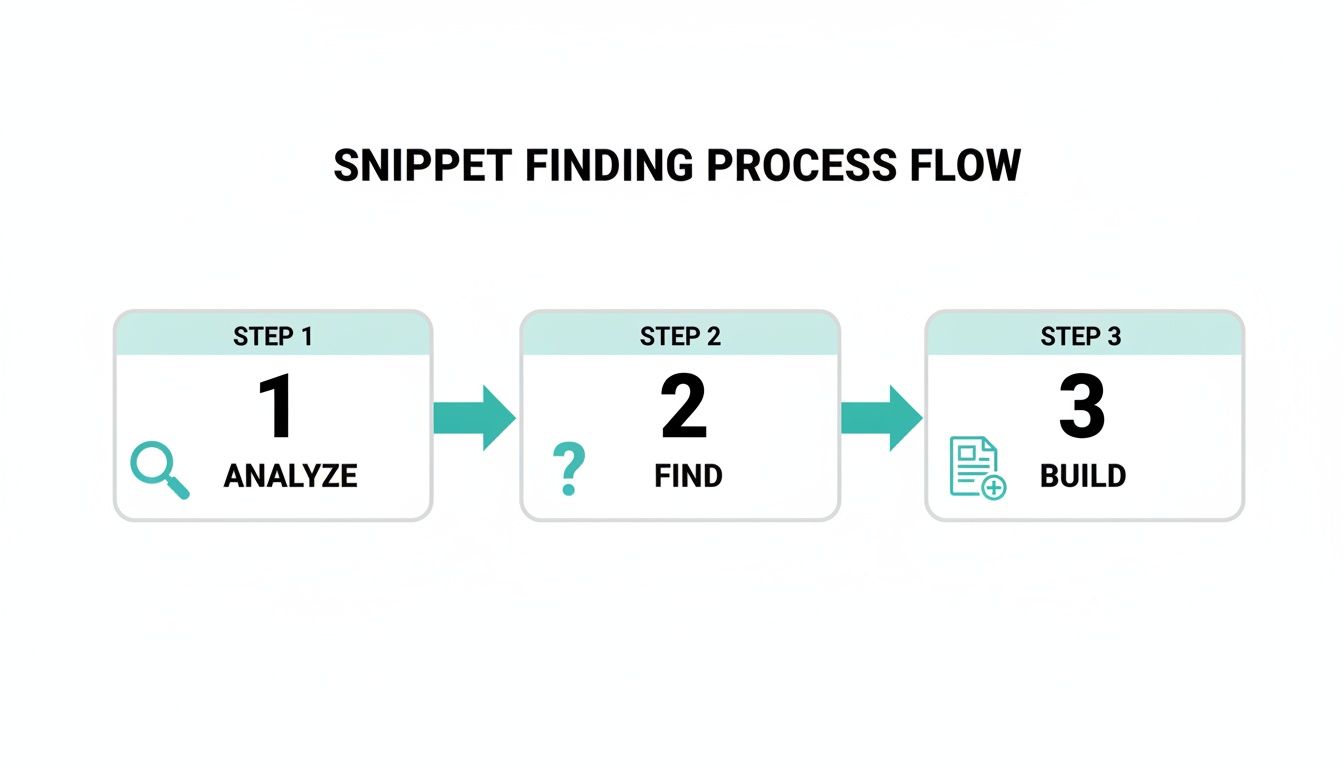
It boils down to a repeatable loop: analyze the search landscape for opportunities, find the exact questions your audience is asking, and then build content structured specifically to answer them.
The single most critical technique for winning featured snippets is the "Inverted Pyramid" method. It’s a classic journalism principle, and it works like a charm for SEO. You put the most important information right at the top, immediately followed by supporting details.
For your MSP blog, this means placing a concise, direct answer immediately below the heading that asks the question. No long-winded introductions. No fluff. Just the answer.
A common mistake I see is burying the lead. You can’t make Google dig for the answer. Your structure must be: Question (as a heading), followed immediately by the Answer (as a short paragraph, list, or table).
This direct approach is exactly what Google's algorithm is designed to find. It's looking for a self-contained block of text it can easily lift and place into the search results.
Paragraph snippets are the most common type you'll see, often triggered by "what is," "who is," or "why is" questions. The key here is to be brief and crystal clear.
Your target is a paragraph that’s around 40 to 60 words long. This is the sweet spot for a definition or a concise explanation that fits perfectly inside the snippet box.
For instance, directly under an H2 heading titled "What Are Managed Detection and Response Services?," you’d write:
"Managed Detection and Response (MDR) is a cybersecurity service that combines technology and human expertise to perform threat hunting, monitoring, and response. Unlike traditional security tools, MDR provides a dedicated team to actively investigate and mitigate threats once they are discovered."
That's it. A perfect, self-contained answer that Google can easily pull.
Lists are absolute gold for "how-to" guides, process explanations, or "best of" roundups. Google loves to feature numbered lists (<ol>) for step-by-step processes and bulleted lists (<ul>) for items that don't follow a specific order.
To optimize for list snippets, follow these simple rules:
<ol> or <ul> tags, with each item wrapped in a <li> tag. This semantic HTML is a direct signal to Google about your content's structure.Remember, creating new content this way is great, but don't forget about your existing assets. Performing a regular SEO content audit can help you find older posts that are prime candidates for a quick reformat to target these snippets.
Tables are your secret weapon for comparison queries, such as "Co-managed vs. Fully Managed IT" or "Microsoft 365 E3 vs. E5." Google can pull data directly from a properly formatted HTML table (<table>) to create a clean, easy-to-read table snippet.
When building a table, keep it simple. Google needs to be able to parse it easily. Use clear headers (<th>) for each column and keep the data in each cell (<td>) short and to the point. A complex, multi-layered table is far less likely to be featured than a clean, straightforward one.
The table below gives you a quick reference guide for formatting your content to target the three main types of featured snippets.
Paragraph: A 40-60 word definition placed directly under a question-based heading (H2/H3). MSP Example — H2: "What is Zero Trust Security?" followed by a paragraph: "Zero Trust is a security model..."
List: A properly formatted HTML bulleted or numbered list with a clear, descriptive header. MSP Example — H2: "5 Steps to Improve Your Cybersecurity Posture" followed by a list: "1. Conduct a Risk Assessment..."
Table: A simple HTML table with clear column headers and concise data for easy comparison. MSP Example — H2: "SIEM vs. SOAR: Key Differences" followed by a table comparing features of each.
By structuring your content with these specific formats in mind, you're doing more than just writing for your readers. You're engineering your content to be the perfect, algorithm-friendly answer that Google is actively looking for.
Getting your content and formatting right is half the battle. But there's a whole other layer working behind the scenes that can give you a serious edge: technical SEO. This is what helps Google actually find, understand, and trust your content in the first place.
Think of it like this: your amazing, well-structured content is the payload. Technical SEO is the super-fast rocket that gets it in front of Google. Without a solid technical foundation, even the best content can get stuck on the launchpad.
This part of the process is all about giving Google explicit clues about what your content is for and ensuring your site runs flawlessly. When Google can crawl and process your page without a hitch, it's far more likely to reward you with that coveted Position Zero.
One of the most powerful tools in your technical arsenal is Schema markup. It's basically a special vocabulary of code you add to your website's HTML to give search engines more context. Instead of leaving Google to guess what your page is about, you’re telling it directly.
For MSPs trying to win snippets, two types of Schema are gold:
By adding this markup, you're essentially pre-formatting your content for Google. It's like handing them a perfectly organized cheat sheet for your page, which dramatically boosts your chances of being featured.
Let's say you have a page dedicated to your managed cybersecurity services. You can use FAQPage Schema to highlight the common questions people ask.
Here's a simplified code snippet you could adapt for your own site:
{
"@context": "https://schema.org",
"@type": "FAQPage",
"mainEntity": [{
"@type": "Question",
"name": "What is included in managed cybersecurity services?",
"acceptedAnswer": {
"@type": "Answer",
"text": "Our managed cybersecurity services include 24/7 network monitoring, threat detection and response, vulnerability management, security awareness training, and compliance reporting to protect your business assets."
}
},{
"@type": "Question",
"name": "How much do managed cybersecurity services cost?",
"acceptedAnswer": {
"@type": "Answer",
"text": "The cost of managed cybersecurity services varies based on the size of your business, the complexity of your IT environment, and the specific services required. We offer custom quotes after an initial consultation."
}
}]
}
Placing this code on your page makes the Q&A structure crystal clear to Google, making it a prime candidate for a featured snippet or a spot in the "People Also Ask" box.
Technical SEO isn't just about code; it’s about making sure your website offers a great experience to human visitors. This is a massive factor for Google. If your page is slow, clunky, or impossible to use on a phone, your snippet chances will plummet.
A fast-loading, mobile-friendly page isn't just a 'nice-to-have' feature; it's a fundamental requirement. Google will almost always favor a page that provides a great user experience over one that doesn't, even if the content is similar.
I always tell clients to zero in on these two areas:
A strong technical foundation simply makes your content more accessible, both for search engine bots and for the people you want to reach.
Finally, don’t underestimate the power of a smart internal linking strategy. When you link from other relevant pages on your site to the page you want to win a snippet for, you're sending a strong signal to Google: "Hey, pay attention! This page is a cornerstone for this topic."
This simple act passes authority (often called "link equity") to your target page and helps Google see how it fits into your site's overall structure.
For instance, if you’ve written several blog posts about different aspects of cybersecurity, make sure they all link back to your main "Managed Cybersecurity Services" page. This reinforces its authority and drastically improves its chances of winning snippets for those high-value commercial keywords.
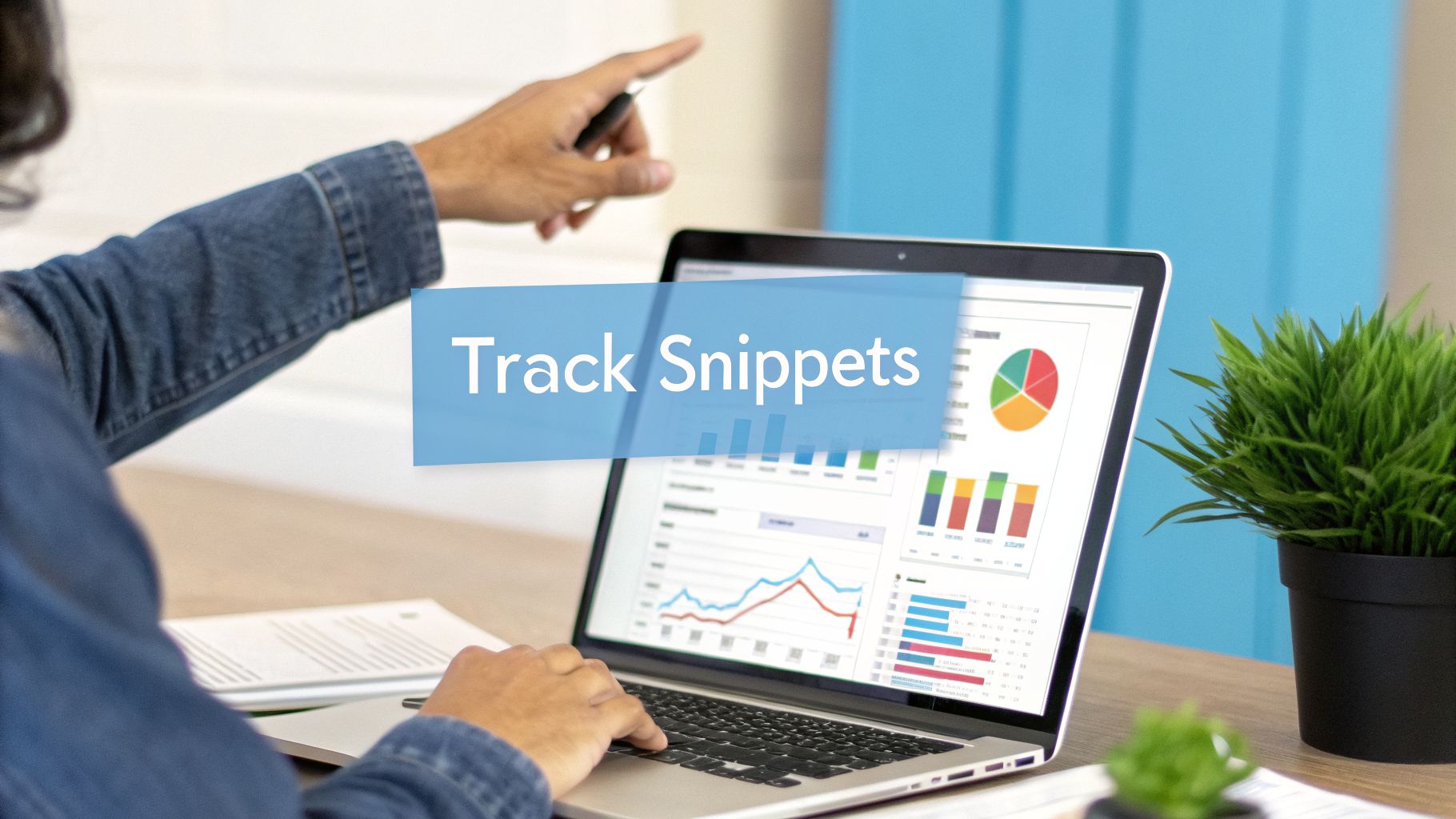
Here’s a hard truth about featured snippets: earning one is only half the battle. This isn't a "set it and forget it" game. It’s an active, ongoing process of tracking, analyzing, and refining your approach. An answer that wins you a snippet today might be replaced tomorrow by a competitor who just did it a little bit better.
The good news is you don’t have to work in the dark. With the right tools and a bit of detective work, you can make sharp, data-driven decisions that keep your content right where you want it: at the top of the search results.
Your first stop should always be Google Search Console. This free tool is a goldmine for finding your best snippet targets. I always tell MSP owners to look for the "low-hanging fruit" first.
This means finding pages that are already performing well but just need a nudge to claim that coveted Position Zero. You're hunting for queries where your pages already rank somewhere from position 2 to 10.
If you’re already on the first page, Google considers your content authoritative. Often, all it takes is a few simple formatting tweaks or a more direct answer to leapfrog the current snippet holder. This is genuinely one of the fastest ways to see a real impact from your efforts.
While Search Console is fantastic for spotting opportunities, you’ll want a dedicated SEO platform to monitor your snippet wins and losses over time. Tools like Ahrefs or Semrush are built for this.
Set up rank tracking for your target keywords and, this is key, configure it to alert you whenever you gain or lose a featured snippet. This creates a real-time feedback loop.
This kind of continuous monitoring transforms your snippet strategy from guesswork into a repeatable, data-backed process for your MSP's growth.
The core of a successful snippet strategy is iterative improvement. It's about constantly asking: "Why did Google choose that answer, and how can I make mine better?" This mindset is what separates those who occasionally get lucky from those who consistently own Position Zero.
With your tracking in place, the real work begins: refining your content. This doesn't have to mean massive rewrites. It’s about making small, strategic adjustments based on what the data is telling you.
Let’s say you lose a paragraph snippet for "what is co-managed IT." Look at the winning page. Is their definition clearer? Shorter? Try rewriting your opening paragraph to be even more direct, aiming for that 40-60 word sweet spot.
Or maybe a competitor just nabbed a list snippet for "steps to improve cybersecurity." Analyze their list. Is the language simpler? Are their steps more actionable? You might reformat your content from a dense paragraph into a clean, numbered list to better match the format Google is clearly rewarding for that query.
Finally, remember that Google has a strong preference for fresh, up-to-date content. This is especially true in the fast-moving worlds of IT services and cybersecurity. An article on the "best antivirus software" from three years ago isn't going to hold a snippet for long.
Get into the habit of regularly reviewing your most important snippet-winning articles. Add new information, update key statistics, and remove outdated advice. Every time you refresh a page, you send a strong signal to Google that your content is still relevant and authoritative, which is a huge part of defending your Position Zero rankings. This continuous cycle of tracking, analyzing, and refining is fundamental to learning how to optimize for featured snippets for the long haul.
Even with a solid plan, it's normal to have questions when you first start chasing featured snippets. Getting this right is a bit of an art and a science. Understanding the quirks of the process helps you set realistic goals and put your energy where it'll actually pay off for your business.
Let's dig into some of the most common questions I hear from MSPs, along with some straight-up answers to get you on the right track.
This is, without a doubt, the number one question I get asked, and the honest answer is: it depends. There’s no magic timeline. How quickly you can snag a snippet comes down to your website's current authority, how competitive the search term is, and how fast Google re-crawls your page after you've updated it.
If you have a page that’s already ranking in the top five for a query, you could see a featured snippet pop up in just a few days or weeks after making your optimizations. For a brand new blog post, however, you're looking at several months, at least. You have to build up the authority and rankings just to get in the game. Consistency is what makes the difference.
Yes, absolutely! This is the biggest opportunity snippets offer. While Google often pulls from the top organic result, it frequently sources the answer from any of the URLs on the first page.
This is a massive advantage. If your MSP’s blog post is sitting at position five but has a perfectly formatted, concise answer, you can jump right over everyone above you to claim "Position Zero." It’s a fantastic way to punch above your weight class in a crowded search results page.
This is exactly why getting the formatting and the directness of your answer right is so crucial. You don't always have to outrank your competitors in the traditional sense to beat them to the best spot on the page.
You don't need them to get started, but using the right SEO tools makes this process way more efficient and data-backed. They can save you a ton of time on manual research and give you insights you'd never find on your own.
Here’s a quick rundown of the tools that really help:
At the end of the day, you can apply the core principles: clear writing, logical page structure, and clean HTML, without spending a dime. But if you want to do this at scale and stay ahead of the competition, specialized tools give you a serious leg up in finding opportunities and proving your ROI.
Ready to stop guessing and start winning the search results that drive real leads for your MSP? At MSP SEO Agency, we build data-driven SEO strategies that capture high-intent traffic and position you as the authority in your market. Schedule your free consultation today and see how we can help you dominate Position Zero.
Featured snippet optimization is one of the most overlooked MSP SEO opportunities available today. For managed service providers competing in crowded local markets, winning Position Zero for a high-intent query can deliver more qualified traffic than ranking first in the traditional organic results. A skilled MSP SEO agency builds featured snippet targeting directly into the broader MSP SEO strategy, identifying the exact questions your ideal clients are asking and structuring your content to provide the definitive answer. This approach complements your existing MSP SEO services by maximizing the visibility of the authoritative content you have already invested in creating.
See how targeted SEO delivers measurable impact for managed service providers. Explore our proven strategies and real-world outcomes.