What if you could get your MSP in front of a prospect at the exact moment they’re about to sign with your biggest rival? That's the power of bidding on competitor keywords, a direct, often-overlooked PPC strategy for MSPs.
We’re not just talking about general searches. This is about showing up when potential clients are already deep in the buying cycle, actively researching specific IT providers by name.
Let's face it, the local MSP market is a crowded one. Potential clients don't just search for "managed IT services in [Your City]." They've heard names from referrals, seen vans on the road, or read local business journals. They search for "ABC Tech Solutions reviews" or "XYZ Managed Services pricing."
These aren't top-of-funnel, casual searches. These are high-intent queries from businesses on the verge of making a decision. By placing your ad right there, you are inserting your MSP into the final conversation and giving them a reason to pause and consider a better option.
The goal here isn't to be deceptive. It’s to make a compelling, last-minute introduction.
Think of it this way: a local business is frustrated with its current IT provider's slow ticket resolution. They've heard about "Competitor X" and are looking them up. If your ad appears, highlighting your 15-minute response time guarantee, you've just intercepted that prospect with a solution to their exact pain point.
You’re essentially saying, "Thinking about them? Before you decide, here’s what makes us different." This simple act turns your competitor's marketing spend and brand awareness into a lead generation opportunity for you.
The real power of this strategy is its timing. You're getting a shot at a nearly-closed deal by reaching prospects at their absolute peak of interest, right when they are making direct comparisons.
Before we dive into the how, it’s important to understand the strategic differences between this approach and your standard keyword campaigns.
| Factor | Competitor Bidding | General Bidding |
|---|---|---|
| Audience Intent | Very high; actively comparing and close to purchase. | Varies from low (research) to high (buying). |
| Search Volume | Lower; tied to a competitor's brand recognition. | Higher; broad audience searching for services. |
| Cost-Per-Click (CPC) | Can be higher due to lower Quality Score. | Generally lower, but can be high for popular terms. |
| Lead Quality | High; prospect is already "solution-aware." | Mixed; requires more nurturing and qualification. |
| Primary Goal | Intercept traffic, create comparison, win market share. | Build awareness, capture general demand. |
As you can see, this isn't about replacing your existing campaigns: it's about adding a highly targeted, surgical tactic to your growth arsenal.
Ultimately, a well-executed competitor campaign is a proactive way to grow your MSP. It helps you:
Instead of waiting for prospects to stumble upon you, you’re going directly to where they're shopping. It's a bold move, but one that can deliver a significant return and start chipping away at your competitors' market share.
Getting this right isn't about guesswork or just targeting every MSP in a fifty-mile radius. Success comes from precision. You need a data-driven hit list of your true digital rivals and the exact branded terms that will actually bring in qualified leads.
First things first: you need to figure out who you're really competing with online. This list might surprise you. It's often different from the companies you bump into at local business events. An SEO competitor is any site ranking for the keywords you want, while your business rivals are the MSPs chasing the same clients. Sometimes they overlap, sometimes they don't.
Start by jotting down the local or regional MSPs you already know. These are your obvious business rivals, the ones you see in the wild. But to get the full picture, you have to dig into the search data.
This is where tools like SEMrush or SpyFu become invaluable. Plug a known competitor’s website into one of these tools, and you'll see exactly what they're up to. You can see which organic keywords they rank for and, more importantly, which paid keywords they're actively bidding on. This is a direct signal of what terms they find valuable enough to spend money on.
Don't just look for their company name. The real gold is in the variations people search for when they're getting ready to make a move.
These long-tail keywords are absolute goldmines. They almost always have lower competition and are used by prospects with sky-high intent. If you want to brush up on the fundamentals, our guide on how to do keyword research for MSPs is a great place to start.
Now that you have a raw list of competitors and their branded keywords, it’s time to refine it. Not all keywords are worth your budget. You need to analyze them based on a few key metrics to make sure your ad spend is working as hard as you do.
Zero in on search volume, cost-per-click (CPC), and competitive density. The sweet spot is a keyword with decent search volume and a manageable CPC. You're looking for the perfect balance between reach and affordability.
This whole process is about intercepting a prospect at a critical moment. Think of it like this:
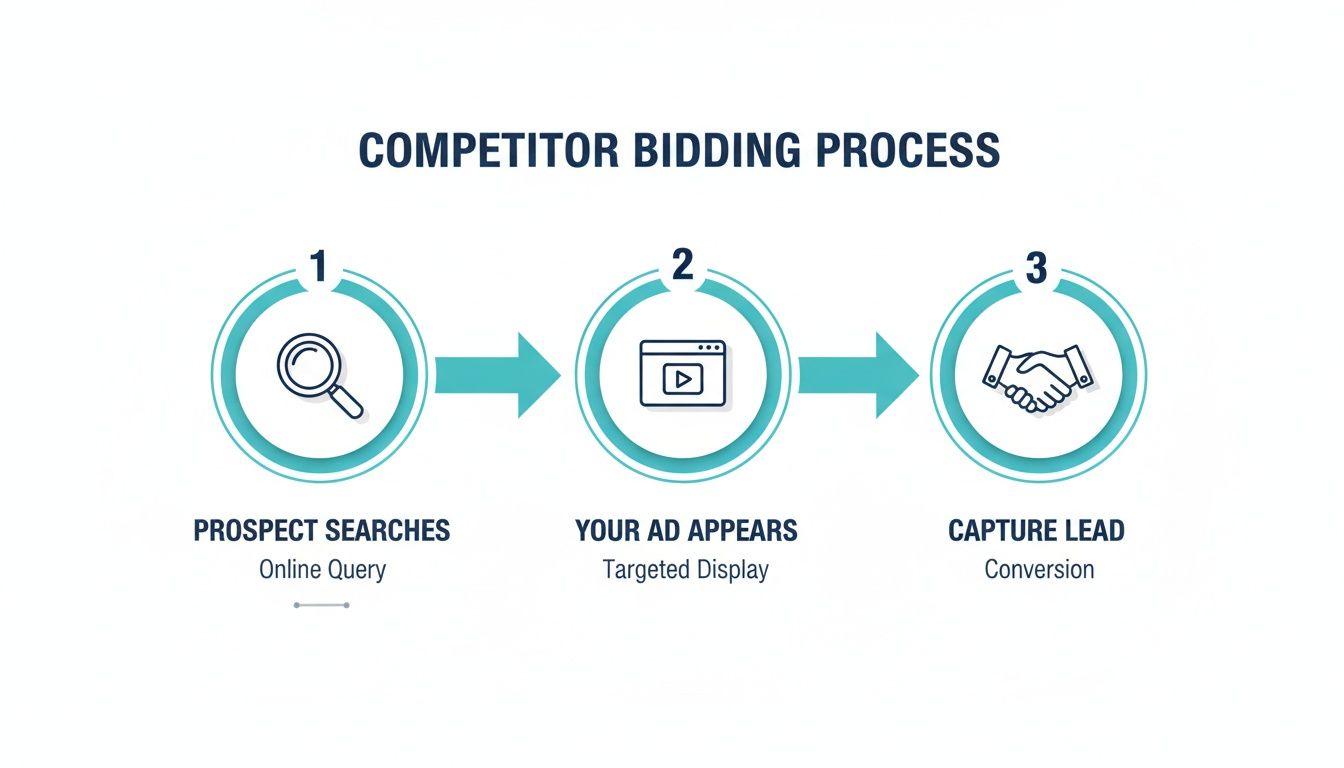
The journey is simple: your ad gets in front of a prospect looking for a rival, giving you a golden opportunity to win them over.
When done correctly, this tactic is powerful. In the B2B tech space, we've seen competitor campaigns produce 2.5x higher lead-to-sale rates. While general terms like 'managed IT services' are hyper-competitive, bidding on branded competitor terms can slash that competition significantly. Average CPCs for these terms hover around $8.50 in the US, making them a much more efficient investment.
Your final hit list should be a prioritized document. I always recommend starting small. Pick your top one or two competitors and a handful of their most valuable branded keywords. This lets you test the waters, learn what works, and then scale your efforts with confidence.
By following this process, you stop guessing and start executing a precise, data-backed strategy. You’ll have a focused list that ensures every dollar you spend is aimed squarely at capturing high-intent leads, right from under your competitors' noses.
Alright, you're bidding on your competitor's keywords. Now for the hard part. Your ad has to do some serious heavy lifting to get that click. Just showing up in the search results isn't enough.
You need to give a prospect a powerful, irresistible reason to ditch their original search and check you out instead. This is where sharp, persuasive ad copy isn't just nice to have, it's everything.

This isn't about shady tactics or trickery. It's about smart, ethical persuasion. You're simply presenting a clear alternative by shining a spotlight on your strengths, especially in areas where your competitor might be falling short. The goal is to interrupt their search and make them think, "Hang on, this other MSP might actually be a better fit."
Before we dive into writing, let's clear the air on the legal side of things. The good news is that platforms like Google Ads generally allow you to bid on competitor keywords. The line in the sand, however, is using their trademarked name in your actual ad copy: the headlines and descriptions people see.
The safest, and frankly most effective, approach is to never use your competitor’s trademarked name in your ad headlines or descriptions. Ever. It's a fast track to getting your ads disapproved, your account suspended, or even receiving a cease and desist letter. It's a line you just don't want to cross. Your focus should be on your value, not their name.
The core principle here is to avoid any chance of confusion. Your ad should never, ever imply that you are the competitor or are somehow affiliated with them. The whole point is to present your MSP as a distinct, and superior, alternative.
Instead of naming them, you can craft ads that speak directly to the frustrations their current customers or prospects might be feeling. This is where all that competitor research you did really starts to pay off.
Great ad copy in a competitor campaign is all about creating contrast. You need to have a solid grasp of the common complaints about your rivals. Is their support team notoriously slow? Are their pricing models confusing and unpredictable? Do they lack deep expertise in cybersecurity or compliance?
Use this intel to your advantage. Your ad headlines should read like a direct solution to their most well-known problems. This works because you’re connecting with the searcher’s frustration right at the moment they’re feeling it.
Let's walk through a few common MSP scenarios:
If your competitor is known for slow response times:
If your rival has complex, unpredictable billing:
If your competitor lacks strong cybersecurity services:
See what's happening here? None of these examples mention the competitor by name. They don't need to. The person searching for that specific brand and feeling that specific pain will instantly recognize that your ad is speaking directly to them.
When you're trying to siphon traffic away from a competitor, your ad has to make a compelling case for why your MSP is the smarter choice. The structure of that ad, from headline to description, plays a huge role in making that split-second argument.
I've found a simple but powerful framework that works consistently. Think of it in three parts:
First, acknowledge their pain in your first headline. Start with a question that zeroes in on a known weakness of your competitor. This immediately grabs the attention of anyone who's feeling that frustration.
Next, present your solution in the second headline. Directly counter that pain point with your specific, benefit-driven value proposition. Make it concrete and appealing.
Finally, reinforce with proof in the description. Use this space to add credibility. Mention specific guarantees, awards, or differentiators (like your response time or a compliance certification) that prove you can deliver on your promise.
This structure is effective because it follows a logical and persuasive path: problem, solution, and proof. It quickly builds a case for why clicking on your ad is a worthwhile detour. By focusing on your unique strengths against their known weaknesses, you turn a simple search for their brand into a potential lead for your MSP. That's how you start winning their customers.
You’ve managed to get the click. You crafted a compelling ad, snagged a prospect’s attention, and they’re one step away from your pipeline. But here's where so many MSPs drop the ball: they send that high-intent traffic straight to their generic homepage.
This is one of the fastest ways to burn through your ad budget. A prospect searching for your competitor needs a custom-tailored experience, not a one-size-fits-all website. The click is just the beginning; the real test is what happens next on your landing page.
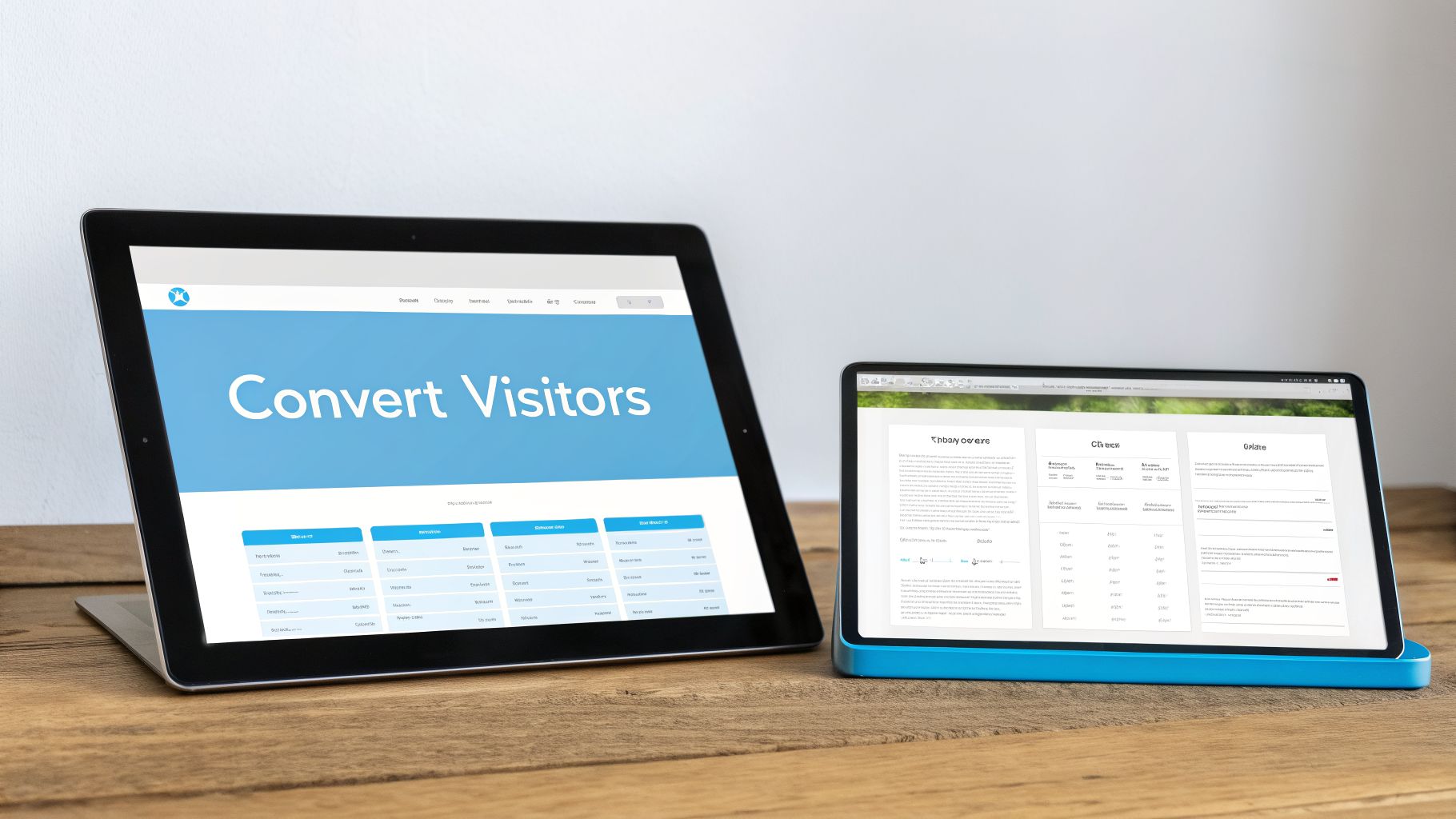
Your homepage is designed to serve everyone: existing clients, job seekers, and curious visitors. It’s loaded with different navigation paths and messages. A visitor who just clicked an ad about a "better alternative" doesn't have the time or patience to hunt for relevant information. They'll just bounce.
A dedicated landing page, however, picks up the conversation right where your ad left off. It delivers on the promise you made and immediately addresses the visitor's specific needs and search intent.
The numbers don't lie. While competitor campaigns in the B2B world can boast a 47% higher click-through rate, a staggering 62% of these campaigns ultimately fail because of a poorly aligned landing page. We've seen generic pages convert at a dismal 1.2%, whereas a tailored comparison page can easily hit conversion rates of 8.5% or more. For more on how page performance affects conversions, take a look at our guide on how to improve site speed.
Your most powerful tool in this scenario is a comparison landing page. This isn't about attacking your rival; it's about providing a clear, honest, and direct comparison that helps the prospect make an informed decision. You’re building trust and making a logical case for why your MSP is the superior choice.
Here are the critical components of a high-converting comparison page:
A great comparison table isn't about slinging mud. It’s a tool for clarity. You're giving a busy decision-maker a quick visual guide to see the real, tangible benefits of switching to your MSP. Let the facts do the selling.
Let's be honest, a prospect clicking your ad is skeptical. They were looking for someone else, after all. Your job is to dissolve that skepticism as quickly as possible, and nothing does that better than social proof.
Your comparison page absolutely must feature testimonials from clients, especially those who switched to your MSP from another provider. There is almost nothing more powerful than a quote like, "After struggling with slow response times from our old IT company, we switched to [Your MSP Name]. The difference in support has been night and day." This single sentence validates the prospect’s own potential frustrations and presents you as the solution.
Be sure to include these trust signals:
Finally, every single element on this page should funnel the visitor toward one specific goal. Don't sabotage your efforts by adding links to your blog, company history, or social media. Every extra link is a potential exit ramp that reduces your conversion rate.
Your call to action (CTA) needs to be a prominent button with clear, benefit-driven text. Ditch the generic "Submit" and use something that promises value:
By creating a landing page that is focused, persuasive, and packed with proof, you turn a simple click into a genuine, high-quality sales opportunity that belongs exclusively to you.
Getting your competitor campaign launched is a great first step, but it’s just the starting line. The real work, the part that turns ad spend into a predictable growth engine, begins now. Without constant management and a sharp eye on the results, you're basically just hoping for the best.
The first few weeks are all about gathering data and making adjustments. You need to live inside your Google Ads search terms report. This report is a goldmine, showing you the exact search queries people used that triggered your ads.
Let's be realistic: not every search that includes a competitor's name is a hot lead. Far from it. People are looking for your competitor's login page, their support number, or even jobs. Those clicks are budget-killers, and they’ll poison your performance data if you don't filter them out.
This is exactly what a negative keyword list is for. By telling Google not to show your ads for searches containing terms like “careers,” “login,” “portal,” or “support,” you stop wasting money on clicks that will never convert.
Think of it as putting up a velvet rope. You only want to let in traffic that’s actually looking to buy. A well-tended negative keyword list is one of the fastest ways to make a campaign profitable.
Start by blocking these common search categories:
Get into the habit of reviewing your search terms report weekly. This is not a set-it-and-forget-it task. New, irrelevant queries will always pop up, and adding them to your negative list keeps your campaign running lean.
It’s tempting to chase that number one ad spot. But while the visibility is nice, being at the very top isn't always the most profitable play. The cost-per-click for the top position can be incredibly high, sometimes high enough to erase your entire profit margin.
Your goal here is profit, not vanity.
Start by comparing your ad position data with your conversion data. You’ll often find that position two or three delivers a much healthier cost-per-lead.
This is where Google's automated bidding strategies can be a game-changer. Using Maximize Conversions or Target CPA (Cost Per Acquisition) lets Google's own machine learning do the heavy lifting. It adjusts your bids in real time, factoring in hundreds of signals to find that perfect balance between visibility and cost.
Clicks and impressions look good on a report, but they don't pay the bills. You need to connect your ad spend directly to new revenue. For an MSP, this means tracking the metrics that actually signal a real sales opportunity.
You have to look past the initial form submission. True success tracking means monitoring:
To get this right, you absolutely must have your conversion tracking dialed in. This means not just tracking the form fill on your landing page, but connecting that data to your CRM. This creates a clear line of sight from the initial ad click all the way to a signed contract.
If this sounds a bit overwhelming, we have a great resource on how to track SEO performance that walks through many of the same core principles.
Ultimately, it all comes down to Customer Lifetime Value (CLV). If you know the average new client is worth $60,000 over three years, and your competitor campaign is acquiring those clients for a $2,000 cost-per-acquisition, the ROI is crystal clear. That's the data that justifies scaling your budget and proves you’re not just spending money, you’re strategically investing in growth.
Thinking about bidding on your competitor's name? It can feel a little aggressive, and if you're like most MSP owners, you probably have a few nagging questions holding you back. Before you put a dollar into this kind of campaign, you need to understand the real risks and rules of the game.
Let's clear the air on the most common concerns we see.
Let's get the big one out of the way first: Yes, in most cases, it is perfectly legal to bid on another company's trademarked name as a keyword. Ad platforms like Google Ads have built their systems to allow for this.
But here’s the non-negotiable rule you absolutely must follow: You cannot use your competitor’s trademarked name in your actual ad copy. That means it can't be in your headlines or descriptions. The goal is to present your MSP as a compelling alternative, not to impersonate them or confuse the searcher. Violating this can get your ads disapproved, your account suspended, or even land you in legal hot water.
I get this question all the time. It’s a legitimate worry, nobody wants to drain their marketing budget fighting a war of attrition. The good news is that an all-out bidding war, where costs spiral out of control, is much rarer than you might think.
Many small and mid-sized MSPs simply don't have the marketing budget, time, or expertise to retaliate aggressively. You can also be smart about how you approach it to fly under the radar.
Here are a few tactics we use to minimize the chances of retaliation:
The point isn't to be a loud, aggressive bully. It’s about strategically inserting your MSP into the conversation when a prospect is already evaluating their options. Your quiet presence alone can be enough to win their business.
There’s no magic number here. A reasonable budget for an MSP in a competitive metro area like Dallas will look very different from one in a smaller suburban town. It all comes down to local competition and the cost-per-click (CPC) for your target terms.
A good starting point is a modest, controlled budget, maybe a few hundred dollars a month, that you're comfortable experimenting with. The initial amount is less important than your commitment to tracking the results obsessively from day one.
Pay close attention to these key metrics:
If the data shows you're acquiring quality leads at an acceptable cost, you can confidently start scaling up your investment. If not, you can pause the campaign, fine-tune your messaging, and try again without having risked a fortune.
Ready to stop letting competitors scoop up all the best leads? At MSP SEO Agency, we help you build and manage smart campaigns that get you in front of high-intent prospects. Let's talk about a strategy for your MSP.
See how targeted SEO delivers measurable impact for managed service providers. Explore our proven strategies and real-world outcomes.