

Effective keyword research for your MSP starts with a simple question: What are our actual business goals? The point is to figure out which services make you the most money, define where you can serve clients, and uncover the exact phrases those potential clients are typing into Google to solve their IT headaches.
Before you open a tool like Ahrefs or Semrush, you need a solid foundation. For a Managed Service Provider, keyword research isn't just another marketing task. It’s the strategic blueprint for connecting your most valuable services with the local businesses that desperately need them.
Get this alignment wrong, and you'll waste time and money attracting website traffic that never turns into a paying client. The goal is to generate a predictable stream of high-quality leads, transforming your website from a digital brochure into a reliable growth engine.
This initial planning ensures every article you write and every page you optimize serves a direct business purpose. It's the critical difference between blindly chasing vanity traffic and strategically building a pipeline of ideal MSP customers.
First, take a hard look at your service offerings. Which ones drive the most revenue or have the highest profit margins? Let's be honest, not all services are created equal. Your co-managed IT packages might be far more lucrative than one-off break-fix jobs, or perhaps your cybersecurity compliance services have a much higher customer lifetime value.
Jot down a list of these core, high-value offerings. These are your "money" services, and they need to be the absolute bedrock of your keyword strategy.
Think about services like:
By prioritizing your most profitable services, you guarantee your SEO efforts directly fuel your bottom line. You stop attracting tire-kickers and start bringing in clients actively searching for the high-value solutions you excel at delivering.
Next, you have to get crystal clear about where you actually do business. As an MSP, your market is almost always local or, at most, regional. Trying to rank for a massive, generic term like "IT support" is a fool's errand. You'll be buried by national brands with bottomless budgets.
The real money is in owning your specific service area. Your sweet spot is combining your service with your location, like "IT support for law firms in Dallas" or "cybersecurity compliance in Irvine."
This simple flowchart shows how these foundational pieces: your business goals, core services, and geographic focus: all click together to create a powerful keyword strategy.
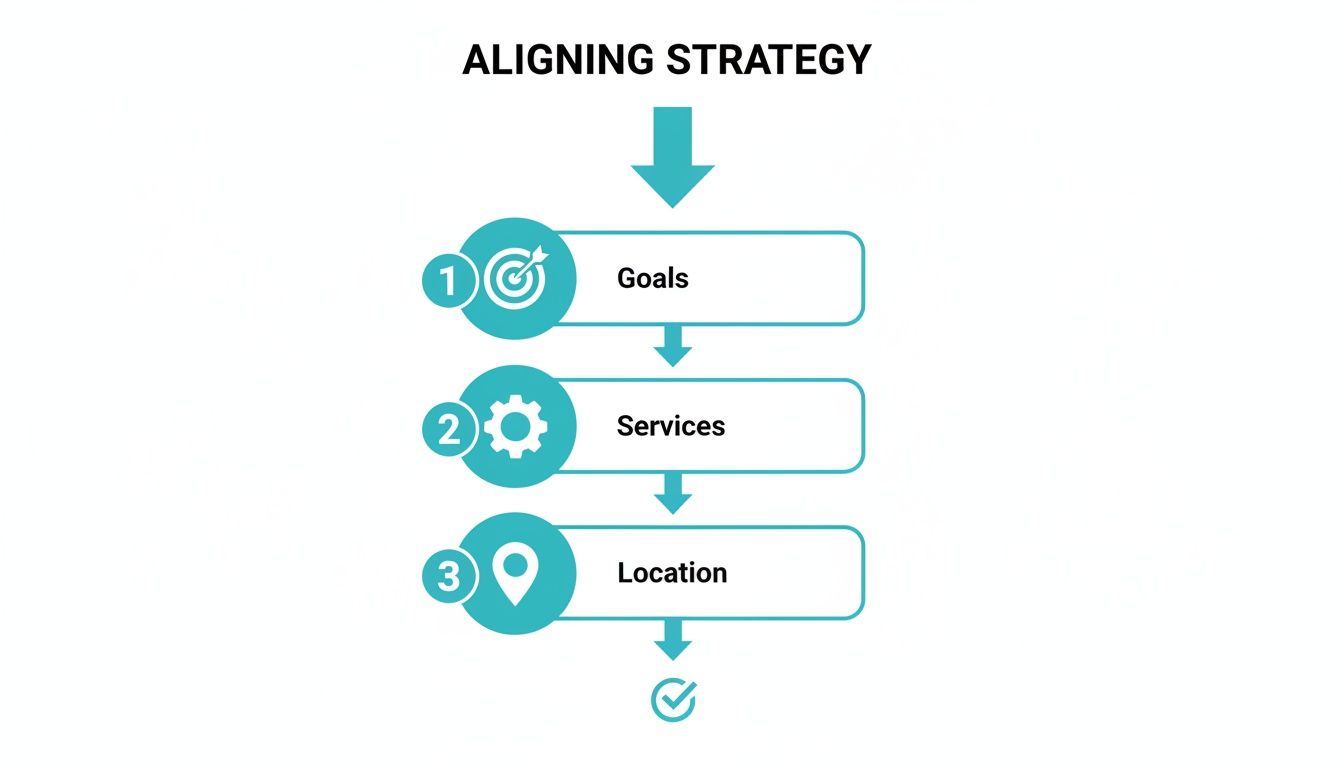
As you can see, a winning strategy starts broad with your main goals, narrows down to your key services, and then hones in on a precise location. By layering these elements, you create a laser-focused approach that automatically filters out irrelevant global traffic and pulls in qualified local leads. This groundwork is what separates a generic, ineffective SEO campaign from a targeted lead-generation machine built specifically for your MSP.

Now that you’ve defined your most valuable services and the geographic areas you serve, we can get down to the fun part: discovery. This is where we step into your ideal client's shoes and figure out the exact phrases they’re typing into Google when a critical piece of technology breaks or they need to upgrade their infrastructure.
Our journey begins with what we call "seed keywords." These are the broad, foundational terms that map directly to your core services. Think of them as the roots from which hundreds of more specific, high-intent variations will sprout.
For instance, if managed security is a high-profit service for your MSP, your initial seed keywords would be straightforward terms like “managed security services,” “cybersecurity for business,” or “MSSP.” These simple phrases are the launchpad for everything that follows.
Right now, the goal isn't to find the "perfect" keyword. It's about quantity over quality. We want to generate a massive, unfiltered list of every possible way a client might search for your help. Don't get bogged down by search volume or competition just yet, that comes later. For now, just focus on getting all the ideas out of your head and onto paper.
A great way to approach this is by combining your services with different modifiers. Think about specific problems, urgent needs, or the types of businesses you want to attract.
Here are a few angles to consider to get the ball rolling:
By brainstorming across these categories, you start to map the entire customer journey. You’ll find phrases used by prospects who are just realizing they have a problem, all the way to those ready to compare local providers and sign a contract.
Your seed keywords are just the starting point. The real gold is in the long-tail keywords, those longer, more descriptive search phrases. Understanding keyword research means appreciating that a staggering 70% of searches contain more than three words. These are the queries that bring you qualified leads, like “managed cybersecurity services for small businesses in Texas.” If you're curious, you can dig deeper into these powerful SEO statistics and what they mean for your strategy.
Long-tail keywords might have lower individual search volume, but they carry much higher commercial intent. It's a classic trade-off. Someone searching for "IT support" is probably just kicking tires. But someone searching for “emergency IT support for ransomware attack in Chicago” needs an expert, and they need one now.
To systematically brainstorm these valuable long-tail keywords, you can use a simple matrix. This framework helps you think through all the different combinations a potential client might use.
This table is designed to help you combine your core offerings with common client needs and locations to generate a robust list of seed keywords.
Using a framework like this transforms a simple list into a strategic asset. It forces you to think from the customer's perspective and ensures your research is directly tied to the real-world language your ideal clients are using. With this raw list in hand, our next step is to analyze it and figure out which of these opportunities are truly worth pursuing.

Your keyword strategy can't exist in a vacuum. You’re vying for the attention of a limited pool of local clients, and to win their business, you absolutely have to know who you’re up against. This is where we pivot from looking inward at our own services to sizing up the competition.
Effective competitor analysis isn't about corporate espionage. It's much simpler: we need to figure out who’s already ranking for our target keywords and, more importantly, why Google likes their content so much. This intelligence gathering is a crucial part of building a keyword strategy that actually generates leads.
By systematically dissecting your rivals' online presence, you can uncover their entire playbook. You'll see which services they're pushing, what content they're creating, and where their online authority comes from. This insight is what lets you spot their weaknesses, find new opportunities, and build a strategy that gives you a clear edge.
First, let's get one thing straight: your biggest business competitor isn't always your biggest SEO competitor. You might go head-to-head with another local MSP for every contract, but online, your main rival could be a national IT franchise, a popular tech blog, or even a hardware vendor that ranks for the same search terms.
Your real SEO competitors are the domains that consistently own the first page of Google for the high-intent keywords you want.
To find them, just start searching. Plug in your most important phrases, like "managed IT services in [Your City]" or "cybersecurity for small businesses in [Your Region]," and see who shows up. The names that appear over and over again are your primary targets for analysis. SEO tools like Ahrefs or Semrush can even automate this with a "competitor overlap" report, instantly showing who you’re clashing with most in the search results.
Once you have a list of 3-5 key SEO competitors, it’s time to get your hands dirty. The goal here is to reverse-engineer their success so you can replicate what works and improve on it.
Here’s a practical checklist for analyzing a competing MSP’s website:
By studying your competitors, you get a free education in what Google wants to see for your target market. You can skip the painful trial and error and build a strategy based on proven success.
Beyond just looking at individual competitors, you have to analyze the Search Engine Results Page (SERP) itself. The SERP is Google's answer sheet, and its layout gives you massive clues about what searchers are looking for and how you should structure your content.
For an MSP, the results for a local commercial query are rarely just ten blue links. Google customizes the SERP with special features based on what it thinks the searcher wants. For your target keywords, pay close attention to these elements.
Does Google show a map pack at the top? This is a dead giveaway that the search has strong local intent, making your Google Business Profile optimization non-negotiable. See a "People Also Ask" box? Those questions are a goldmine for H2s and H3s in your next blog post. Is there a featured snippet or a video carousel? That tells you a direct, concise answer or a visual demo is what Google thinks will best satisfy the user.
Creating content that is designed to fit into these SERP features is how you not only rank but also stand out and get the click.
You’ve got a solid list of potential keywords and a good handle on what your competitors are doing. Now for what I consider the most critical step in the entire process: decoding search intent.
Let's be blunt. Ranking for a keyword is a complete waste of time if the person searching has zero interest in buying your services.
Search intent is simply the "why" behind what someone types into Google. Getting this right is the difference between attracting tire-kickers looking for free advice and pulling in qualified prospects who are ready to talk about a service agreement. This is how you turn website traffic into actual revenue.
For MSPs, we can boil search intent down to three main categories. Nailing these will show you exactly what kind of content you need to create to engage prospects at every stage of their decision-making process.
Informational intent is all about education. The searcher isn't looking to buy anything right now. They have a problem or a question, and they’re looking for an answer. For an MSP, these queries usually sound like "how-to" questions, searches about specific tech, or requests for definitions.
A few real-world examples:
These keywords are top-of-funnel gold. You’re not going to land a managed services contract directly from a blog post about phishing. But you will build immense trust and establish your MSP as a credible authority. The right content for these terms is almost always a genuinely helpful blog post, a downloadable guide, or an explanatory video.
By answering your prospects' questions before they're ready to buy, you become the first MSP they think of when they finally are. It's a long-term play that builds your brand and fills your future sales pipeline.
This is where the money is. Commercial intent signals that someone is actively researching solutions and comparing providers. They know they have a problem, and they're now figuring out who can solve it. These keywords are often packed with modifiers like "best," "services," "provider," or "for small business."
Think about searches like these:
These are the high-value keywords you need to aim your core service and industry pages at. The content has to be persuasive and crystal clear. It should outline the benefits of working with you, show off social proof like client testimonials, and have a strong call to action guiding them to request a consultation.
As an MSP, local intent is your bread and butter. These searches show a clear, urgent need to find a provider in a specific geographic area. They're often a powerful mix of commercial and local intent, where the user is looking for a nearby business to contact now.
You can easily spot local intent in keywords containing "near me" or a specific city or neighborhood. Think "IT support near me" or "managed service provider in Irvine." The conversion potential here is massive because the searcher has already pre-qualified themselves by location. Optimizing your Google Business Profile and building out dedicated city or service-area pages are non-negotiable for capturing this traffic.
Properly analyzing search intent is a fundamental skill that directly impacts your bottom line. After all, 53.3% of all website traffic originates from organic search, making it a top lead source for B2B marketers. Given that long-tail keywords make up 70% of all searches, their highly specific nature often reveals clearer intent, which is why they convert so well for MSPs targeting niche services. You can see more SEO statistics that highlight these trends and confirm why this focus is so effective.
For a deeper dive into this concept, you can read also: What is Search Intent and Why It's a Game-Changer for MSPs.

You’ve done the work and now you’re staring at a spreadsheet overflowing with promising keywords. This is the exact point where many MSPs get stuck. Having a list is one thing, but knowing where to start is another beast entirely.
Without a smart way to prioritize, you risk having your team spend months creating content for keywords that will never bring in a single qualified lead.
This is where we turn that raw data into an actionable strategy. The goal is to strike a perfect balance: securing some quick wins to build momentum while also laying the foundation for long-term dominance in your market. It's about making smart decisions now that will pay dividends for years.
To bring some order to the chaos, you need a simple framework for scoring your keywords. This isn't about getting lost in complex algorithms. It's about applying practical business sense to your SEO data. I always recommend adding three simple columns to your keyword spreadsheet: Volume, Difficulty, and Business Relevance.
Give each keyword a score from 1 to 3 for each category (1 = low, 3 = high). This simple system gives you a quick, visual way to spot the real opportunities at a glance.
The "goldilocks" keywords are the ones with moderate volume, low difficulty, and extremely high business relevance. These are your quick wins, the low-hanging fruit you should go after first to build momentum and show results.
Once your list is scored and prioritized, the next critical step is keyword mapping. This is simply the process of deciding what kind of content to create for each keyword or, more accurately, for each cluster of related keywords.
A common and costly mistake is trying to target every single keyword with a brand-new blog post. Don't do it.
Instead, you group semantically related keywords and assign them to a single, authoritative page. This strategy prevents keyword cannibalization, where you accidentally have multiple pages competing against each other for the same terms. A well-executed map becomes your content roadmap for the next 6 to 12 months.
Here’s how I typically break it down:
This mapping process has become even more crucial as search technology evolves. The rise of AI in search has accelerated this need. Traffic from AI-driven search, for instance, grew an astonishing 527% year-over-year. To see what this means for your strategy, you can explore the full findings on AI search trends from a recent study. This massive shift demands a thoughtful content plan that answers questions directly, making a clear content map more important than ever.
Building out this roadmap also shines a light on gaps in your existing content. You might find you have no content at all for a high-value service. A great next step is to perform a quick audit of your current site to see what you already have. You can learn the ropes by reading our guide on how to do an SEO content audit for your MSP.
So, where do you go from here? You've done the hard work of building a data-backed keyword strategy. The biggest mistake you can make now is letting that research gather dust.
Effective keyword research isn't a one-and-done task. It’s the engine that powers a predictable lead generation machine for your MSP. You now have a repeatable workflow for identifying the exact terms that attract high-value clients.
By tying your SEO efforts back to tangible business goals, like landing three new co-managed IT clients this quarter, you’ve built a solid foundation. From there, digging into customer intent and dissecting the competitive landscape adds the necessary strategic layers. This entire process is designed to ensure you’re not just getting more website visitors, but attracting the right ones.
The next phase is all about execution. Think of your prioritized keyword list and content roadmap as the architectural blueprints for a much stronger online presence. Consistent, methodical execution is what turns those blueprints into a digital asset that reliably generates qualified leads for your sales team.
This strategic approach elevates keyword research from a simple marketing task to a core business driver. It's how you build a system that produces ROI long after the initial effort, creating a genuine growth engine for your MSP.
Now, it’s time to start building. Here’s how to put your plan into practice:
If you’re looking at this plan and feeling overwhelmed, you’re not alone. Many MSPs have the ambition but lack the time or in-house expertise to see it through. If that sounds familiar, it might be time to bring in specialists.
Partnering with a team that lives and breathes MSP marketing can fast-track your growth and ensure your meticulously crafted keyword plan actually delivers the results your business needs.
Even with a solid plan, keyword research always sparks a few specific, nagging questions. As an MSP owner, you don't have time for vague answers. You need practical advice that applies directly to your business. Let's tackle some of the most common questions we hear from MSPs just like you.
Getting this right is all about staying on top of the tools and tactics that actually work today. These answers will help you make smarter, more confident decisions.
You absolutely do not need to break the bank on tools to get started. While the big enterprise platforms like Semrush and Ahrefs are fantastic, their price tags can be steep for a growing MSP. The good news is, a budget-friendly tool like Keysearch often provides more than enough firepower to build a winning strategy.
Keysearch delivers the essentials: search volume, keyword difficulty scores, and solid competitor analysis features. It hits that sweet spot between affordability and function, making it the perfect starting point for most service providers.
And don't forget the powerful free resources at your fingertips:
The best tool is the one you actually use consistently. Start with an affordable option like Keysearch, master it, and then decide if you need to upgrade. The principles of good research are far more important than the brand name on the software.
If your MSP serves multiple cities or a sprawling metro area, a one-size-fits-all approach to local SEO just won't cut it. You have to create distinct digital footprints for each major service area. This is how you signal to Google that you're a legitimate local player in each city, not just some company in a neighboring town.
The first step is building dedicated location pages on your website. For example, you need a page for "IT Support in Dallas" and a completely separate one for "Managed Services in Fort Worth." Each page must have unique content tailored to that city. Mention local business districts, specific industries you serve there, or even local landmarks to prove your connection to the community.
Beyond your own site, you need a separate Google Business Profile for each physical office you have. If you only have one office but serve a wide area, your primary GBP is still the cornerstone of your local efforts. Make sure your name, address, and phone number (NAP) are perfectly consistent across all your local citations, from your GBP to industry directories. This consistency is what builds trust with search engines and helps you dominate those all-important map pack results.
AI search, especially what we're seeing with Google's AI Overviews, is changing the game but not throwing out the rulebook. If anything, it’s doubling down on the need to answer questions directly and with authority. You can't just target keywords anymore. You have to focus on becoming the definitive source for answers related to your services.
Your strategy needs to shift slightly toward more conversational, question-based searches. Put yourself in your client's shoes. What would they ask an AI assistant? Things like, "What is the best way to protect my small business from ransomware?" or "How much do managed IT services cost for a 20-person company?"
This means your job is to create content that answers those questions better than anyone else. Use clear headings, bulleted lists, and hard data to make your content easy for AI to understand and feature in its summaries. The fundamentals haven't changed: high-quality, intent-focused content still wins. AI just raises the bar for clarity and expertise.
Feeling ready to turn your keyword research into a steady stream of qualified leads? The MSP SEO Agency specializes in creating and executing SEO strategies that drive predictable growth for managed service providers. Learn how we can build your lead-generation engine.
See how targeted SEO delivers measurable impact for managed service providers. Explore our proven strategies and real-world outcomes.