Guest posting is a powerful SEO strategy where you write and publish an article on another company’s website. For an MSP, this is like being invited to speak at a major tech conference. You get to stand on their stage, share your expertise with their audience, and in return, you build authority and earn powerful "votes of confidence" in the form of backlinks that boost your Google rankings.

Think of the internet as a massive network of interconnected hubs. Your MSP's website is one of those hubs, but to grow your influence, you need to forge connections with larger, more established ones. Guest posting is one of the best ways to build those bridges.
It's not just about getting a link back to your site: it's about strategic placement.
When you contribute a high-value article to a reputable tech publication or an industry blog your ideal clients are already reading, you accomplish several critical business goals at once. You're putting your brand in the spotlight, positioning your MSP as a thought leader on topics like cybersecurity threats, cloud migration, or IT compliance.
This strategy goes far beyond talking about your expertise on your own blog. It provides a powerful third-party endorsement that resonates with both people and algorithms.
When a respected site publishes your content, they are vouching for your credibility. A potential client sees your article and thinks, "This MSP is trusted by a publication I follow; they must be a legitimate expert." Google sees the backlink from that trusted site to yours and interprets it as a strong signal of authority, which helps improve your search rankings.
Guest posting is fundamentally a link-building activity, but its true value extends far beyond SEO. It's a potent mix of public relations, content marketing, and brand building that drives highly qualified traffic.
Guest posting has become a cornerstone of modern digital marketing for a reason. Research shows that articles with links placed naturally within the content generate 387% more what is referral traffic than those where links are just tacked on in the author bio. This highlights the need for a strategic, thoughtful approach.
To get the full picture, it helps to understand how guest posting fits into a broader marketing framework. This is covered well in this piece on What Is a Link Building Strategy for SaaS Growth. A successful guest posting campaign isn't just about writing an article; it’s about making a smart business move to generate leads and grow your MSP.
Guest posting is more than just another SEO task to check off your list. Think about your marketing budget. You could spend it on a generic billboard hoping the right person drives by, or you could contribute an insightful article to an industry publication you know your ideal clients read. Which one gets better results?
By publishing your expertise on websites where potential customers are already looking for answers, you position your MSP as the go-to expert. Every guest post acts like a specialized magnet for pre-qualified leads. It attracts prospects grappling with the exact issues your services solve, whether that’s shoring up data security or untangling cloud infrastructure.
This approach has a fantastic side effect: it naturally shortens the sales cycle. You’re building trust and establishing credibility long before a prospect ever lands on your website. Instead of feeding your sales team cold leads, you’re sending them warm prospects who are already informed and engaged.
The real power of guest posting comes from its ability to tap into an audience with clear search intent. These are not casual browsers. These are professionals actively hunting for solutions to specific problems, problems you are perfectly equipped to handle. When your guest article provides the answer they’re looking for, your company becomes the obvious next call.
A well-placed guest post can deliver more leads close to conversion than other content strategies. This isn't just theory. We see it in practice. A well-executed guest posting effort can translate into significant, predictable revenue for an MSP by attracting prospects who are ready for a serious business discussion.
It’s this direct line to a motivated audience that makes guest posting one of the best lead-generation tools available. You’re making a targeted strike, not just spraying and praying.
So, what does a strategic guest post actually deliver? It’s a combination of three distinct benefits that work together to bring qualified leads right to your digital doorstep.
By focusing on these outcomes, guest posting transforms from a simple SEO tactic into a fundamental part of your lead generation machine. If you want to better understand how to attract these specific users, check out our guide on what is search intent.
Alright, you get the basic idea behind guest posting. Now, let's talk about how to do it right. This is where most people get it wrong, and it's critical to understand that not all guest post opportunities are created equal.
Think about it like getting a referral for your MSP. A glowing recommendation from a respected CTO at a major company is gold. A random shout-out from someone on an obscure forum means nothing and might even make you look desperate. In SEO, one great guest post on a high-authority tech site is worth more than a hundred posts on irrelevant, low-traffic blogs.
The internet is flooded with cheap, low-quality offers that can actively hurt your rankings and tarnish your brand. I'm here to show you how to spot the difference, so you can invest your marketing budget wisely and avoid the junk.
Learning to distinguish a valuable opportunity from a risky tactic is the most important skill in guest posting. A high-quality placement is a powerful endorsement; a low-quality one ties your brand to the spammy corners of the web. When done correctly, focusing on quality is a cornerstone of learning how to build backlinks that stand the test of time.
The table below breaks down exactly what to look for and what to run away from.
| Characteristic | High-Quality Post (The Goal) | Low-Quality Post (The Risk) |
|---|---|---|
| Topical Relevance | The site is focused on tech, business, or cybersecurity. It's a natural fit for your expertise. | The site covers everything from pets to fashion. Your content looks out of place. |
| Domain Authority | Strong, established site with a good reputation (think a DR of 50+). It passes real authority. | Weak or non-existent authority. The link provides almost zero SEO value. |
| Audience & Traffic | Has real, consistent monthly traffic from your target audience (e.g., IT decision-makers). | "Ghost town" site with fake or nonexistent traffic. No one will see your post. |
| Editorial Standards | A tough editor reviews your content for quality, originality, and value. | "Pay and publish" model. They'll post anything as long as you pay the fee. |
| Link Profile | The site has a clean backlink profile from other reputable sources. | The site links out to spammy industries like casinos or payday loans. |
| Cost & Value | Represents a real investment but delivers tangible ROI in authority and leads. | Cheap or even free, but the "cost" is a potential Google penalty and brand damage. |
Spotting these differences is key. The guest post marketplace is incredibly noisy. Industry data reveals that a huge percentage of available guest post sites are low-quality domains with pathetic traffic and no real authority.
Truly valuable opportunities, from sites with high domain ratings and significant monthly traffic, are scarce. This scarcity is what makes them so valuable, with costs for a single quality placement often running from $692 to $957 before any agency fees. You can find a deeper dive into these costs in this insightful report.
So, what are the non-negotiables? A quality placement is about so much more than just a link. It’s about strategically aligning your MSP with other credible, authoritative voices in your industry.
The core principle is simple: publish content where your ideal clients already are, on platforms they already trust. A link from a relevant, well-respected site tells Google that your MSP is a noteworthy entity in the IT services or cybersecurity space.
Here are the key characteristics of a guest post opportunity worth pursuing:
By prioritizing these factors, you build a backlink profile that does more than just tick a box for Google. It builds genuine brand authority and credibility. This strategic approach is how you establish topical authority, signaling to search engines that you are a true expert in your niche.
A successful guest posting campaign does not come down to luck. The MSPs that get real, measurable results follow a proven process. Breaking this process down into a clear, repeatable framework is what separates an authority-building effort from a waste of time and money. It all starts with a plan.
This visual shows you the core stages of any effective guest posting workflow. It's a simple, three-part system that works.
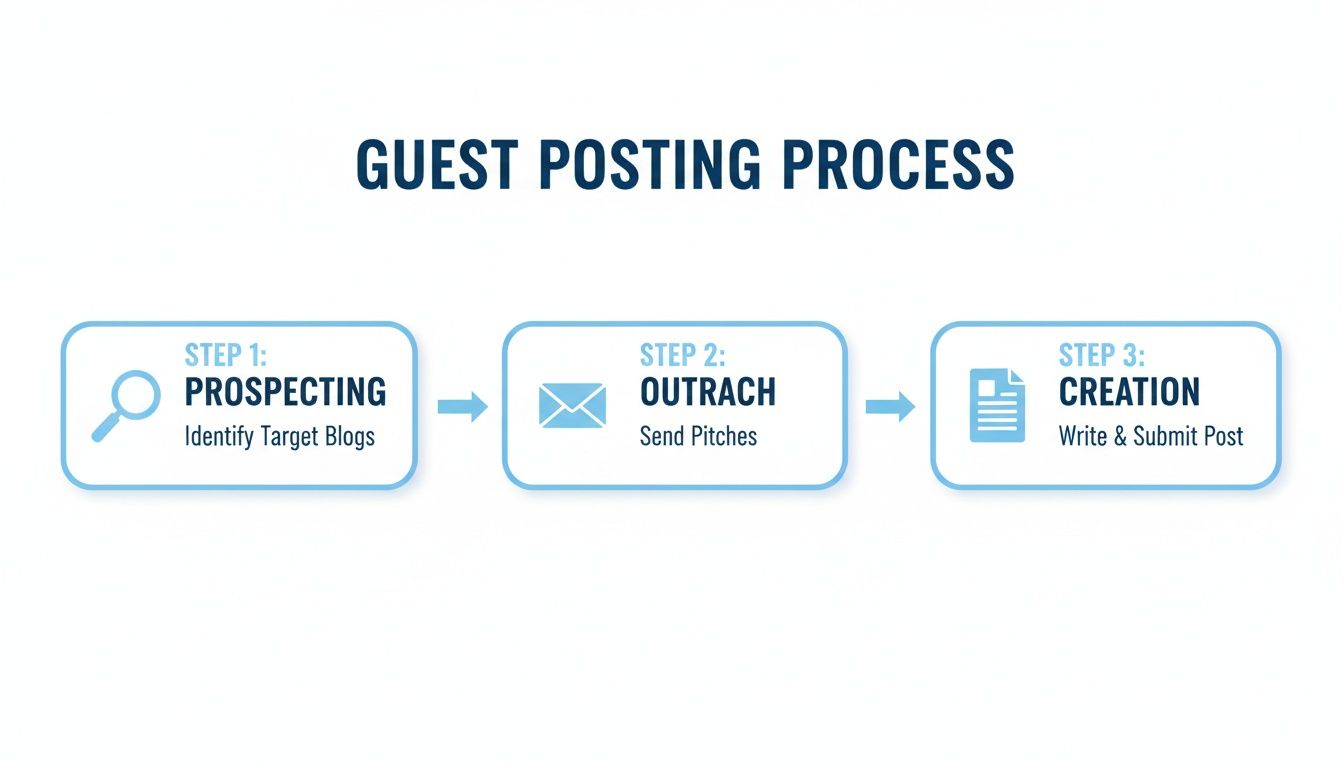
The process boils down to three key phases: finding the right sites, reaching out the right way, and creating content that's worth reading. The secret is executing each stage with precision, not just going through the motions.
Before you even think about writing, define what a "win" looks like for your business. Are you trying to drive more referral traffic? Improve your search rankings for a key service page like "managed IT services"? Or is the main goal to get your brand name in front of more eyeballs? Your goals will dictate every other decision you make.
Once you know your objectives, it's time to start prospecting. This is the hunt for relevant, high-authority websites where your ideal clients are already spending their time. You're looking for respected industry blogs, tech publications, and business journals that align with your MSP's expertise.
Prospecting is all about separating the wheat from the chaff. Remember, this is a game of quality, not quantity. One well-placed article on a top-tier tech journal is worth more than ten posts on low-traffic, irrelevant blogs. Build a curated list of targets based on real metrics like domain authority, organic traffic, and audience relevance.
With a solid list of target sites, you can start brainstorming article topics. The best ideas solve a real problem for the reader. Think about the common questions you hear from prospects and clients during sales calls. Those are your gold mines.
Here are a few examples of high-value topics an MSP could pitch:
After you have a killer topic, write a personalized outreach email. Generic, copy-paste templates are deleted on sight. A great pitch proves you've done your homework. Mention a recent article they published, explain why your topic is a perfect fit for their audience, and briefly outline your credentials. Your goal is to start a real conversation.
Congratulations, your pitch was accepted! Now the real work starts. It’s time to deliver a genuinely helpful, non-promotional piece of content that showcases your expertise. This article is a reflection of your brand, so make it insightful, well-researched, and polished. Within the article, you'll place your backlink naturally where it adds value for the reader.
But your job isn't over when you hit "publish." Once the article is live, promote it across your own channels like LinkedIn and your email newsletter. This maximizes its reach and shows the publisher that you’re a valuable partner, making them more likely to work with you again.
With AI-driven search becoming the norm, building real authority has taken on a new meaning. Guest posting is one of the most direct ways to prove your MSP’s credibility, not just to clients, but to the very AI models like ChatGPT and Gemini that are shaping their search experience.
When you publish genuinely helpful content on a well-respected tech site, you’re doing more than just earning a backlink. You are effectively teaching these AI systems to see your brand as a legitimate expert in the managed services field. Think of each guest post as a verified data point that backs up your claim to expertise.
These external articles and backlinks are powerful signals of your relevance. They’re third-party endorsements that AI algorithms are designed to find and value. An AI doesn't just look at your website in a vacuum; it pieces together a picture of your company's authority by seeing who else in the industry is talking about you.
This is how you get recommended. When a potential customer asks an AI assistant to suggest top cybersecurity firms, your MSP has a much better shot at being included. You've built a web of trust signals that all point back to your brand.
Being featured on other websites is valuable for improving your visibility in large language model (LLM) tools. Gaining brand mentions, even unlinked ones, makes those tools more likely to reference you in their responses. This is a direct path to getting recommended by AI. This entire process is what SEO experts call building "entity authority."
AI assistants are designed to synthesize information from countless sources to deliver a single, confident answer. They give immense weight to sources that are consistently referenced by other authorities. A guest post on a respected industry blog is a perfect example of this in action.
Here’s a practical look at how this works for an MSP:
By doing this consistently, you’re training the AI to associate your brand with genuine expertise. Your MSP becomes a reliable source in its massive knowledge base, making you a go-to recommendation when users ask for help. In a world of AI-driven search, this is what long-term visibility and lead generation look like.

As an MSP owner, you know that every dollar in your marketing budget has a job to do. Guest posting is no different. Getting an article published on a respected industry site feels good, but that feeling doesn't pay the bills. You need to connect that activity directly to business growth, not just sit back and count backlinks.
Measuring the return on investment (ROI) is what separates a one-off tactic from a predictable lead-generation engine. It’s the only way to prove the business case for your efforts and understand guest posting as a strategic investment, not just another line item in the budget.
To measure the real impact of your guest posting, you have to look past vanity metrics. You need to track the key performance indicators (KPIs) that connect your content to your sales funnel.
Here are the KPIs that truly matter for your MSP:
When you track these metrics properly, you can draw a straight line from a published article to a new client. It’s a powerful story to tell.
Imagine showing that one guest post on a cybersecurity blog drove 300 visitors to your site. Of those, 5 became qualified leads, and one signed a $5,000 per month managed services contract. That’s the goal.
This level of tracking is crucial. It transforms your marketing from a hopeful expense into a predictable system for growth. When you can directly attribute revenue to specific SEO activities, you can confidently scale your investment to accelerate your business.
Even with a clear understanding of the strategy, it's natural for MSP leaders to have a few questions before diving in. Let's walk through some of the most common concerns we hear.
While a new guest post can send referral traffic your way almost instantly, the real SEO benefits don't happen overnight. It's a long-term play. Generally, you can expect to see a meaningful, positive shift in your keyword rankings and domain authority within 3 to 6 months of landing your first few high-quality placements.
Think of it less like a single campaign and more like building a reputation. Each quality post is another vote of confidence in your brand. It takes time for search engines to recognize and reward that accumulated authority.
That's a fair question, and the honest answer is: it can be. The risk depends on the partner you choose. A low-quality agency chasing easy wins can damage your reputation with spammy tactics that Google will eventually penalize.
A reputable partner will be transparent about their process. They should show you the sites they're targeting, focus on creating helpful content that highlights your expertise, and prioritize quality over quantity. Always ask for examples of past work and a clear outreach strategy before signing anything.
It’s not an either/or situation. The two are complementary parts of a healthy SEO strategy. They work together but do different jobs.
A winning strategy uses both. You build authority on your own site and then use guest posts to amplify that authority across the web, earning valuable backlinks and driving qualified traffic back to your home base.
Ready to turn your expertise into a predictable lead generation engine? We specialize in building authority for MSPs through strategic guest posting and comprehensive SEO. Schedule a consultation today to see how we can put your brand in front of the clients you want to win.
See how targeted SEO delivers measurable impact for managed service providers. Explore our proven strategies and real-world outcomes.