

Let's get right down to it. Think of Domain Authority (DA) as your website's professional reputation, a lot like a credit score for your business online. It’s a metric from Moz, scored on a scale from 1 to 100, that predicts how well your website might rank in search results.
For a Managed Service Provider, a higher DA means you're far more likely to show up on the first page when a potential client searches for "managed IT services" or "cybersecurity support" in your city. It's a measure of your online clout.
As an MSP owner, you know reputation is everything. It's what brings in referrals, builds trust, and fuels your growth. In the digital world, Domain Authority serves that exact purpose.
While it isn't a direct ranking factor Google uses, it's an incredibly useful proxy for your site's SEO health and its power to attract organic leads.
Think about it this way: imagine two MSPs pitching a new client. One has a long history of successful projects and glowing testimonials from local companies. The other is a startup with no track record. Who gets the business? It's almost always the one with more established authority.
Domain Authority works the same for your website. A higher score signals to search engines that you're a credible, trustworthy source, making you a safer bet to show to their users.
This is a common question, but the answer is simple: a "good" score is one that's better than your direct competitors. It’s all relative.
If the top-ranking MSPs in your service area have scores between 30 and 40, then achieving a DA of 45 would give you a serious competitive advantage. The goal isn't to chase a random number like 80, but to strategically build more authority than the other providers vying for the same clients you are.
It helps to understand what these numbers mean. Let's look at a practical breakdown of the score ranges.
This table breaks down what different DA scores mean for a typical MSP's website.
| DA Score Range | Competitive Level | Typical MSP Scenario |
|---|---|---|
| 1-20 | Low | A brand new MSP website or one with little marketing effort. Struggles to rank even for its own name. |
| 21-40 | Moderate | A growing MSP that has started content marketing. Starts ranking for local, long-tail keywords. |
| 41-60 | Strong | An established MSP with a solid reputation and consistent marketing. Competes for high-value local service keywords. |
| 61+ | Elite | A regional or national industry leader. Dominates search results for a wide range of competitive terms. |
Most MSPs live in the 21-40 range and should aim for the 41-60 bracket to own their local market. Getting past 60 is rare and requires a significant, long-term investment.
It's a tough climb. Global SEO data from 2026 shows that only 5% of websites ever exceed a DA of 60, while a staggering 70% of sites stay below 30. This means most MSPs face a real battle against incumbents who are already capturing the best organic leads. If you want to dig deeper, you can find great insights on Marketing Illumination.
This visual gives you a quick snapshot of the different tiers of Domain Authority.
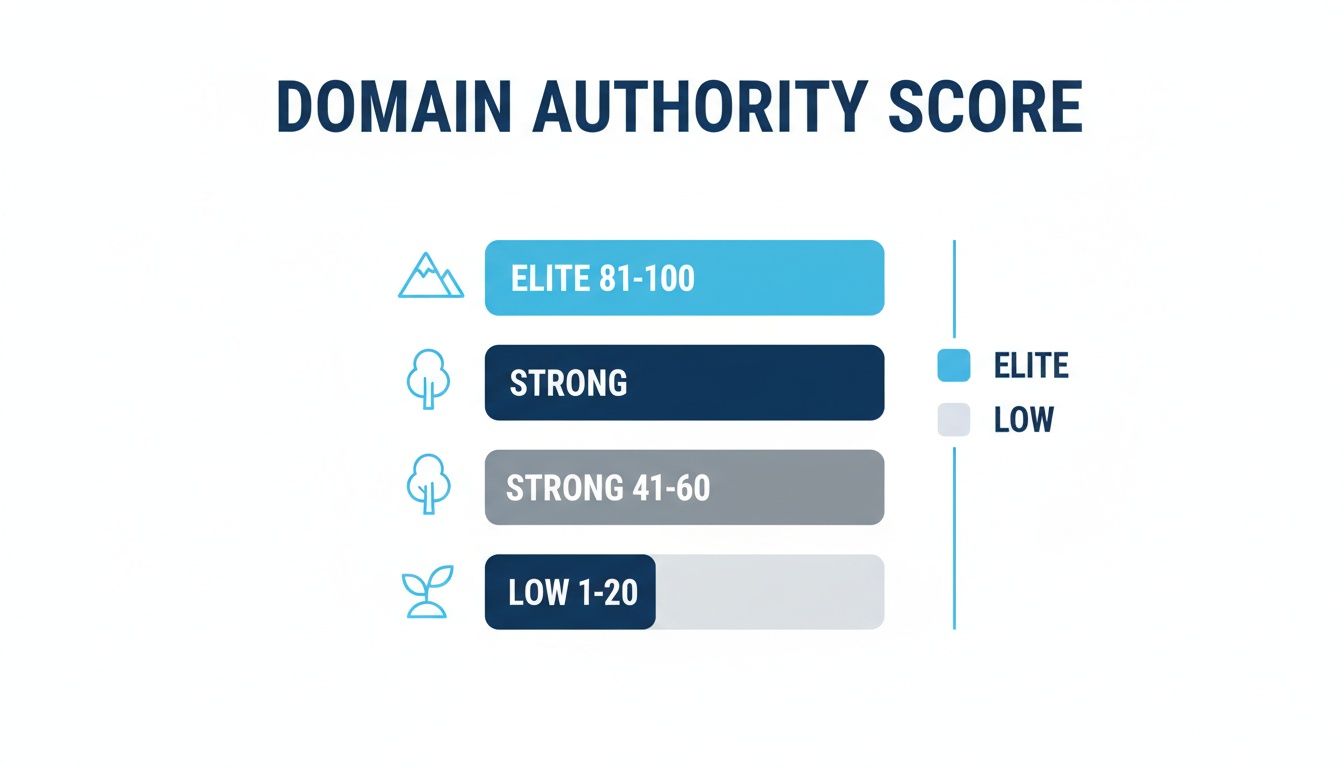
As you can see, reaching that elite tier is a monumental task. The good news? Hitting a "Strong" score is an achievable goal that will put your MSP in a powerful position.
Here’s where the rubber meets the road for your MSP. A higher Domain Authority translates directly into more qualified leads and predictable revenue.
When a potential client actively searches for solutions you provide, a strong DA gets your website in front of them. This isn't just about traffic; it's about being visible at the exact moment a buyer needs help. That’s the core of effective inbound marketing.
Here’s how a better DA helps your bottom line:
At the end of the day, investing in activities that improve your Domain Authority is a direct investment in your MSP's long-term lead generation engine.

So, what’s under the hood of this score? While Moz keeps its exact formula secret, we know the single most important ingredient: your website's backlink profile.
Think of every link pointing to your site as a vote of confidence. The Moz algorithm crawls the web, analyzing this complex network of votes to figure out how much authority your website has earned.
But it’s more sophisticated than just counting links. The calculation focuses on a few specific factors you can directly influence.
The biggest piece of the puzzle is the number of linking root domains. In simple terms, this is how many unique websites have linked to your MSP's site.
For example, if a tech blog links to your latest cybersecurity report ten times in one article, that only counts as one linking root domain. But if ten different websites each link to you once, that’s ten linking root domains. That distinction is critical.
Your goal should be to earn links from a diverse number of unique, relevant websites. This signals to search engines that your MSP is a trusted resource across the industry, not just a favorite of one or two sites.
This is where real strategy separates the amateurs from the pros. The quality of the websites linking to you carries more weight than the sheer number of links.
Here’s an analogy for MSPs: are you better off with one glowing referral from the CIO of a major local corporation, or a hundred vague compliments from people you barely know? The answer is obvious.
The same logic applies to backlinks. A single link from a high-authority source like a major tech publication is worth more than hundreds of links from low-quality sites. Moz's algorithm is built to recognize this, passing more value from websites that have high Domain Authority themselves.
A smart backlink strategy for an MSP should focus on earning mentions from places like:
At its core, Domain Authority is powered by a machine learning model that weighs over 40 different signals, but backlinks are the clear driver. For a deeper dive, you can explore how Domain Authority has been explained over the years.
Stop chasing every link you can get. Instead, focus your energy on earning high-quality, relevant links that will build your MSP's reputation as an industry leader.
When you dip your toes into SEO, the terminology can feel like a foreign language. While Domain Authority is a great starting point, a few other metrics give you a clearer picture of your website's strength.
Getting a handle on these will help you build a smarter growth strategy for your MSP. Let's break down what they are and which ones truly matter.
First, let's clear up a common point of confusion. Both Domain Authority (DA) and Page Authority (PA) come from Moz, but they measure different things.
Think of your website as a university. Its Domain Authority is like the overall reputation of the entire institution, like Harvard or MIT. It’s a big-picture score that reflects the strength of your whole domain.
Page Authority, on the other hand, is the reputation of a single department. A specific, high-value blog post or service page can earn a high PA, even if the site's overall DA is still building. For an MSP, this is a golden opportunity.
You'll also see a metric called Domain Rating (DR) from another powerhouse SEO tool, Ahrefs. At its core, DR is Ahrefs’ version of Domain Authority. It runs on the same 0-100 scale and is also primarily concerned with your backlink profile.
While the exact formulas for DA and DR are different, their purpose is identical: to estimate your website's authority based on who links to you. Most pros keep an eye on both to get a balanced perspective.
Remember, whether you're looking at DA or DR, the game is the same. Your authority is overwhelmingly driven by the number of unique, high-quality websites sending links your way. Knowing this is step one, and step two is setting realistic goals for your MSP. It's not just about the number; it's about understanding what is a good Domain Authority score for your specific market.
Focusing on the right metrics helps you avoid chasing vanity numbers and instead build a website that genuinely generates leads. This is all built on a solid foundation, which is why your site's technical health is so important. If you want to dive deeper, our guide on what is technical SEO is a great place to start.
Alright, you get the "what" and "why." Now for the important part: how do you actually improve it? Moving your DA score is a long-term investment, not a quick fix. But the good news is that the process is logical.
For an MSP, this effort gets focused into a few key areas. Each one builds on the last, creating a powerful engine that drives organic growth and brings qualified leads to your door.
Before you write a single blog post, get your own house in order. Think of your website’s technical health as the foundation of a building. If the foundation is cracked, it doesn’t matter how impressive the rest of the structure is. Search engines must be able to find and understand your site effortlessly.
Here are the non-negotiables to tackle first:
Fixing these core issues ensures your hard work pays off.
With a solid technical base, you can start building stuff that actually attracts people. For an MSP, this means creating genuinely helpful content that solves the real-world problems your ideal clients face. The goal is to become their go-to resource.
It’s time to move beyond generic posts like "The Benefits of Managed IT." Get specific and tactical. A single, deeply researched article like a "Cybersecurity Checklist for Local Law Firms" is worth more than ten generic blog posts combined.
Your content needs to be so valuable that other websites feel compelled to reference it. That’s the secret to building authority and earning links naturally. This principle applies across all formats; for example, applying actionable YouTube SEO best practices can dramatically expand your content's reach.
Once you have great, problem-solving content, you can pursue the single biggest factor in your DA score: high-quality backlinks. Every link from another website is a vote of confidence. Your mission is to earn votes from the most reputable sites you can.
Forget about spammy shortcuts. The only sustainable path is earning links through value and genuine outreach.
Here are a few proven tactics for MSPs:
This is a marathon, not a sprint. For a more detailed playbook, our guide on link building best practices for MSPs goes deeper into effective strategies.
Finally, for most MSPs, local business is everything. You need to be the first name that pops up when a business owner in your city searches for "IT support [Your Town]." Bolstering your local signals is a critical piece of building authority.
The core of this is consistency. Your business's name, address, and phone number (NAP) must be identical everywhere it appears online.
Your immediate action items should be:
These local signals reinforce your legitimacy in your target market, directly contributing to your overall authority.

You can't just hope your authority is growing; you have to measure it. Building real Domain Authority is a long game. Without tracking your progress, you're flying blind.
A few key tools can show you exactly how your efforts are paying off. The secret is knowing which metrics to watch besides the main DA score itself.
To get a clear picture, you'll need to get familiar with the industry's go-to platforms. These are what the pros use to analyze website authority.
Domain Authority (DA) is a score from 1 to 100 that predicts ranking potential. A new MSP might start at 10-20, while an established competitor could be at 40+. These scores are quite consistent; studies show Moz's DA has a strong correlation (around ρ ≈ 0.9) with Ahrefs' and Semrush's scores. You can discover more insights about its history on copypress.com.
Your DA score is a lagging indicator. It tells you the result, but not how you got there. To understand what’s working, you have to track the "in-game" stats that lead to the final score.
These are the leading indicators you should monitor monthly. They'll tell you if your strategy is gaining momentum long before the DA score itself moves.
Don’t get discouraged if your DA score doesn't budge for a few months. It's a slow-moving metric. Instead, focus on the consistent growth of your referring domains, as these are the building blocks of authority.
When you log into a tool like Moz, you'll see a dashboard that gives you a quick health check.
This snapshot shows you the top-level numbers that matter most: your overall DA, the number of unique websites linking to you (linking domains), and your total inbound links.
For an MSP owner, a high DA score is nice, but leads and new clients are what really count. The goal is to connect your SEO activities to tangible business growth.
Here’s how to think about the chain of events:
When you follow this process, you can draw a straight line from your SEO work to revenue. For a deeper dive, check out our guide on how to track SEO performance. This is how you prove that SEO isn't just a cost, it's a reliable engine for generating qualified leads.

Let's dig into a few questions we see MSP owners ask all the time. Getting clear on these points will help you set realistic goals and build a smarter strategy.
This is always the first question, and the honest answer is that it requires patience. Think of improving your Domain Authority as a marathon, not a sprint. You're building a digital reputation from the ground up, and that doesn't happen overnight.
For most MSP websites, seeing a meaningful jump in your score takes 6 to 12 months of consistent effort. This means regularly publishing high-quality content and actively earning authoritative backlinks. A significant move from a DA of 20 to 35 is a long-term commitment.
Absolutely. Your DA score is not set in stone, and it can definitely decrease. While it can be jarring to see that number drop, it's a normal part of the process.
A score can fall for a few reasons:
This is why SEO can't be a "set it and forget it" activity. You have to continually work on building authority just to maintain your ground.
The only correct answer here is: it's all relative. A "good" score for your MSP is whatever it takes to outrank the local competitors you're up against.
The goal isn’t hitting an arbitrary score like 50. The real objective is to become more authoritative than the other MSPs competing for clients in your specific service area.
Start by analyzing the DA scores of the top three to five MSPs that rank for your most important keywords. If their scores are between 25 and 35, your strategic target should be to push past them and hit a DA of 40. That score would give you a serious competitive advantage in your specific market.
Let's put this all together. We’ve established that Domain Authority, while not a direct Google ranking factor, is an excellent measure of your website's ability to pull in new clients. Improving it is a long game built on consistent, expert-level content and a strong backlink profile.
The real prize? A reliable stream of qualified, organic leads who are actively searching for the exact services you provide. This is how you shift your website from a simple digital brochure into your most dependable lead generation tool.
Think of it this way: focusing on activities that improve your DA score naturally aligns your marketing with what Google rewards. You're demonstrating expertise, credibility, and genuine value.
This changes your approach. You stop guessing what might work and start executing a proven strategy for building a valuable digital asset, one that delivers returns for years.
If you're ready to stop throwing spaghetti at the wall and build a real strategy for your MSP's online presence, the first step is to know where you stand today. A solid SEO plan is always built on data, not assumptions.
Understanding your current authority score and how you stack up against competitors is the starting point. This data gives you a clear roadmap for what it will take to become the go-to provider in your service area. Ready to find out where you stand and get a clear plan for growth?
MSP SEO Agency can help you turn your website into your best salesperson. Schedule a complimentary SEO consultation to get a clear roadmap for outranking your competitors.
See how targeted SEO delivers measurable impact for managed service providers. Explore our proven strategies and real-world outcomes.