Website speed optimization is the process of making your site load faster. For an MSP, it’s not just a technical task. It’s a powerful tool for sales that directly impacts how many leads you get and how potential clients see your brand. A fast, responsive website grabs a visitor's attention and starts building trust from the first click.

Picture this: a local business owner has a critical IT problem. They jump on Google, searching for managed service providers. They find you and a competitor. They click on the competitor’s link, and the page loads instantly, clearly presenting solutions. Then, they click on your site.
And they wait.
The page stutters as images slowly crawl into view. Those few seconds of delay create frustration. Just like that, you’ve probably lost a lead. The prospect thinks: if this MSP can’t even run its own website well, how can I trust them with my entire IT infrastructure? This isn't just a guess; it’s happening every day to MSPs with slow websites.
Your website is your digital handshake and your 24/7 sales rep. A fast website shows you’re professional and you respect a visitor's time. A slow one does the opposite, pushing away your best prospects before they even see what you offer.
When a decision-maker is looking for an urgent solution, every millisecond counts. People expect websites to be fast. In fact, 50% of users expect a site to load in under 2 seconds. A huge 53% of mobile visitors will leave a page that takes longer than 3 seconds to load.
Slow pages also lose up to 35% more user time compared to fast ones. And 44% of online shoppers say a slow experience makes them see a brand as less trustworthy. For an MSP, this data is a major warning. A slow site isn't just annoying; it kills revenue. You can learn more about these website speed trends and their impact on user trust to see the whole picture.
A slow website doesn't just cost you a click; it damages your credibility. It creates a poor user experience that tells prospects you don't value efficiency, the very thing you promise to deliver. That bad first impression is incredibly hard to overcome.
The damage from a slow site goes beyond just having people leave. It creates a ripple effect that directly hurts your MSP's growth. The table below shows exactly how poor performance hurts your business.
.tbl-scroll{contain:inline-size;overflow-x:auto;-webkit-overflow-scrolling:touch}.tbl-scroll table{min-width:600px;width:100%;border-collapse:collapse;margin-bottom:20px}.tbl-scroll th{border:1px solid #ddd;padding:8px;text-align:left;background-color:#f2f2f2;white-space:nowrap}.tbl-scroll td{border:1px solid #ddd;padding:8px;text-align:left}Problem AreaImpact on Your MSPLost Lead GenerationPotential clients get frustrated and leave before they fill out a contact form or book a consultation.Damaged Brand PerceptionA slow site makes your MSP look outdated and unprofessional, hurting your expert image.Lower SEO RankingsGoogle prefers fast, user-friendly sites. A slow site gets pushed down in search results.Reduced Conversion RatesEven if a visitor stays, a slow form can make them give up at the last step.
This table makes it clear: a slow website actively works against your business goals.
Investing in website speed optimization services is an investment in your sales pipeline. It ensures your "silent salesperson" always makes a great first impression. It welcomes every visitor with a smooth experience that builds confidence and moves them closer to becoming a client.
Let's get straight to it: your website's speed isn't just a technical detail. It's a key part of your sales process. It directly impacts how you show up in search results and how many visitors become actual leads for your MSP.
Think about it from Google's point of view. Their goal is to show the best, most helpful results. If a potential client clicks your link and has to wait for a slow page to load, what will they do? They'll hit the back button. That "bounce" tells Google your site gave a bad experience, making it less likely to rank you for valuable searches like "managed IT services in [your city]".
To make performance measurable, Google created specific metrics called Core Web Vitals (CWV). These aren't just random numbers. They are designed to measure the actual experience a real person has on your website. Getting these right is essential for modern SEO.
We have a complete breakdown in our guide on Core Web Vitals, but here’s what you need to know about the three main parts:
Passing the Core Web Vitals assessment is like getting a stamp of approval from Google. It shows that your site provides a great user experience. This is a major factor in helping you climb the rankings and get in front of businesses looking for your MSP services.
Getting to the top of Google is just the first step. If your site is too slow to keep a visitor's attention, all that visibility is wasted. The data is clear: even a 1-second delay in page load time can cut conversions by up to 7%. Once you pass the 3-second mark, bounce rates skyrocket.
Here’s where it gets interesting for MSPs. As of 2026, only 53% of desktop sites and 41% of mobile sites globally have 'good' Core Web Vitals scores. This isn't a problem; it's a huge competitive advantage for you. By simply having a well-optimized site, you immediately stand out from the competition.
A great user experience connects traffic to revenue. Good CWV scores improve your SEO, which drives more traffic. A fast, stable site then turns that traffic into qualified leads and consultation requests because it builds trust from the first click.
Hiring a professional for website speed optimization services is like handing your car keys to a mechanic. You know you need help, but you're not sure what they do under the hood. It’s not just flipping a switch. It's a careful process involving a deep technical audit, strategic fixes, and ongoing monitoring to get your site running at its best.
It all starts with a full audit. A specialized agency will dig into every part of your site’s performance, from server response times to your code structure. This is much more than a quick online speed test. It’s a deep dive to find the exact bottlenecks that are slowing you down and costing you leads. This audit becomes the plan for everything that follows.
Once they've found the problems, the real work begins. This is where technical expertise comes in, turning diagnostic data into real improvements that a potential client will feel the moment they land on your site.
The infographic below shows the business outcome of this process. Good performance scores lead directly to higher search rankings, which in turn drive more qualified leads to your MSP.
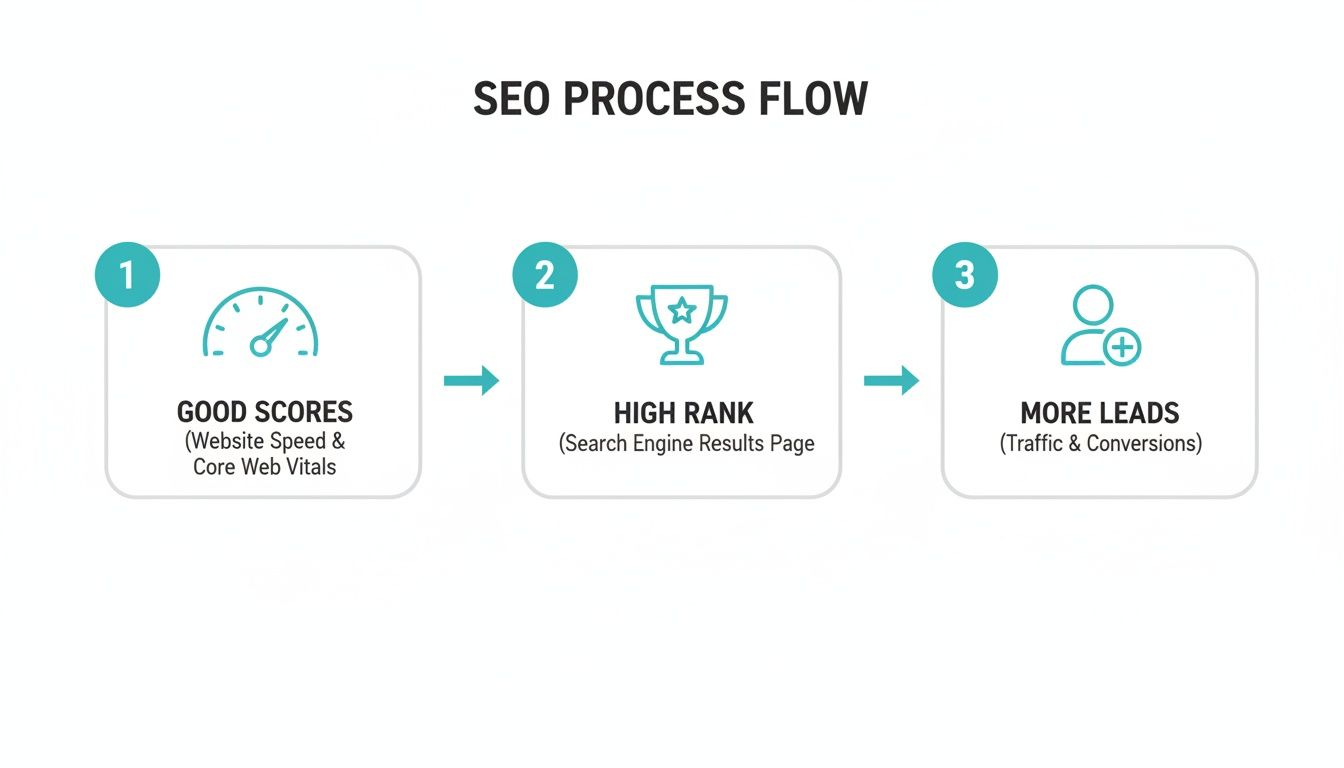
As you can see, optimizing your site is a direct investment in your sales pipeline. It creates a clear path from technical fixes to real business growth for your MSP.
So, what are these "technical improvements"? Let's translate the jargon into plain English and show how each action directly helps your MSP. This all falls under a practice known as technical SEO, which you can read more about in our guide to what technical SEO is.
A quality optimization service will get to work on a mix of these key tasks:
All of these actions work together to create a smooth, quick, and frustration-free experience for every single visitor.
Optimization isn't a one-time task. A good partner will follow a careful, structured process to make sure changes are implemented safely and deliver results you can measure. First, all the work happens on a staging site, which is a private copy of your live website. This is essential, as it allows for testing without any risk of disrupting your business.
After changes are tested and you’ve given the green light, they are carefully moved to your live site. This careful process ensures a smooth transition with no negative impact on your existing traffic or lead flow.
But the job isn't done after deployment. Continuous monitoring is key. Your agency will keep a close watch on performance metrics and your Core Web Vitals scores. As you add new blog posts or service pages, they’ll ensure these new elements are also optimized. Think of it as ongoing maintenance to keep your digital salesperson effective.

As an MSP owner, you live by data. Gut feelings aren't enough when you’re making business decisions, and investing in website speed optimization services is no different. A high score on a tool like PageSpeed Insights is great, but it’s just a number. It only becomes a true win when it leads to real business results.
The real goal isn't just to please Google's algorithm. It's about seeing a measurable impact on your bottom line. To do that, we need to focus on the key performance indicators (KPIs) that actually drive your MSP’s growth.
Let's talk about what really moves the needle: how potential clients interact with your site. These are the numbers you must track before and after any optimization project to prove its value. A full website review is the best starting point, which we cover in our guide on how to conduct an SEO audit.
Before starting a speed optimization project, it's critical to get a baseline. By tracking these key metrics before and after the work is done, you create a clear picture of the impact on your MSP.
Key Metrics to Track Before and After Optimization
Bounce Rate: The percentage of visitors who land on a page and leave without clicking anything. A high rate is a red flag. They likely got frustrated by slow loading and hit the "back" button. Goal: Decrease.
Avg. Session Duration: The average amount of time visitors spend on your website during a single visit. A lower number means more visitors are sticking around because the experience is fast and engaging. Goal: Increase.
Pages Per Session: How many different pages a visitor views in one session. A faster site encourages prospects to explore your services and read case studies. A quick site makes it easy to navigate from your homepage to your services page and then your contact form. Goal: Increase.
Conversion Rate: The percentage of visitors who complete a desired action, like filling out a "Request a Quote" form. This shows that users are more engaged and are looking deeper into what your MSP offers. This is the ultimate measure of your website's success and the metric most directly tied to revenue. Even a small lift here can mean a big increase in leads. Goal: Increase.
These user engagement metrics are the leading indicators of a healthier, more effective website. They prove you're not just getting traffic, you're getting their attention and guiding them toward becoming a lead.
Now for the most important part: connecting your investment directly to revenue. This is where you translate better engagement into real dollars. The math is simpler than you might think, and it all revolves around your conversion rate.
A conversion is any valuable action a visitor takes, from filling out a "Request a Consultation" form to downloading a guide. Your conversion rate is the percentage of visitors who complete that action.
Let’s walk through a quick, practical example for your MSP.
Imagine your website currently gets 2,000 visitors a month, and your conversion rate for demo requests is 1%. That’s 20 leads per month.
After optimization, your improved speed and user experience bump that conversion rate up to just 1.5%. It's a small change, but the impact is huge. Suddenly, you’re getting 30 leads per month. That's 10 extra qualified leads you didn't have before.
If your sales team has a 20% close rate, those 10 additional leads translate directly into two new clients every single month. What’s the average lifetime value of a client for your MSP? Multiply that number by two, and you have the monthly ROI from your website speed investment. This simple math turns a technical service into a predictable, revenue-generating machine.
Picking the right partner for your website speed optimization is a big decision. A great agency is a growth partner who understands how a faster site leads to more leads and deals for your MSP. The wrong one will waste your budget on technical fixes that don't actually help your business.
Not all "optimization" providers are the same. You need a team that gets the challenges of a B2B tech company like yours. They need to see the big picture: how a fast load time leads to more people filling out your consultation form. That takes a combination of deep technical skill and a smart marketing mindset.
Before you sign a contract, you have to do your homework. The way a potential partner answers these questions will tell you everything you need to know about them. A confident expert will welcome the tough questions.
Here’s what you need to ask to find the real pros:
These questions help you find a partner who is just as focused on your MSP's growth as you are.
Knowing what to look for is only half the battle; you also need to know what to avoid. Some agencies will try to impress you with big promises that hide a lack of real strategy. These are the warning signs that should make you walk away.
A true optimization expert focuses on a data-driven process. They set realistic expectations and tie their work directly to measurable improvements in user engagement and lead generation.
Keep your eyes open for these red flags:
Finding the right partner means finding an extension of your own team. You need an agency that understands your business goals and has a proven track record of helping MSPs turn their websites into powerful lead generation machines.
Even when you see the value, it's smart to have questions before you commit to a service. Let's walk through some of the most common things MSP owners ask about website speed optimization.
The honest answer: it depends. The cost is tied to your site's complexity and the problems that need fixing. A good agency won't give you a generic price. They'll start with a deep audit to find the exact problems and then give you a clear, project-based fee.
Think of this less as a cost and more as an investment in your main lead generation asset. The real question is about the return. If a faster site helps you land just one or two new managed services contracts, the project often pays for itself many times over.
Absolutely not, as long as you work with a professional. Any good agency will do all optimization work in a staging environment. This is a private, fully functional copy of your website.
This sandbox approach lets their team implement and test every change without touching your live site. Your visitors and lead forms won't notice a thing. Only after you've approved the results are the changes carefully moved to the live site. This process guarantees zero downtime.
A "staging-first" workflow is the professional standard for web projects. It removes all the risk from the process, ensuring the only change your prospects see is a much faster website.
You'll see the technical improvements almost right away. Performance scores on tools like Google PageSpeed Insights will jump, often within the first 30 to 60 days. Your site visitors will feel the difference immediately, which usually leads to a quick drop in your bounce rate.
The bigger SEO wins take a bit more patience. It takes time for search engines to crawl your improved site and reward it with better rankings. You can generally expect to see a real lift in organic traffic and keyword positions in about 3 to 6 months as Google recognizes the speed improvements. It’s a long-term play, but it’s what builds a steady pipeline of new leads for your MSP.
Ready to turn your MSP website into a high-performance lead generation tool? The team at MSP SEO Agency specializes in technical SEO and speed optimization that delivers measurable business results. Let’s start with a comprehensive audit to uncover your site’s full potential. Schedule your free consultation today!
Website speed is a critical ranking factor that directly influences how search engines evaluate your MSP website SEO health. Slow-loading pages not only push prospects toward your competitors but also signal to Google that your site may not deserve premium placement in search results. As part of a comprehensive MSP SEO strategy, speed optimization works hand in hand with content quality, backlink authority, and local SEO for MSP visibility to create a site that both users and search engines prefer. An MSP SEO agency with deep technical expertise can diagnose and resolve the performance bottlenecks that generic web developers often overlook, ensuring your site speed supports rather than undermines your broader MSP SEO services investment.
See how targeted SEO delivers measurable impact for managed service providers. Explore our proven strategies and real-world outcomes.