
Solid lead gen for tech companies isn't about chasing one-off wins. It’s about building a repeatable system that consistently attracts, converts, and nurtures prospects online. This is how you finally shift marketing from a cost center to a predictable revenue machine for your MSP.
Let's be honest: the old playbook is dead. For MSPs and other tech firms, relying on cold calls and a few trade shows just doesn't cut it anymore.
Your prospects, whether they're searching for managed IT services or a new SaaS tool, are doing their homework online long before they ever want to talk to a salesperson. This massive shift in B2B buying behavior means your website has become your single most important sales asset.
Today's buyers are in control. They use search engines, read articles, and watch videos to educate themselves on their own terms. If you're not there with valuable information when they're looking, you're invisible.
This is why a multi-channel digital strategy is no longer a "nice-to-have." It's essential for survival. For a deep dive into this approach, many find a modern playbook for SaaS lead generation to be a great starting point.
A successful lead generation engine really comes down to three fundamental stages. They work in tandem to guide someone from being a curious visitor to becoming a sales-ready lead. For an MSP, getting this right is the key to finally achieving predictable, scalable growth.
Here’s how it breaks down:
Let's be realistic: not all marketing channels are created equal, especially when you're an MSP trying to generate leads. The space is noisy, and your marketing budget isn't infinite. The key is to pick the channels that actually move the needle and deliver a steady stream of real opportunities, not just vanity metrics.
For an MSP or a cybersecurity firm, the goal is to build a balanced marketing engine. You need a system that brings in leads right now while simultaneously building a strong pipeline for the future. It’s a mix of short-term wins and long-term brand building.
Think of it as a continuous process with three core stages: attracting strangers, converting them into leads, and nurturing them into clients.
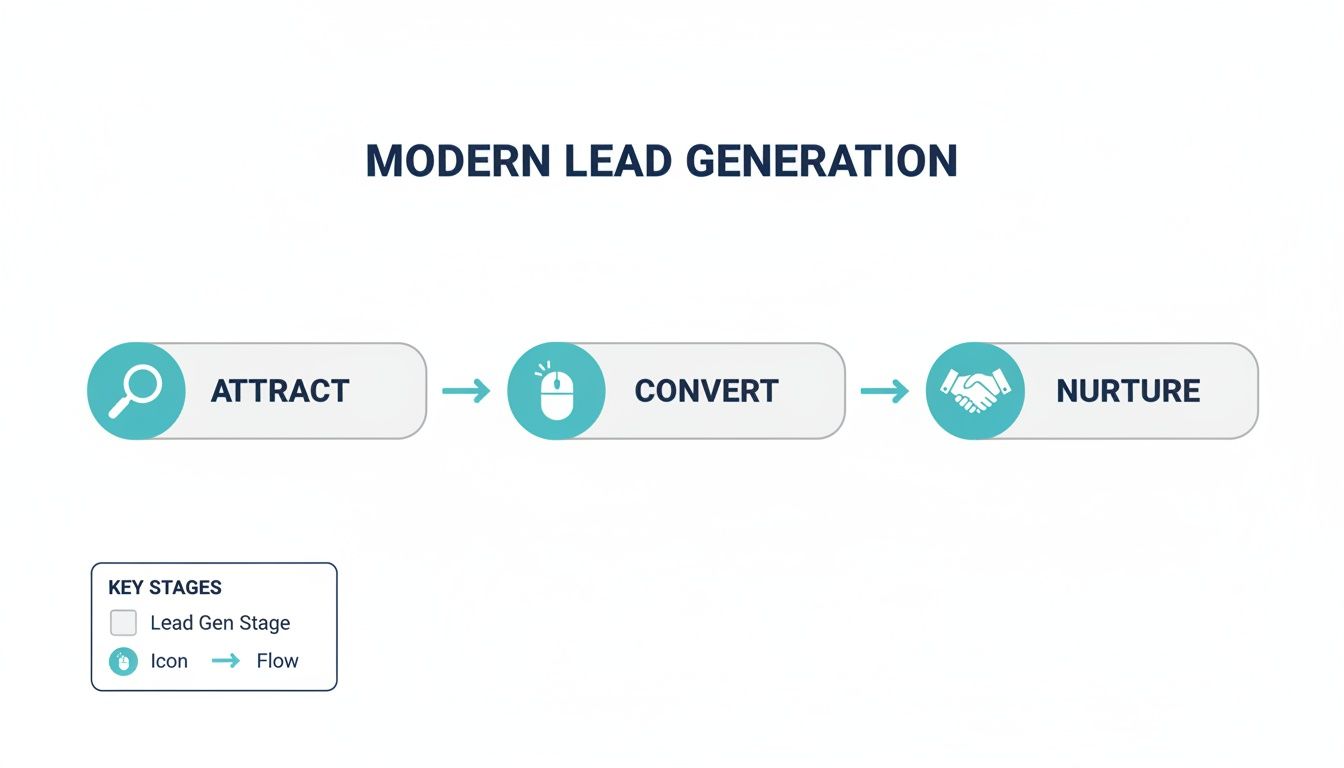
This isn't about a single campaign. It's about creating a smooth journey that guides potential customers from their first interaction with your brand all the way to a signed contract.
Before we dive into the specific channels, it's helpful to see how they stack up against each other. I've found that looking at lead quality versus cost is the best way to prioritize your efforts as an MSP owner.
For any managed service provider, Search Engine Optimization is the undisputed champion of inbound marketing. It's simple, really. When a CFO in your city searches for "managed IT services for accounting firms," you absolutely have to be the first name they see. That’s a hot lead, delivered right to your digital doorstep, asking for help.
This isn’t just my opinion; the data is overwhelming. In the hyper-competitive tech landscape, SEO consistently delivers the highest-scoring leads for B2B companies. In fact, 35% of marketers report their best leads come from their SEO efforts, handily beating referrals and paid social.
Even better, SEO leads are known to close at a 14.6% rate, which is nearly double the average from outbound marketing sources. You can dig into more of these kinds of lead generation stats over at Databox.
The magic of SEO is that you’re meeting prospects at their exact moment of need. You aren't interrupting their day with an ad; you're providing the perfect solution they were already looking for.
While SEO brings people to your website, it's your content that convinces them to stay and, eventually, to trust you. This is how you build genuine authority. By creating truly helpful articles, in-depth guides, and practical videos, you answer your audience's most pressing questions and prove you know your stuff.
This strategy ties directly into a concept called Answer Engine Optimization (AEO). Search engines like Google and AI tools like ChatGPT are no longer just directories of links; they are answer engines. They want to give users a direct answer. Your job is to create content so good that you become the answer.
For an MSP, this could look like:
Content marketing is your chance to become the go-to resource in your niche. When a prospect sees you as the expert who consistently provides value, you become the only logical choice when it's time to buy.
Organic channels are a long game, but sometimes you need to turn on the faucet and get leads flowing now. This is where paid advertising, particularly on LinkedIn, becomes an MSP's secret weapon. For B2B, its targeting capabilities are simply unmatched.
You can get incredibly granular and put your ads in front of the exact people you want to reach. Think about targeting based on:
This level of precision means you aren't wasting your ad budget on irrelevant clicks. A perfect example would be running a campaign promoting a webinar on "Cloud Cost Optimization," targeted specifically at finance leaders in your region. You're combining a high-value offer with a perfectly curated audience. That's a strategic play that generates results.
So, you’ve managed to get targeted traffic to your website. That's a huge win, but it’s just the first leg of the race. The real test for any MSP is turning those anonymous visitors into qualified leads you can actually talk to. This is where your lead magnet comes in, it’s the crucial handshake that turns a browser into a prospect.
Let’s be honest, a generic "Download our free ebook" button just won't fly anymore. Your prospects, whether it's a small business owner terrified of a data breach or a CFO scrutinizing cloud costs, are hunting for specific answers to very specific problems. Your lead magnet has to be an offer so compelling they don't even think twice about trading their contact info for it.
For a managed services or cybersecurity provider, the most powerful lead magnets aren't fluffy, high-level documents. They are practical, hands-on tools and resources that make your prospect’s job easier right now. Forget the vague whitepaper and think about creating assets that offer a direct solution.
This is your moment to prove your expertise by actually being helpful. When your offer feels like a genuine assist instead of a veiled sales pitch, you start building trust from the very first click.
Some of the best-performing lead magnets I've seen for MSPs include:
The best lead magnets solve a small piece of a larger problem your service solves. They provide an instant win for the prospect and naturally open the door for you to help them with the rest.
By offering a solution to a real pain point, you're not just grabbing an email address. You're qualifying the lead. Someone who downloads a SOC 2 guide is almost certainly in the market for compliance services.
Of course, not every visitor is ready to hop on a sales call. Most aren't. That’s why you need different types of lead magnets for different stages of awareness. Your content has to meet people where they are.
Think about it: a prospect who is just starting to research a problem needs different information than one who is actively comparing vendors. Guiding them is key. A study found that buyers who made a self-service purchase reported 43% higher regret than those assisted by a sales rep. Your lead magnets are the very first step in that helpful, assisted process.
A brilliant lead magnet can't do its job alone; it needs a solid campaign infrastructure. Every offer you create should have its own dedicated conversion path to guide the user from interest to action.
Here’s the simple flow that turns a download into a sales opportunity.
First, you need a dedicated landing page. This page has one job: get the visitor to download your asset. That means a killer headline, benefit-driven bullet points, and a short form. Critically, you need to remove the main site navigation. No distractions, just the offer.
Once they hit "submit," they land on the thank you page. Don't just flash a "Thanks for your download!" message. This is prime real estate. Tell them what to expect next and present a secondary call-to-action, like an invitation to book a 15-minute discovery call or watch a relevant case study video.
Simultaneously, the delivery email should hit their inbox. This email does one thing: it delivers the goods. Keep it simple, friendly, and make the download link or button big, bold, and impossible to miss.
Finally, the real work begins with the nurture sequence. This is an automated series of 3-5 emails that go out over the following week or two. Each email should offer more value related to the original topic, like a blog post, another tool, or a short video tip. This sequence builds the relationship, keeps your firm top-of-mind, and gently nudges the lead toward a sales conversation without ever feeling pushy.
Think of your website as your best salesperson. It works around the clock, never calls in sick, and can handle thousands of prospects at once. But if it’s slow, confusing, or just doesn't feel trustworthy, it will sink your entire marketing effort, no matter how much traffic you drive.

This isn’t about chasing flashy design trends. It’s about being deliberate. Every single element, from your page headlines down to the text on your buttons, needs to have one clear job: turning a visitor into a lead.
The stakes are getting higher. The market for tech lead generation is on track to hit $15.55 billion by 2031, with a huge push from AI and automation. With 90.7% of marketers pointing to their website as their top lead source and the average B2B lead costing $208, a poorly performing site is just burning cash. For a closer look at the numbers, you can find more lead generation statistics on Keywords Everywhere.
You have about three seconds to make a good impression online. That's it. If your page is still loading, your prospect has already bounced, and they're not coming back. A slow website is the silent killer of conversions. Google even uses site speed and user experience metrics, known as Core Web Vitals, as a direct ranking factor.
A fast site does more than just appease search engines; it signals professionalism and respect for your visitor's time. Run your site through Google's PageSpeed Insights. It's free and will give you a clear-cut list of what to fix, which often comes down to compressing images and cleaning up bloated code.
Once your site loads, can people actually find what they need? Confusing navigation is another common pitfall. Your menu should be dead simple. Use clear, specific labels like “Managed IT Services” or “Cybersecurity Solutions” instead of vague corporate-speak like “What We Do.” The goal is to create a frictionless path from their problem to your solution.
Every page needs a point. You have to tell visitors what to do next with a clear Call to Action (CTA). If you don't ask, you don't get. Vague, passive CTAs are one of the biggest missed opportunities I see on MSP websites.
It's time to banish "Submit" and "Click Here" from your vocabulary. Your CTAs need to be specific and highlight a benefit for the user.
See the difference? These small tweaks reframe the action around what the prospect gets, not what they have to give. And make sure the button itself pops with a contrasting color. It should be impossible to miss.
Your CTA is the final instruction in a conversation. It should feel like a natural, helpful next step, guiding the prospect closer to a solution for their problem.
For an MSP, trust is the entire game. A potential client has to believe you’re the right choice to protect their most critical assets. Your website is ground zero for building that confidence, and social proof is your most powerful tool.
You're essentially showing visitors that other companies, just like them, already trust you. Here are a few of the most effective ways to do it:
Sprinkle these trust signals throughout your site, paying special attention to your service pages and the areas right next to your CTAs. This reduces their hesitation and makes it that much easier for a prospect to say "yes." Our guide on how to optimize your website for search engines dives deeper into building this kind of authority.
So, your website and content are finally bringing in leads. That's a huge win, but what happens next is where most MSPs drop the ball. The moments right after someone fills out a form are make-or-break. A slow, manual, or disorganized follow-up process is a black hole where your best opportunities disappear.
Think of this as the operational plumbing for your entire marketing engine. It’s the system that guarantees every lead gets handled quickly and correctly, every single time. Without a solid process here, you're just pouring your marketing budget into a leaky bucket.
Your CRM needs to be the central nervous system of your sales operation, not just a glorified contact list. When set up right, it becomes the definitive record for every touchpoint a prospect has with your company.
For an MSP, this means tracking the entire journey. You can see the first time they downloaded a guide, which emails they've opened, and every call your team has logged. This rich history is gold for your sales reps. They can skip the generic "So, what are you looking for?" and lead with something far more impactful, like, "I saw you downloaded our SOC 2 compliance guide. Are you gearing up for an audit soon?"
In sales, speed is your greatest advantage. I’ve seen it firsthand: responding to a new lead within five minutes can boost conversion rates by a staggering nine times. The only way to hit that mark consistently is with automation.
This is all about creating simple, powerful rules in your CRM to assign new leads to the right person instantly. Forget having someone manually sort through an "info@" inbox, the system does the work for you.
Here are a few common routing rules that work well for MSPs:
This simple bit of automation cuts out human error and delays. It's a small change that drastically shortens your sales cycle and stops good leads from ever going cold.
Let's be honest, not all leads are created equal. Some are just browsing, while others are holding a credit card. Your sales team’s time is their most valuable asset, and they need to focus it on the accounts that are actually ready to talk business. This is precisely what lead scoring is for.
Lead scoring ranks your prospects by assigning points based on who they are and what they do. You're essentially measuring two things: how much they look like your ideal customer (fit score) and how much interest they're showing in you (engagement score).
A lead scoring model is your sales team's priority list. It separates the hot prospects from the curious researchers, ensuring your team spends its time on revenue-generating activities, not chasing dead ends.
For example, a "Director of IT" (a great fit) who visits your pricing page and downloads a case study (high engagement) will rack up a high score. They're immediately flagged as a Marketing Qualified Lead (MQL) and get bumped to the very top of a salesperson's to-do list.
To turn your site into a 24/7 qualifying machine, you can even use a lead generation chatbot to capture and score these interactions in real time. This ensures your hottest opportunities always get the immediate attention they deserve.
There's an old saying that you can't improve what you don't measure. In marketing, that's the absolute truth. This is the final step in creating a predictable lead engine for your MSP, and honestly, it's the one that separates the pros from the amateurs.
It's all too easy to get caught up in vanity metrics. Things like website traffic, social media likes, and follower counts feel good, but they don't keep the lights on. The real goal is to zero in on the key performance indicators (KPIs) that draw a straight line from your marketing efforts to your revenue.
When you can confidently show how a specific campaign impacted the bottom line, you change the conversation. Marketing stops being an expense and starts being seen for what it is: a powerful growth driver. It takes the guesswork out of your budget and lets you invest with data-backed confidence.
Tracking everything is just as bad as tracking nothing. For an MSP, a few core metrics will give you a clear picture of your lead generation health. These are the numbers that matter to the business, not just to a marketing report.
Here are the KPIs we always have on a simple, real-time dashboard for our clients:
Beyond the high-level view, you have to get granular with your channels to truly optimize. Take LinkedIn, for instance. It has become an absolute powerhouse for lead gen for tech companies, proving itself 277% more effective than other social platforms.
With a staggering 80% of B2B social leads coming from LinkedIn, you can't afford to fly blind. We've seen its native Lead Gen Forms hit a 13% conversion rate, far better than most landing pages, and when you automate the follow-up for those leads, you can slash your CPL by as much as 33%. To see more on how LinkedIn is changing the B2B game, check out the data on Sopro.io.
The goal isn't just to generate leads; it's to acquire profitable customers. Tracking these KPIs allows you to prove your marketing ROI and confidently scale the channels that are working best.
By focusing on these core numbers, you stop guessing and start making informed decisions. For a deeper look at what to track, especially on the organic side, check out our guide on how to track SEO performance and learn how to build a dashboard that truly reflects business impact.
If you’re running an MSP, you probably have a lot of questions about how to make lead generation actually work. It's a common hurdle. Let's break down some of the most frequent questions we hear from owners just like you.
Let’s tackle the big one first. While you can get immediate traffic with paid ads, SEO is a different beast: it’s an investment in long-term, predictable growth for your MSP.
For an MSP that's new to SEO, you'll likely start seeing some early signs of life within three to six months. This usually looks like better rankings for very specific, long-tail keywords that show buying intent.
But if you're aiming for a steady stream of quality leads for those high-value, competitive terms (think "managed IT services in Chicago"), you need to be more patient. That often takes closer to six to twelve months of consistent effort. The timeline really depends on where you're starting from, how fierce your local competition is, and how aggressive your campaign is. Consistency is everything here.
Your marketing budget shouldn't be a random number; it should be tied directly to your growth ambitions. As a solid rule of thumb, we see growing MSPs invest 5% to 10% of their target annual revenue back into marketing. This approach ensures your spend scales with your goals.
So, what does that look like in practice? To get a real lead generation program off the ground, one that builds a foundation with SEO and content, you should plan for a starting budget between $3,000 to $7,000 per month. That's a realistic figure to cover professional SEO, a steady drumbeat of content creation, and a small budget to promote that content.
The most successful MSPs view marketing not as an expense on a spreadsheet, but as a direct investment in acquiring profitable, long-term client relationships. It’s the fuel for predictable revenue.
This comes up a lot. For sustainable, scalable growth, we almost always recommend that MSPs start with an inbound strategy. At its core, inbound marketing (driven by SEO and great content) attracts prospects who are already out there looking for the solutions you provide.
The result? The leads are warmer, the quality is higher, and your close rate is naturally better. They came to you, after all.
Outbound tactics like cold calling or emailing can create some short-term buzz, but they're tough to scale and often deliver a lower return on investment. The best approach is to build a strong inbound engine first to create a consistent pipeline. Once that's humming, you can layer in highly targeted outbound campaigns to go after specific, high-value accounts. It's a one-two punch.
Ready to stop guessing and start building a predictable lead generation engine for your MSP? At MSP SEO Agency, we build specialized SEO strategies that drive qualified leads and measurable growth.
Book a free consultation today and let's talk about hitting your revenue goals.
See how targeted SEO delivers measurable impact for managed service providers. Explore our proven strategies and real-world outcomes.