Optimizing your website for search engines has a few key layers: the technical stuff behind the scenes, the actual content on your pages, and building your site’s authority and trust across the web. For an MSP, this means your site needs to be fast and easy for Google to read. Your service pages have to answer your clients’ biggest questions, and you need trust signals like backlinks to climb the search rankings.
If your MSP is still running on sporadic referrals or hit-or-miss outbound sales, you're building your business on unstable ground. The hard truth is that your best clients aren't waiting for a cold call. They're already online, actively searching for answers to their IT headaches with queries like "cybersecurity services near me" or "IT support for small business." When you optimize your website for search engines, you put your business directly in their path the moment they need you most.

This isn't about chasing vanity metrics like "more traffic." It's about attracting high-intent visitors, the kind that lead to booked consultations and new monthly recurring revenue. When a local business owner searches for "managed IT services in Dallas," they have a real problem. Seeing your MSP at the top of the search results establishes you as the credible expert.
Good SEO isn't about stuffing keywords into a page anymore. It’s about building a systematic, reliable lead generation machine that works for you 24/7. This system rests on a few core pillars that have to work together to boost your visibility and drive real growth for your MSP.
For any MSP looking to get serious about SEO, these are the non-negotiables:
Getting these areas right turns your website from a static digital brochure into your single most effective sales tool. You’ll stop chasing down leads and instead build a system that brings qualified prospects directly to you. This guide gives you the actionable steps to make that a reality.
Before your content can win over a new client, your website has to pass Google's technical inspection. Think of technical SEO as the foundation of your digital storefront. If the foundation has cracks, the whole structure is unstable, no matter how great your services are.
Getting this right isn't just a suggestion; it’s the first step in any serious effort to get your MSP website noticed by search engines.
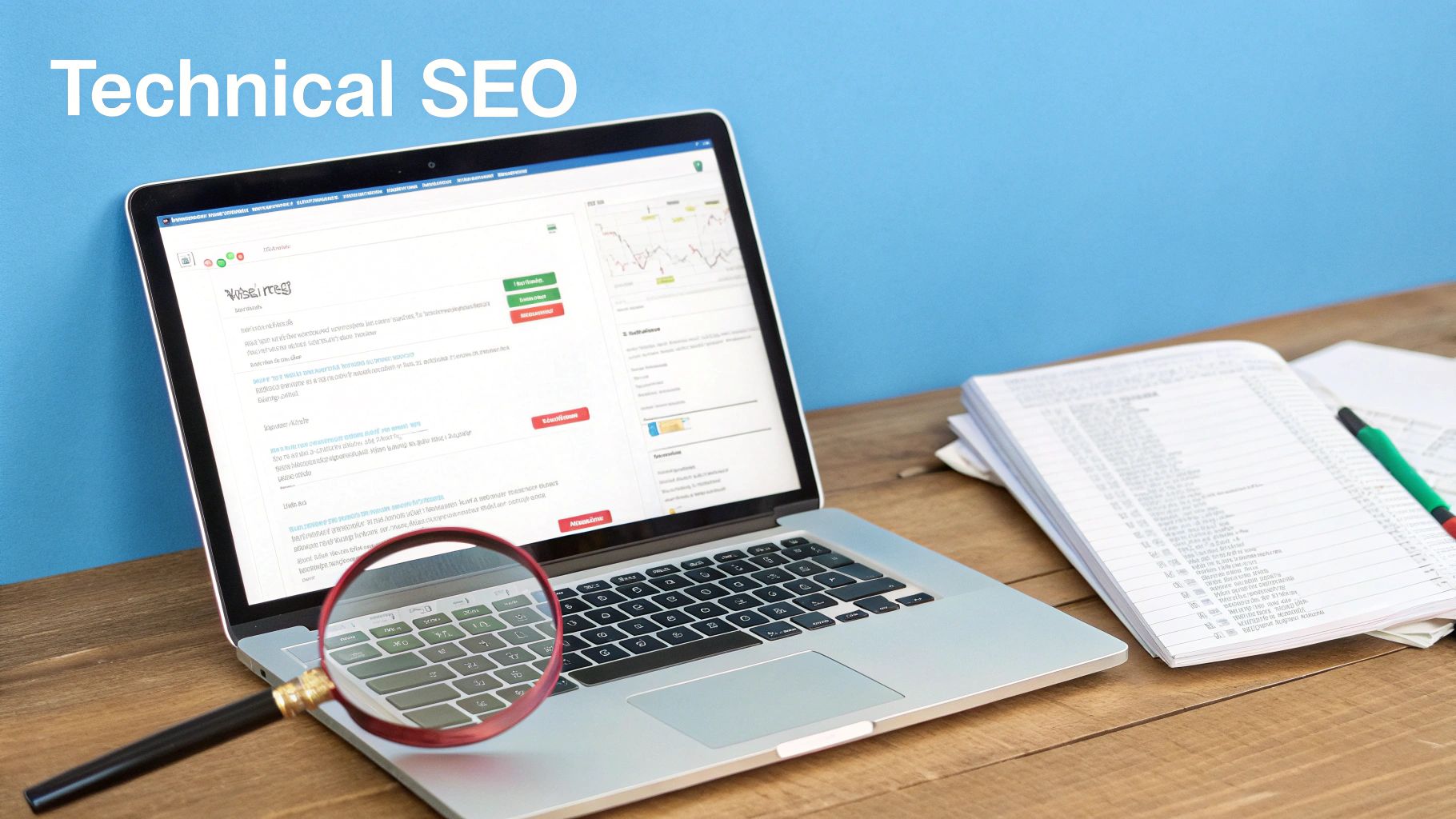
A solid technical setup ensures that search engine crawlers, the bots that scan the web, can find, understand, and index your pages without hitting roadblocks. If a bot gets lost or hits a dead end, that page might as well be invisible. For an MSP, this means a potential client searching for "managed IT services in [Your City]" finds your competitor instead of you.
First things first: you have to make sure Google can actually see your website. This sounds basic, but you’d be surprised how often we find sites with simple technical glitches blocking search engines. The best place to start is Google Search Console, a free tool that’s like a direct line of communication between your website and Google.
Once you’re set up, go straight to the "Pages" report. This section tells you exactly which of your pages are indexed and, more importantly, which ones are not, along with the reasons why.
Keep an eye out for errors like "Crawled : currently not indexed" or "Discovered : currently not indexed." These are major red flags. They tell you that Google knows a page exists but has chosen not to include it in search results for a specific reason.
What are the usual suspects?
Fixing these indexing errors is non-negotiable. It’s the digital equivalent of unlocking your front door so customers can walk in. For a deeper dive, you can learn more about what is technical SEO.
A slow, clunky website doesn't just frustrate potential clients; it actively harms your search rankings. Google's Core Web Vitals are a specific set of metrics designed to measure the real-world user experience of your site, focusing on loading speed, interactivity, and visual stability. These are direct ranking factors.
Here’s what you need to zero in on:
You can check your scores for free using Google's PageSpeed Insights tool. It will give you a detailed report card and specific recommendations, like compressing images or reducing server response times. Improving these scores makes your site better for users, which, in turn, makes it better for Google.
To help you prioritize, we've put together a checklist of the most critical technical SEO elements for any MSP website.
This table breaks down the essential technical tasks that directly impact your ability to rank higher and generate more qualified leads.
Indexing & Crawlability: Regularly check Google Search Console for "Pages" errors and submit an XML sitemap. If Google can't find and index your pages, you're invisible to potential clients.
Site Speed (LCP): Compress images, use a CDN, and optimize server response time to get LCP under 2.5 seconds. A faster site reduces bounce rates and is a confirmed Google ranking factor.
User Experience (FID & CLS): Minimize JavaScript execution and ensure ad/image elements have set size attributes. A smooth, stable website builds trust and encourages users to convert to leads.
Mobile-Friendliness: Ensure your site uses a responsive design that works flawlessly on all devices. The majority of B2B research starts on mobile. A poor mobile experience means lost business.
HTTPS Security: Implement a valid SSL certificate across your entire site. HTTPS is a baseline for trust and a minor ranking signal. Browsers will flag non-secure sites.
Focusing on these core areas ensures your website is built on a strong foundation, ready for the more advanced optimization strategies to come.
Your technical SEO foundation is set, but that just gets the search engines to your door. The content is what invites them in and, more importantly, convinces a potential client to stay. On-page SEO is where you connect your MSP’s technical expertise with the real-world problems your ideal customers are trying to solve.
This isn’t about stuffing keywords into a page like we did in the old days. It's about understanding what a business owner is really looking for when they need IT support or are worried about cybersecurity.

When a prospect searches on Google, they aren't just looking for a list of services. They have a pain point, like crippling downtime, nagging compliance worries, or the threat of a data breach. Your content needs to meet them right there, in that moment of need, with a clear solution.
Forget targeting broad, vague terms like "IT services." The competition is a nightmare, and you have no idea who is on the other side of that search. The real money is in uncovering long-tail keywords, the specific phrases that signal a prospect is much closer to making a buying decision.
These are the multi-word queries that tell you exactly what someone needs. Think about the difference between a search for "cybersecurity" and a search for "managed cybersecurity services for small law firms in Chicago." You can guess which one is the qualified lead.
To dig up these gems, you need to think like your clients:
This approach doesn't just attract more traffic; it attracts the right traffic.
Think of your service pages as your digital sales floor. This is where a potential client decides if you have what it takes to solve their problem. Every single element on these pages needs to answer their questions and check all the boxes for search engines.
In a competitive market, a first-page Google ranking is a lead-generation machine. Organic search drives a staggering 53% of all website traffic, blowing paid ads out of the water. If your pages aren't optimized, you're handing leads to your competitors.
Let's nail the basics. Your meta title is the blue link they see in the search results. Keep it concise, but make sure it includes your primary keyword and location. Something like "Managed Cybersecurity for Dallas Businesses | Your MSP Name" works perfectly.
Then you have the meta description, which is your 160-character elevator pitch. A good one can make someone click your link instead of a competitor's. Don’t just list what you do; sell the outcome. Try: "Protect your Dallas business with our 24/7 managed cybersecurity. We stop threats before they cause costly downtime. Get a free assessment." See the difference?
Finally, structure your content with header tags (H1, H2, H3). Your H1 is your main headline. Use H2s and H3s to break the page into scannable sections that cover specific benefits, features, or common questions about that service.
Google is incredibly smart now. It doesn't just scan for exact keywords; it understands the overall context and meaning of your content. This is called semantic search. To win this game, you need to build topical authority, proving to Google that you are a legitimate expert on everything from cybersecurity to cloud management.
So, how do you do that? You create a web of interconnected content around a core topic. Let's say your main service is "Managed IT Support." A single page isn't enough. You need to support it with blog posts that answer all the related questions your prospects have:
This "hub and spoke" model shows search engines that your knowledge runs deep. Each piece of content reinforces the others, making your entire site more authoritative. It’s a strategy built on understanding the concept of search intent and creating content that actually helps people. The result? You rank for a wider range of terms and become the go-to resource in your market.
Search isn't what it used to be. The classic list of blue links is quickly being overshadowed by AI Overviews and conversational answers. For your MSP, this shift means the old SEO playbook just won't cut it anymore. We're now in the age of Answer Engine Optimization (AEO).
This isn't just a minor tweak; it's a fundamental change in how we need to think about content. The game is no longer just about ranking for a specific keyword. It's about becoming the trusted, definitive source that AI models like Google's Gemini rely on to build their answers. When your content is the one they cite, you're positioned as the authority.
Answer Engine Optimization (AEO) is about creating and structuring your content so AI language models can easily find, understand, and feature it in their generated responses. It’s a departure from traditional SEO, which is geared toward ranking your entire webpage. AEO is about getting specific, factual pieces of your content pulled out and highlighted.
Here’s a simple way to look at it: Traditional SEO gets your website invited to the party. AEO gets you quoted by the host.
For an MSP, this could look like your crisp explanation of "zero-trust security" being pulled directly into an AI summary. That summary almost always includes a link back to your site, driving highly qualified traffic from users who now see you as an expert.
The real goal here is to make your website the most reliable, citable, and easily digestible source of information for your niche. When an AI needs a clear answer about cybersecurity compliance or disaster recovery, your content should be its first stop.
To get your content featured in AI summaries, you have to start writing and formatting it with an AI "reader" in mind. These crawlers don't browse a page like a person does; they parse it, looking for logical, self-contained chunks of information to use. Long, meandering paragraphs are often skipped over.
Here are a few tactics I’ve seen work wonders:
With the rise of AI, some website owners have panicked and started blocking AI crawlers from their sites. For any MSP trying to grow, this is a huge mistake.
Blocking crawlers from Google or OpenAI is like locking the door when a potential customer knocks. You’re effectively taking yourself out of the running for AI-powered search results, making your firm invisible to a massive, and growing, audience.
Adopting an AI-first mindset is no longer optional. The data is clear: AI search traffic is projected to skyrocket by a staggering 527% year-over-year. You can dig into more stats on the impact of AI on SEO over at Semrush.
This new search ecosystem rewards clarity and authority. By optimizing for AI summaries, you position your MSP to capture high-intent users looking for expert solutions. Allowing crawlers access is the first and most critical step to earning those valuable mentions that drive traffic and build your authority.
It’s easy to get caught up in the idea of a global reach, but for most MSPs, new business is won and lost right in your own backyard. Potential clients aren't just searching for "IT support"; they're looking for "IT support in Austin" or "cybersecurity services near me." This is where a dialed-in local SEO strategy becomes your most powerful lead-generation tool.
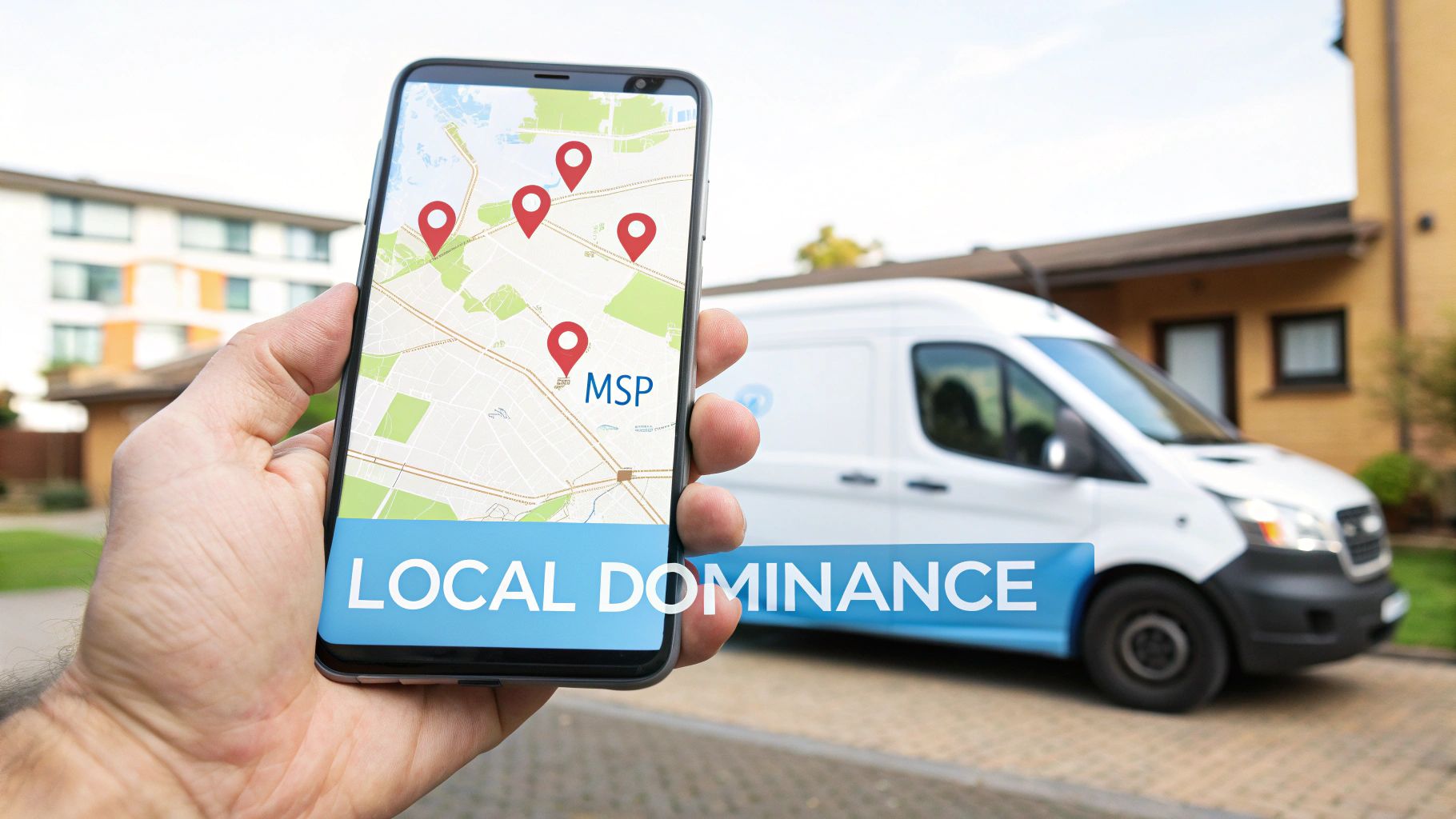
Winning locally means showing up in the Google Map Pack. You know the one: it’s that prime real estate at the top of the search results with a map and three business listings. Landing a spot there puts you directly in the line of sight of prospects ready to make a decision.
Think of your Google Business Profile (GBP) as your digital storefront. It's often the very first impression a potential client has of your business. Simply claiming your profile isn't enough; you have to treat it like a living part of your marketing.
The first rule of the local SEO game is NAP consistency. That’s your business Name, Address, and Phone number. These details must be identical everywhere they appear online, from your website’s footer to your GBP and other local business directories. A tiny variation, like listing "St." in one place and "Street" in another, can hurt your local rankings.
A truly optimized profile goes much deeper:
With your GBP in good shape, the next move is to build your authority across your entire service area. This is all about sending signals to Google that prove you're a legitimate, trusted expert in your specific region.
A great place to start is with location-specific service pages on your website. Instead of a single "Managed Services" page, create dedicated pages like "Managed IT Services in Houston" or "Cybersecurity for Dallas-Based Law Firms." This lets you tailor your messaging and keywords directly to each market.
A strong local presence is built on trust, and nothing builds trust faster than social proof. Actively encourage your happy clients to leave reviews on your Google Business Profile. These reviews are a massive ranking factor and heavily influence whether a prospect decides to pick up the phone.
Earning backlinks from other local businesses is another powerful signal. Think about sponsoring a local tech meetup, joining your city's chamber of commerce, or partnering with a non-competing firm like a local accounting practice. When their websites link to yours, it's a vote of confidence that tells Google you're a recognized part of the local community.
If your technical SEO and on-page content are the engine, then authority is the fuel that drives real results. In the eyes of search engines, authority is built primarily through backlinks, which are links from other websites pointing to your own. You can think of every high-quality backlink as a vote of confidence, signaling to Google that other credible sources trust your expertise.
This isn't just a numbers game. A single, powerful link from a well-respected tech publication is worth more than a hundred low-quality links from random online directories. The goal is to earn placements that boost your domain authority and drive qualified referral traffic from people who need your MSP's services.
For an MSP, context is everything. A good backlink comes from a site that lives in your ecosystem. We're talking about tech blogs, cybersecurity news sites, local business journals, or even the websites of your non-competing technology partners. These links send strong signals to Google that you are an authoritative voice in the IT and cybersecurity space.
On the flip side, bad backlinks are poison. These are links that come from spammy, irrelevant websites or paid link farms. Chasing these can land you a penalty from Google, which can undo all your hard work. Always prioritize quality and relevance over sheer quantity.
So, how does a busy MSP owner build these powerful backlinks? The most effective method is through guest posting. This means writing a genuinely helpful article for another website in your niche. In return, you get a link back to your site. It’s a win-win: they get expert content for their audience, and you get an authoritative backlink and exposure to new clients.
Start by brainstorming where your ideal customers hang out online. Are there popular cybersecurity blogs, local business publications, or industry forums they read? Make a target list.
Once you have your list, your outreach has to be personal. A generic, copy-and-paste email is a one-way ticket to the trash folder.
Your outreach email needs to show you've done your homework. Mention a specific article of theirs you enjoyed. Then, pitch a few unique topic ideas that would genuinely benefit their audience, not just serve as a thinly veiled ad for your MSP. This simple shift changes the entire dynamic. You’re no longer asking for a favor; you’re proposing a professional collaboration.
Let's be honest: optimization without measurement is just guesswork. Pouring time and money into technical fixes and new content is a waste if you can't prove it's actually growing your MSP. This is where tracking performance stops being a chore and becomes your best source of business intelligence, turning effort into tangible ROI.
Your goal here is to get past vanity metrics like raw traffic numbers. We need to focus on Key Performance Indicators (KPIs) that draw a straight line from your SEO work to real business outcomes, like qualified leads in your inbox and new clients signing contracts.
The great news is the essential tools you need are completely free. You just need to get two platforms set up and talking to each other: Google Search Console and Google Analytics 4 (GA4).
Think of it this way: Search Console tells you how your site performs in Google's search results, while GA4 tells you what people do once they actually land on your website.
Setting up a simple dashboard gives you a live look at your progress. It lets you stop making assumptions and start making sharp, data-driven decisions about where your marketing energy should go next. You don't need a complex analytics suite. A properly configured GA4 property linked to your Search Console account gives you every piece of essential data you need.
Forget about getting lost in hundreds of data points. For an MSP owner, only a handful of metrics truly tell the story of your SEO success.
Here are the core KPIs you should have your eyes on every week:
Tracking these specific KPIs shows you exactly how SEO is contributing to your business growth. A great first step is to establish your baseline by learning how to conduct an SEO audit. By focusing on these numbers, you can clearly demonstrate the return on your investment and build a predictable engine for new business.
Ready to stop guessing and start getting real, measurable results from your website? The team at MSP SEO Agency builds SEO programs that drive predictable lead generation for managed service providers. Book a discovery call today and let's build your growth engine.
Optimizing your MSP website is the single most impactful step you can take to improve your online visibility and generate more qualified leads. A well-optimized site serves as the hub of your entire MSP SEO strategy, converting the traffic generated by your content marketing, link building, and local SEO for MSP efforts into actual business opportunities. Professional MSP SEO services ensure your website is not just technically sound but also strategically designed to guide visitors toward conversion. Partnering with an MSP SEO agency that specializes in MSP website SEO means every page, every call to action, and every technical element is fine-tuned to maximize your return on search engine investment.
See how targeted SEO delivers measurable impact for managed service providers. Explore our proven strategies and real-world outcomes.