Great SEO content starts with a simple truth: you have to find the right keywords, understand why someone is searching for them, and then create the absolute best answer out there. Get this right, and you will not just get traffic, you will get qualified leads knocking on your door. For a growing MSP, this is how you build a predictable sales pipeline.
Before you write a single word, you need to step into your ideal client's shoes. What specific problems are they trying to solve? What phrases are they typing into Google when their network is slow, they are worried about a new cyber threat, or they are looking to switch IT partners? This is the bedrock of any content strategy that actually generates leads.

Too many MSPs fall into the trap of targeting huge, generic keywords like "IT services" or "cybersecurity." Sure, the search volume looks impressive, but you end up attracting a massive, unfocused audience of students, job hunters, and DIYers. It’s vanity traffic that almost never turns into a client.
The real wins for an MSP come from long-tail keywords. These are longer, more specific phrases that tell you exactly what a potential client is looking for. They signal a real business problem that needs a solution.
Start by brainstorming the real-world problems your clients have. Think about the exact words they use when they describe their frustrations. Your mission is to find keywords that scream "I have a business problem and I need an expert to solve it."
Here are a few categories that consistently drive qualified leads for MSPs:
Your best keyword ideas will not come from a tool. They will come from your sales team and your techs. These are the people on the front lines who hear the exact language your clients and prospects use every single day. That feedback is pure gold.
Finding a great keyword is just the first step. The real magic happens when you understand the search intent: the why behind the query. Is someone just gathering information, or are they ready to hire an MSP?
If you want to go really deep on this, you can learn more about how to do keyword research for your MSP in our detailed guide.
For MSPs, search intent boils down to three main categories:
By mapping your keywords to a specific stage in the buyer's journey, you make sure your content shows up at the exact moment a prospect needs it most. That’s how you stop chasing clicks and start building a reliable pipeline of high-quality leads for your MSP.
Let’s be honest: top-ranking content does not happen by accident. It might look effortless to the reader, but behind every successful article is a deliberate, strategic plan. For MSPs, this means moving beyond just a keyword and a prayer. The secret to getting predictable results and attracting qualified leads is building a solid content blueprint.

Think of this blueprint, or content brief, as the bridge between your keyword research and the final draft. It is a single document that gives your writer everything they need to create content that hits every strategic mark, with no guesswork required. This is essential for scaling your MSP's lead generation efforts.
A good brief cuts through the noise. Instead of handing a writer a keyword and hoping they read your mind, you are giving them a clear roadmap. It answers all the critical questions before a single word gets written.
Every effective brief must include these core elements:
A detailed brief is your best defense against generic, uninspired content. It forces you to think strategically about how your article will be genuinely better and more helpful than what’s already ranking on Google.
With your strategy locked in, it is time to build the skeleton of the article: the outline. This is where you organize those talking points into a logical sequence using H2 and H3 headings. A clean structure is absolutely crucial for writing SEO-optimized content, as it makes the page easy for people to scan and helps search engines understand the informational hierarchy.
Let's stick with our example, "cloud migration services for small businesses." A strong outline would walk a non-technical reader from a high-level "what is it?" to specific, confidence-building next steps. You are anticipating their questions and answering them in order.
Here’s what that looks like in practice:
This approach creates a seamless journey for the reader, establishing your MSP as a trusted guide. It also sends a powerful signal to Google that your content is deep and authoritative, which is key for attracting qualified business leads.
You have put in the legwork to build a solid content blueprint. The next crucial phase is making sure Google, and more importantly, your future clients, can actually find what you have written. This is where on-page SEO comes in. It is all about fine-tuning your content to send clear signals to search engines about what your page is about, helping them rank it for the right searches.

Think of these technical tweaks as the bridge between a great blog post and a powerful lead-generation asset. Let's walk through the specific elements that make a real difference for an MSP looking to scale.
Your meta title and description are your content's digital billboard on the search results page. This is often the very first impression a potential client has of your MSP. Its one job is to get them to click your link instead of the competition's.
A meta title is the blue, clickable headline you see in Google's results. It’s a huge ranking signal. To make yours count:
Below that headline is the meta description, a short snippet of text summarizing the page. While it is not a direct ranking factor, it has a massive impact on your click-through rate. A compelling description can be the deciding factor for a user. You have about 155 characters to clearly explain what they'll find and why it’s worth their time.
Headings (H2s, H3s, and so on) do more than just break up the text. They create a logical roadmap that guides both human readers and search engine crawlers through your arguments. For an MSP targeting busy decision-makers, this structure is non-negotiable for lead generation.
Your headings should directly mirror the questions a business owner is asking. Use your H2s to frame the major topics of your article and H3s to drill down into the specific details under each one. This creates a clean hierarchy that makes your content scannable for busy executives and easy for search algorithms to understand.
When you structure your content this way, you are doing more than just improving readability. You are essentially spoon-feeding search engines the exact information they need to recognize your expertise on complex topics like "cybersecurity risk assessments" or "cloud cost management."
Even seemingly minor details, like your URL structure and image files, add up. These small optimizations provide extra context for Google and contribute to a better overall user experience, which ultimately helps you generate more leads.
Your page's URL, also called a permalink, should be short, clean, and descriptive. Ditch the clunky, auto-generated URLs and edit them to feature just your primary keyword.
yourmsp.com/blog/2026/07/a-guide-to-understanding-the-benefits-of-voip-for-smbsyourmsp.com/blog/voip-for-small-businessSee the difference? The clean version is far easier for a user to read and share.
Images also need attention. Every image on your site must have descriptive alt text. This text serves a dual purpose: it makes your site accessible for visually impaired users relying on screen readers, and it gives search engines another signal about your page’s content. Instead of a generic filename like "image123.jpg," write something that adds context, like "MSP technician installing a network switch in a client's server room." It’s a small effort that adds real SEO weight.
So you have published a killer blog post that’s getting some decent traffic. That’s a solid first step. But if you are serious about owning the search results for a core service, say, "managed IT services" or "business VoIP," a single article just will not cut it. To truly scale your MSP, you need to build a web of interconnected, expert content that proves your deep knowledge on a subject.
This is what we call topical authority. It’s how you go from being just another MSP to becoming the go-to resource in your market, signaling to both potential clients and Google that you are the expert.
The go-to strategy for this, and what works consistently for our MSP clients, is the pillar and cluster model. The best way to visualize it is as a hub-and-spoke system for all your content.
Pillar Page: This is your cornerstone, a comprehensive guide on a broad topic. For an MSP, a perfect example is a definitive page on "Business VoIP Solutions." It covers the subject broadly but links out to more specific, detailed articles.
Cluster Content: These are the deep dives. They are shorter, more focused articles that explore a single subtopic from your pillar. Using the "Business VoIP" pillar, your clusters might be articles like "Top VoIP Phone Features for Small Businesses" or "Breaking Down the Benefits of a Cloud PBX System."
The real power is unleashed when you connect them all.
Think of it this way: a strong pillar-cluster structure does not just organize your content. It creates an internal linking web that tells Google, "We don't just know a little about this topic, we are the authority on it." This strategy has a lifting effect, boosting rankings across your entire portfolio of related keywords and driving more qualified leads.
Internal links are the threads that weave your content strategy together. On the surface, they guide readers to other relevant articles, keeping them on your site longer and moving them closer to a solution.
More importantly, from an SEO perspective, these links pass authority and context between your pages. A well-placed link helps Google understand the relationships within your content. It says, "This piece on VoIP features is directly related to our main guide on business VoIP." Over time, this interconnected web strengthens the perceived expertise of your entire website. If you want to go deeper, you can discover more about topical authority and how we build it in our complete guide.
Whenever you create a new piece of cluster content, your first move should always be to link it back to its parent pillar page. From there, look for other relevant cluster articles to link to.
When it comes to the anchor text, which is the clickable text of the link, be natural and descriptive. Ditch generic phrases like "click here." Instead, use text that tells the reader exactly what they will get, such as "our guide to cloud PBX benefits." This makes your site more helpful for potential clients and clearer for search engines.
A logical structure is essential for modern search. By structuring your content logically, you make it far easier for both users and search engines to find, understand, and link to your valuable expertise. This is how you build a marketing asset that consistently generates leads for your MSP.
If you think hitting “publish” is the end of the road, you are leaving money on the table. The real work, and the real results for your MSP, begin after your content goes live. This is where you separate a blog that just exists from a content engine that actually drives new business and helps you scale.
It all comes down to a simple, continuous loop: publish, measure, improve, repeat.
To do this right, you do not need a complicated analytics stack. Your most powerful tools are completely free: Google Analytics and Google Search Console. They provide all the data you need to make smart, profitable decisions, as long as you know what to look for.
Do not get bogged down in vanity metrics. As an MSP owner, your time is valuable. You only need to focus on the handful of key performance indicators (KPIs) that directly tie back to business growth.
Here’s what you should track:
Building this kind of performance is not about one-off articles; it is about creating a structure that tells Google you are an expert on a topic. This is where building topical authority comes in.
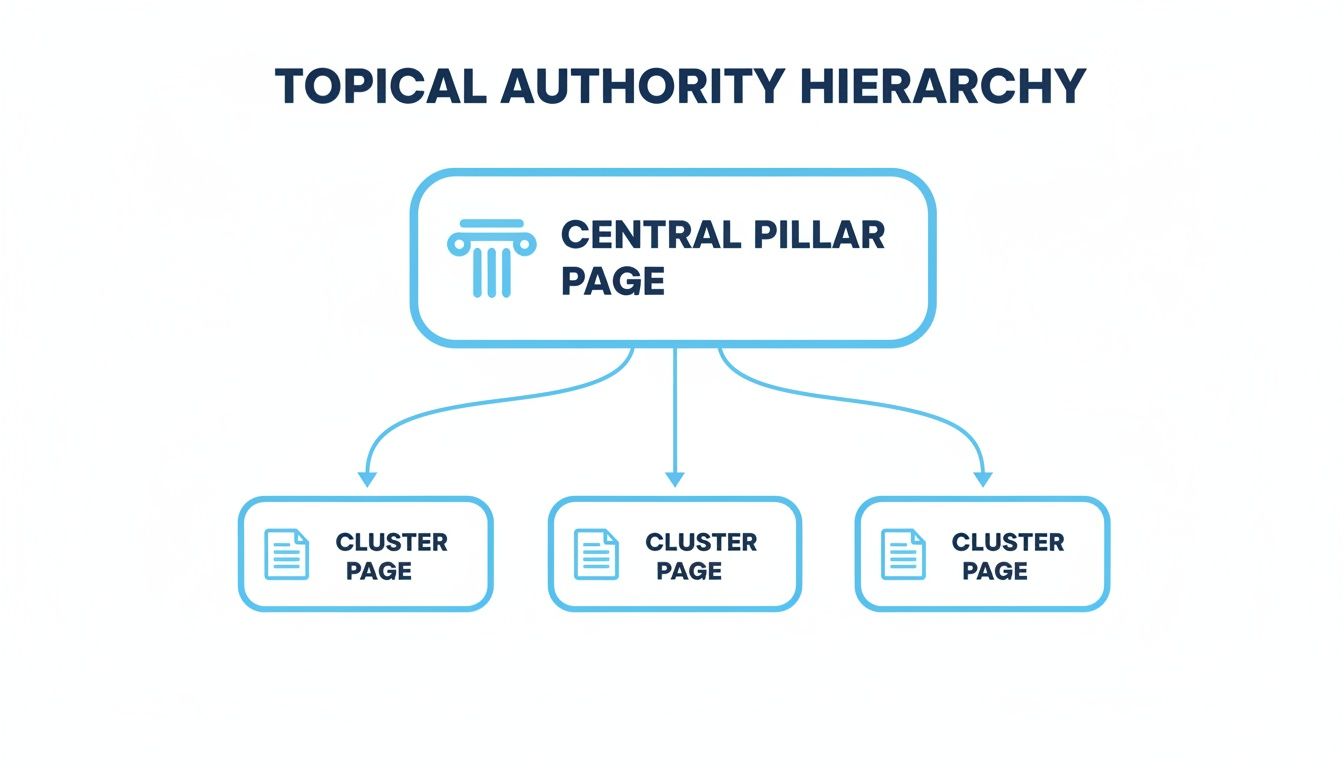
As you can see, by creating a central pillar page and linking it to and from related cluster articles, you build a powerful web of content. This structure signals to search engines that you have deep expertise, which directly boosts the metrics we just discussed and drives more leads.
Your work is still not done. Search results are a moving target. An article that ranked #1 two years ago can easily slip to page two if a competitor publishes something newer and better.
This is why content refreshes are a non-negotiable part of any successful content strategy for an MSP.
A refresh is more than just fixing a typo. It means going back into one of your high-performing posts and updating it with new insights, current data, and expanded sections. This keeps the article valuable for readers and signals to Google that your content is fresh and relevant, protecting your hard-earned rankings.
Do not let your best-performing content go stale. Regularly updating your highest-traffic posts is one of the most efficient SEO tactics you can use to protect your rankings and keep the leads coming in. If you have a post on "Best Cybersecurity Practices" from 2024, a 2026 refresh is the perfect opportunity to add new information on AI-driven phishing attacks or updated compliance requirements.
This cycle of publishing, measuring, and refining is what transforms your blog from a marketing expense into a predictable source of qualified leads. It is how you build an asset that helps your MSP grow consistently.
When it comes to SEO and content, MSP owners often have the same pressing questions. Let's tackle some of the big ones and set some realistic expectations for your content marketing journey.
This is a classic quality vs. quantity debate. My answer is always the same: consistency and quality trump sheer frequency every single time.
It’s far better to publish one truly exceptional, in-depth article per month than to churn out four generic, rushed blog posts. Focus on creating the definitive resource for a specific problem your clients face. That is what builds authority, earns trust, and generates leads. Once you have a system in place, aiming for two well-researched posts per month is a great goal.
I will be straight with you: SEO is a long-term investment, not a quick fix for lead generation. You might see some encouraging signs of traffic within the first few months, but it typically takes a solid 6 to 12 months of consistent, high-quality work to see a reliable flow of qualified leads.
Why so long? It takes time for Google to find your content, understand its value, see how users interact with it, and ultimately decide to rank it for competitive searches that business owners are using. The work you do today builds an asset that will pay dividends for years.
Tempting, right? But while AI is a fantastic tool, letting it do all the work is a recipe for bland, ineffective content that will not connect with your ideal clients. The smart play is using AI as a writing assistant. It’s brilliant for generating first drafts, brainstorming topics, and polishing your prose.
Where AI falls flat is in replicating your MSP’s hard-won experience. It cannot share a story about a specific client save, a unique security challenge you solved, or the nuances of your local market. That is your secret sauce. Use AI for the initial research and drafting, then have your human experts inject those irreplaceable stories and insights that will actually resonate with a potential client.
Ready to turn your website into a lead generation machine that works around the clock? The team at MSP SEO Agency specializes in creating and executing SEO strategies that get results for managed service providers.
Book a discovery call with us today to learn how we can help you dominate your local market and scale your MSP.
See how targeted SEO delivers measurable impact for managed service providers. Explore our proven strategies and real-world outcomes.