
Optimizing for voice search is all about creating conversational content that directly answers your clients' questions, making sure your website is technically sound, and owning local search with a well-maintained Google Business Profile. When you nail this approach, your MSP becomes the go-to answer for voice assistants like Siri and Google Assistant.

Picture this: a potential client is driving and asks their phone, "Find the best MSP near me for cybersecurity services." This isn't a futuristic scenario. It’s how high-value leads are finding IT partners right now. We're seeing a fundamental shift in how people search, moving from short keywords to full, spoken questions.
For MSPs, this change is a huge opportunity. When someone asks a full question, their intent is clear. They have a specific problem and are actively looking for a solution. Answering that question puts your firm directly in their path at the exact moment of need.
Voice assistants like Siri, Alexa, and Google Assistant are designed to give a single, definitive answer. They pull that answer from what SEO professionals call "Position Zero," also known as the featured snippet. It's that highlighted box at the top of Google's search results that offers a direct response to a query.
Winning at voice search means you have to aim for those featured snippets. Google sources this information from websites that provide clear, concise, and well-structured answers to common questions. When your site becomes the source for these snippets, your MSP's name and expertise are literally spoken aloud to potential clients.
This gives you an incredible edge for a few key reasons:
The real conversation isn't just about the upside, it's about the cost of doing nothing. Every time a competitor's website is read aloud by a voice assistant, you've just lost a potential lead. This is especially critical for local services, which is the bread and butter for most MSPs.
That casual, spoken query could be the difference between landing a high-value client or watching them go to a competitor. Over 58% of voice searches are for local business information, which makes optimizing for "near me" searches essential. You can dig deeper into voice search trends for local businesses on Improvado.io.
Inaction is a decision. If your digital strategy doesn't include a plan for voice search, you are effectively handing over leads to the MSPs in your area who are already adapting.
This guide is your playbook for making sure your MSP is the one getting found. We'll walk through the technical foundations, content strategies, and local optimization tactics you need to turn spoken questions into a steady stream of high-quality leads.

Before your content can be read aloud by Siri, search engines need to find and understand it without any friction. This is where technical SEO comes in. Think of it as the engine under the hood. It’s what powers your voice search success by ensuring your website is fast, accessible, and speaks the language of search engines.
Voice assistants are impatient and built to deliver answers instantly. If your site is slow or confusing for a search engine to read, it gets disqualified as a source for a quick, spoken answer. For MSPs, nailing the technical side is the price of entry.
In voice search, speed is everything. When a user asks a question, they expect an immediate response, and search engines are programmed to deliver on that expectation. They heavily favor websites that load in the blink of an eye.
A slow site signals a poor user experience, which takes you out of the running for a top spot. The metrics you need to obsess over are Google's Core Web Vitals. They measure how fast your page loads, how quickly a user can interact with it, and its visual stability. Strong scores here directly improve your shot at being chosen as a voice search answer.
A fast website isn't just a "nice-to-have" anymore. For voice search, it's a fundamental requirement. Every millisecond of load time you can shave off improves your odds.
Let's be real: most voice searches happen on smartphones. People are driving, walking, or multitasking. This makes a flawless mobile experience absolutely critical for capturing voice search traffic.
Google uses mobile-first indexing, which is a technical way of saying it judges your entire website based on its mobile performance. If your site is a pain to navigate on a small screen, with tiny text or buttons that are too close together, it will sink your overall SEO performance.
Your site has to be fully responsive, adapting perfectly to any screen. That way, whether someone sees your result on a phone or a smart display, the experience is clean, professional, and easy to use.
Now for the secret weapon: Schema markup. This is the most powerful technical tool you have for voice search optimization. Schema is code you add to your website that acts like a translator, telling search engines exactly what your content is about. It removes the guesswork.
Instead of Google just seeing a string of text with your address, schema tells it, "This is the physical address of this specific local business." This structured data makes your information much easier for search engines to process and use in featured snippets.
You can dive deeper into how all these elements work together in our complete guide on what is technical SEO.
For an MSP, a few types of schema are especially valuable for voice queries:
By implementing these technical fundamentals, you’re building a foundation that can’t be ignored. You're no longer just hoping Google figures out what you do. You're actively showing it, making your MSP the logical choice for voice answers.
Once your technical SEO is in place, the real work begins. It’s time to focus on what voice assistants actually serve up: your content.
Here’s the thing: people don't talk to Siri in stiff, robotic keywords. They ask real questions, just like they’d ask a colleague. This is the single most important shift you need to make in your content strategy.
Your potential clients aren't typing "cybersecurity MSP Dallas." They’re asking, "Who is the best IT support company near me for a small law firm?" or "How can I protect my business from a ransomware attack?" To show up in those moments, your content has to provide a direct answer.
First, you have to get inside your clients' heads. You need to uncover the exact conversational phrases they're using. The good news is, you don't have to guess.
A goldmine of this data is probably already sitting in your Google Search Console. Dive into the Performance report and look for the queries people are already using to find your site. Pay close attention to the question-based searches. That's your starting point.
Here are a few other places I always look for these conversational gems:
With your list of questions in hand, the next step is building content that answers them head-on. This means creating genuinely helpful, specific resources.
A traditional blog post titled "Our Cybersecurity Services" is far too generic for voice search. It doesn't match a specific question anyone would actually ask.
Instead, reframe that topic into something optimized for a real query, like "How Can I Protect My Small Business From Ransomware?" That title directly mirrors a spoken question and signals to Google that your page has the answer.
This is where understanding user intent is non-negotiable. Someone asking that question is looking for a solution, not a sales pitch. You can get a deeper understanding of this concept by reading our guide on what is search intent.
Organizing your content in a question-and-answer format is one of the most powerful tactics for voice search. When you make your content easy for search engines to parse, you win.
Voice search is changing how MSPs connect with new clients. There are over 1 billion voice searches every month, and as you can see from these voice search statistics on SEOPROFY, nearly 20% of those queries begin with words like "how," "what," or "best." That's the perfect setup for an MSP creating an FAQ page on the best way to secure cloud infrastructure.
When you align your content with how people actually talk, you stop chasing algorithms and start providing answers. That's how you become the go-to authority for qualified leads in your area.

Let's be clear: a massive slice of the voice search pie is local. Potential clients are asking their devices, "find an IT support company near me" or "best cybersecurity services in Dallas." To get in front of these high-intent leads, you have to win the local search game. That battle starts and ends with your Google Business Profile (GBP).
For voice assistants, your GBP listing is your digital storefront. When a user asks a local question, Google Assistant, Siri, and Alexa look to GBP for the most reliable answer. If your profile is incomplete or inaccurate, you’re basically invisible.
Seeing your Google Business Profile as a "set it and forget it" task is a costly mistake. An optimized profile acts as a lead-generation engine, giving voice assistants the exact data they need to recommend your MSP. It builds trust before a prospect even clicks to your site.
Here’s what a rock-solid GBP looks like for an MSP:
Think of your GBP not as a static listing, but as a dynamic asset. The more complete, accurate, and active it is, the more Google trusts it, and the more likely you are to be served as a voice search answer.
Beyond the basics, two GBP features are goldmines for voice search: client reviews and the Questions & Answers section. Both are built on natural, conversational language.
Client reviews are a huge ranking factor. Google sees a steady stream of positive reviews as a strong vote of confidence. Make it a part of your process to ask happy clients for reviews. Just as important: respond to every single one, good or bad. Your replies show you're engaged and give you another chance to include relevant keywords.
The Google Q&A feature is probably the most overlooked tool for voice search. Don't just wait for people to ask questions. Be proactive. Populate this section yourself by asking and answering the most common questions your sales team fields every day.
Put yourself in your prospect's shoes. What would they ask?
By posting these questions and providing sharp, concise answers right on your GBP, you’re building a public-facing FAQ that directly targets voice queries. This strategy lets you intercept local leads before they even check out your competitors.
The ground is shifting. Search isn't just about keywords anymore. Today's search engines, especially those powering voice assistants, are run by AI trying to understand the world just like we do. This is where the idea of an "entity" becomes essential for your MSP.
Simply put, an entity is any distinct thing Google can identify: a person, a place, a brand, or a concept. For your business, this means Google needs to see "Your MSP" not just as text, but as a real-world entity with specific services, a physical location, a solid reputation, and proven expertise.
When a voice assistant gives an answer, it’s not just grabbing a random sentence. It’s pulling information from a source it deeply trusts. The point of building your MSP’s status as an entity is to become that trusted source.
Think of it like building your reputation in your local community. You want to be the firm everyone knows and recommends. Online, this means collecting signals of authority that Google’s AI can piece together. A strong entity presence is how you prepare your MSP for the next wave of search, where being a known, trusted quantity is more valuable than ranking for keywords.
So, how do you actually do this? It boils down to creating a consistent and reputable digital footprint. You have to prove your expertise and legitimacy over and over again, across multiple platforms.
Here are a few strategies you can put into action right away:
A strong entity presence is your ticket to being featured in AI-generated answers and voice search results. When Google is confident about who you are and what you do, it’s far more likely to recommend you.
The real prize here is Position Zero, the featured snippets and knowledge panels that deliver direct answers. Voice assistants pull from these spots almost exclusively. And while 58% of voice searches are for local businesses, securing those positions depends on this entity-building work. You can dig deeper into how voice search rankings work on almcorp.com.
By focusing on these strategies, you’re doing more than just optimizing for today's voice search. You’re future-proofing your MSP’s online presence for a world where AI-driven answers become the standard.
All this work is great, but how do you prove it's actually bringing in new business? You need to connect your efforts to real-world results: more calls, more qualified leads, more revenue. That means cutting through the vanity metrics and focusing on what matters.
The goal isn't just to rank for a few phrases. It's about capturing the high-intent, conversational traffic from people who are actively looking for the services you provide.
Your best friend here is Google Search Console. It gives you a direct look into the exact phrases people are using to find your MSP. Focus on the queries report.
Are you seeing more clicks and impressions for question-based searches like “how much do managed IT services cost” or “best cybersecurity company near me”? A steady climb in these queries is a fantastic sign that your voice search strategy is working.
Here’s exactly what you should be watching:
I get it, this can feel like a lot. To make it easier, I've broken down the process into a simple, actionable checklist. Think of this as your roadmap for turning spoken questions into a consistent stream of leads.
The diagram below brings the whole strategy together. It shows how building brand and authority is the fuel for getting your MSP featured in AI-powered answers, which is where modern search is headed.
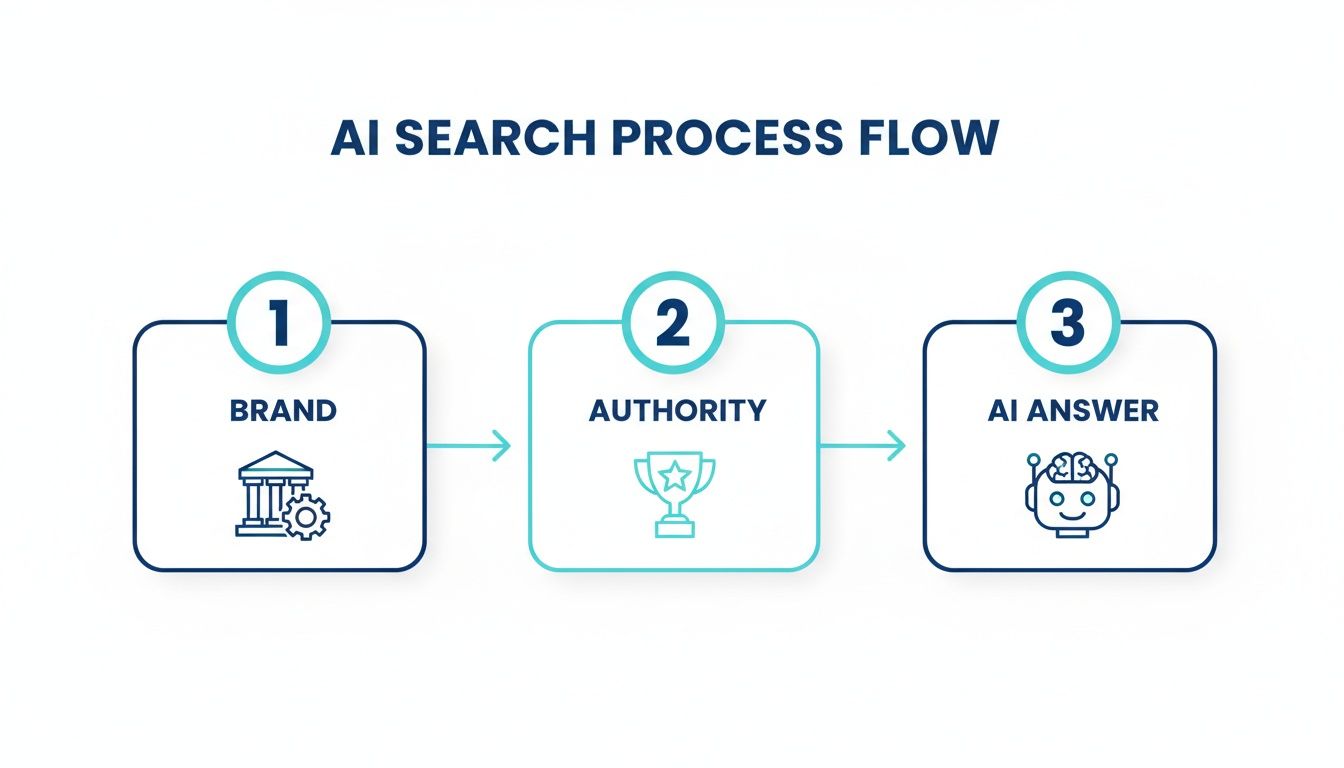
As you can see, a strong brand and deep authority are what get you chosen as the definitive answer. It's a non-negotiable part of the process.
Here’s a quick summary of what to do next:
LocalBusiness, FAQPage, and Service schema markup dialed in. This is how you spoon-feed search engines the info they need.By working through this checklist and watching your metrics, you’ll build a powerful lead generation engine that turns spoken queries into closed deals.
Diving into voice search optimization always brings up a few key questions. As an MSP owner, you need straight answers to decide where to invest your marketing budget. Let's tackle the most common ones.
This is the big one, isn't it? Let's be realistic: voice search SEO is a marathon, not a sprint. You won't flip a switch and have your phone ringing off the hook tomorrow.
You can expect to see early signs of progress, like showing up for more question-based searches, within three to six months. But getting to the point where you're consistently capturing featured snippets and seeing a real bump in calls takes time and consistent effort.
For managed service providers, local is everything. If you do only one thing, make it this: obsess over your Google Business Profile (GBP).
When someone asks Siri for "IT support near me," your GBP is the first place they look. If your name, address, and phone number aren't perfect and consistent everywhere online, you're practically invisible. Keep that profile fresh with new reviews and by answering questions.
For local voice search, your Google Business Profile isn't just part of the strategy. It is the strategy. A neglected profile is the fastest way to get ignored.
It’s a great question because they share the same foundation. The real difference is the intent and the phrasing. Traditional SEO often chases shorter, broader keywords. Voice search optimization is all about answering specific, long-tail questions just like a real person would ask them.
Here’s a simple way to think about it:
The goal shifts to providing a direct, clear answer that a smart speaker can read aloud. This is why things like structured data and FAQ schema become so valuable.
Ready to turn spoken questions into qualified leads for your MSP? At our agency, we build custom SEO strategies that get you found by your ideal clients. Schedule a discovery call with us today to see how we can build a predictable lead flow for your business.
Voice search optimization is becoming an increasingly important component of a complete MSP SEO strategy as more business decision-makers use smart speakers and mobile assistants to research IT solutions. An MSP SEO agency that understands voice search ensures your content is structured to answer conversational queries naturally, which also strengthens your performance in traditional search and AI-powered results. Integrating voice search optimization into your broader MSP SEO services, alongside local SEO for MSP targeting and technical site improvements, positions your managed service provider to capture leads from every channel where prospects are searching for IT support.
See how targeted SEO delivers measurable impact for managed service providers. Explore our proven strategies and real-world outcomes.