If you want to improve your website's rankings, you need a clear, repeatable process. It boils down to three core activities: Audit your site's technical health, Create content that solves client problems, and Build authority in your service area. This framework is what turns SEO from a guessing game into a reliable source of new leads for your MSP.
As an MSP owner, you already know that landing on the first page of Google translates directly to more qualified leads and, ultimately, business growth. The real challenge isn't understanding why SEO matters, but figuring out how to make it work for you.
Too many MSPs get caught up chasing the latest algorithm update or throwing money at random tactics that never deliver. It’s a fast track to wasted budgets and the frustrating conclusion that SEO is a lost cause for technical service businesses.
But here’s the thing: effective SEO isn't about some hidden secret or trying to outsmart Google. It’s about methodically executing a plan built for the way MSPs actually win new clients. You don't need to become an SEO guru overnight, you just need a solid plan to generate leads and scale your business.
The path to better rankings follows a logical sequence. You can’t build a sturdy house on a cracked foundation, and you certainly can't expect content to rank if your website is riddled with technical glitches. It all begins with a thorough look under the hood at your site's current state.
I like to visualize this as a simple, three-part flow:
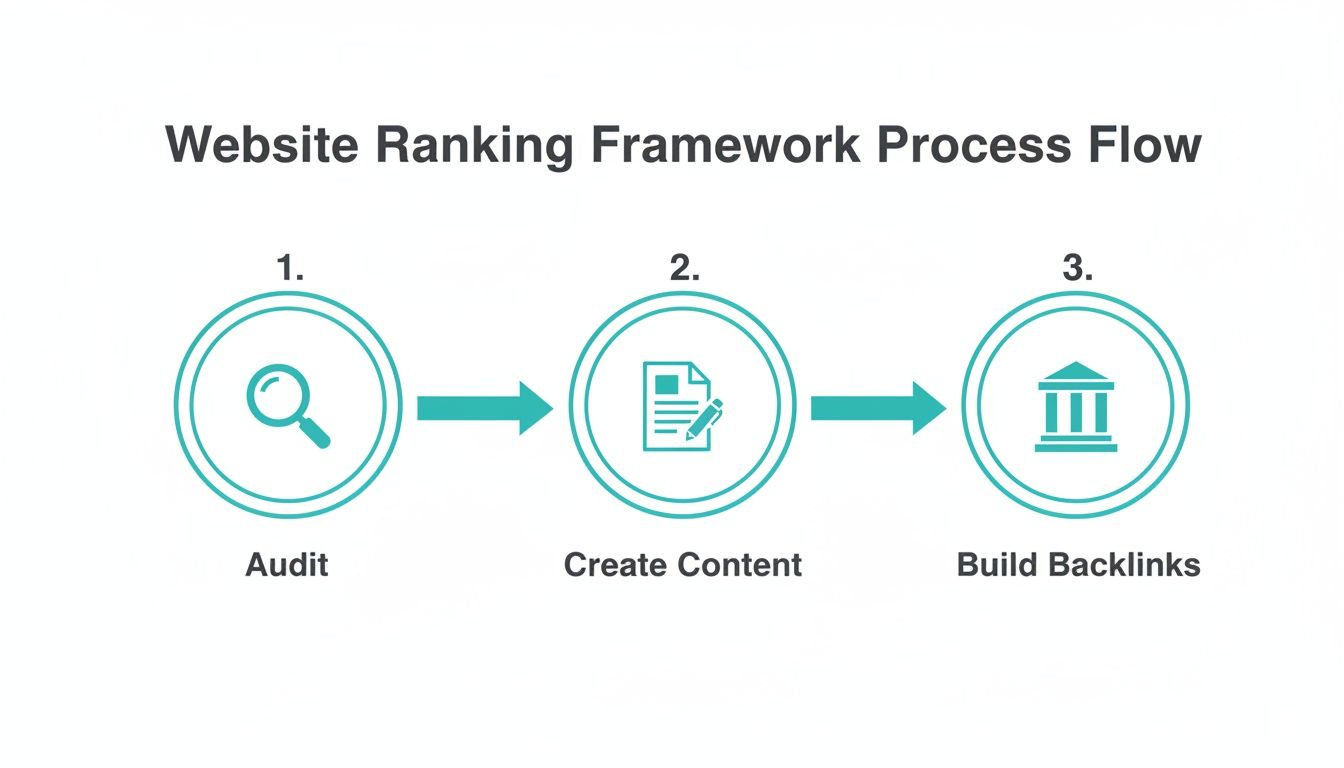
Each stage naturally builds on the one before it. You start with internal fixes (Audit), move to client-facing value (Create), and finish by cementing your position in the market (Build).
This guide is designed to walk you through each of these components, giving you a clear roadmap to follow. We’ll focus on the specific actions that drive the biggest impact for MSPs, making sure your effort is spent where it counts. Let’s dive into the first and most critical step: the foundational technical audit.
Before you even touch content or think about backlinks, you have to get your technical house in order. This is the non-negotiable starting point for any serious MSP SEO campaign. I've seen far too many slick, well-designed MSP websites get kneecapped by hidden technical issues that stop Google cold, killing lead generation before it even starts.
Think of it this way: your website is your digital office. If the front door is jammed and the hallway is a maze, potential clients won't stick around to hear your pitch. A technical SEO audit is how we find and fix those problems, making sure both search engines and people have a seamless experience.
First things first: crawlability. We need to confirm Google can even find and read your pages. This boils down to two critical files: robots.txt and your XML sitemap.
Your robots.txt file is a set of instructions for search engine crawlers, telling them which parts of your site to stay away from. A single misplaced character in this file can accidentally tell Google to ignore your entire website. It happens more often than you'd think.
Next is your XML sitemap. This is a literal roadmap of your site, listing all the important pages you want Google to discover. For an MSP, this means every single service page, location page, and high-value blog post must be on it. If a page isn't on the map, Google might never find it.
A simple gut check is to use a site:yourmspdomain.com search in Google. This command shows you every page Google has indexed for your domain. Are key service pages missing? Are strange, old, or low-value pages showing up? For a deeper dive, check out our guide on how to conduct an SEO audit.
Now, zoom out and look at your site’s overall structure. Is it logical? Can a visitor find what they need in just a couple of clicks? A business owner looking for "managed backup services" shouldn't have to go on a scavenger hunt. A confusing site structure frustrates users and spreads your SEO authority too thin.
A clean, effective hierarchy usually follows this pattern:
This kind of logical flow helps search engines understand which pages are most important, and it gives potential clients a clear path to the exact IT solution they're searching for. A well-structured website isn’t just good for SEO, it’s good for business.
Finally, let's talk about speed. In the IT world, a slow website is a conversion killer. Your prospects are busy professionals, they won't wait for a page that hangs. This is where Google’s Core Web Vitals come in. They are specific, user-centric metrics that measure your site's loading performance, interactivity, and visual stability.
This isn't just technical fluff, it directly impacts your bottom line. Google has confirmed that optimizing for these metrics is a ranking factor precisely because it’s so critical to user experience. The data is stark: bounce rates jump by 9% when a page takes just 2 seconds to load and skyrocket to 38% at 5 seconds. Every second you shave off your load time is another chance to keep a potential client on your site.
For MSPs, where trust and professionalism are everything, this is non-negotiable. With 53.3% of all website traffic coming from organic search, a fast site is a massive competitive advantage. You can use Google’s free PageSpeed Insights tool to get a full report.

Once your site’s technical foundation is solid, it's time to focus on the words on the page. For any MSP or cybersecurity firm, your content has to pull double duty. It needs to rank well in search engines and, more importantly, convince a potential client that you are the solution to their business problems.
Think about it from your client's perspective. They aren't just typing "IT services" into Google. They're searching for answers to urgent issues like "how to prevent ransomware" or "best cloud backup for small business." Your service pages must meet them at that exact point of need, turning a simple search into a qualified sales conversation.
This is exactly where I see many MSPs stumble. They build generic pages listing services but fail to connect with the real-world pain points driving a business owner to seek help. Your content needs to be your best digital salesperson, working around the clock to attract and convert leads.
Your first impression happens on the search results page. Think of your meta title and meta description as your digital billboard on Google. You could be ranking number one, but a bland title will get you scrolled right past.
The trick is to blend your target keyword with a compelling, benefit-driven message. Instead of a generic title like "Cybersecurity Services," get specific and action-oriented. A much better title addresses a direct need and builds immediate trust.
A great meta description then seals the deal, summarizing your value proposition and including a clear call to action. This one-two punch is crucial for boosting your click-through rate, a key signal that tells Google your page is a valuable result.
Let's look at a couple of real-world examples for an MSP targeting local businesses:
Weak Title: Managed IT Services
Strong Title: Proactive Managed IT Services in [City] | Boost Uptime & Security
Weak Description: We offer IT support and services.
Strong Description: Stop worrying about IT. Our flat-rate managed services for [City] businesses prevent problems before they start. Get your free IT assessment today!
Okay, so they clicked through. Now what? Your page structure has to guide them smoothly toward a solution. Huge walls of text are absolute conversion killers.
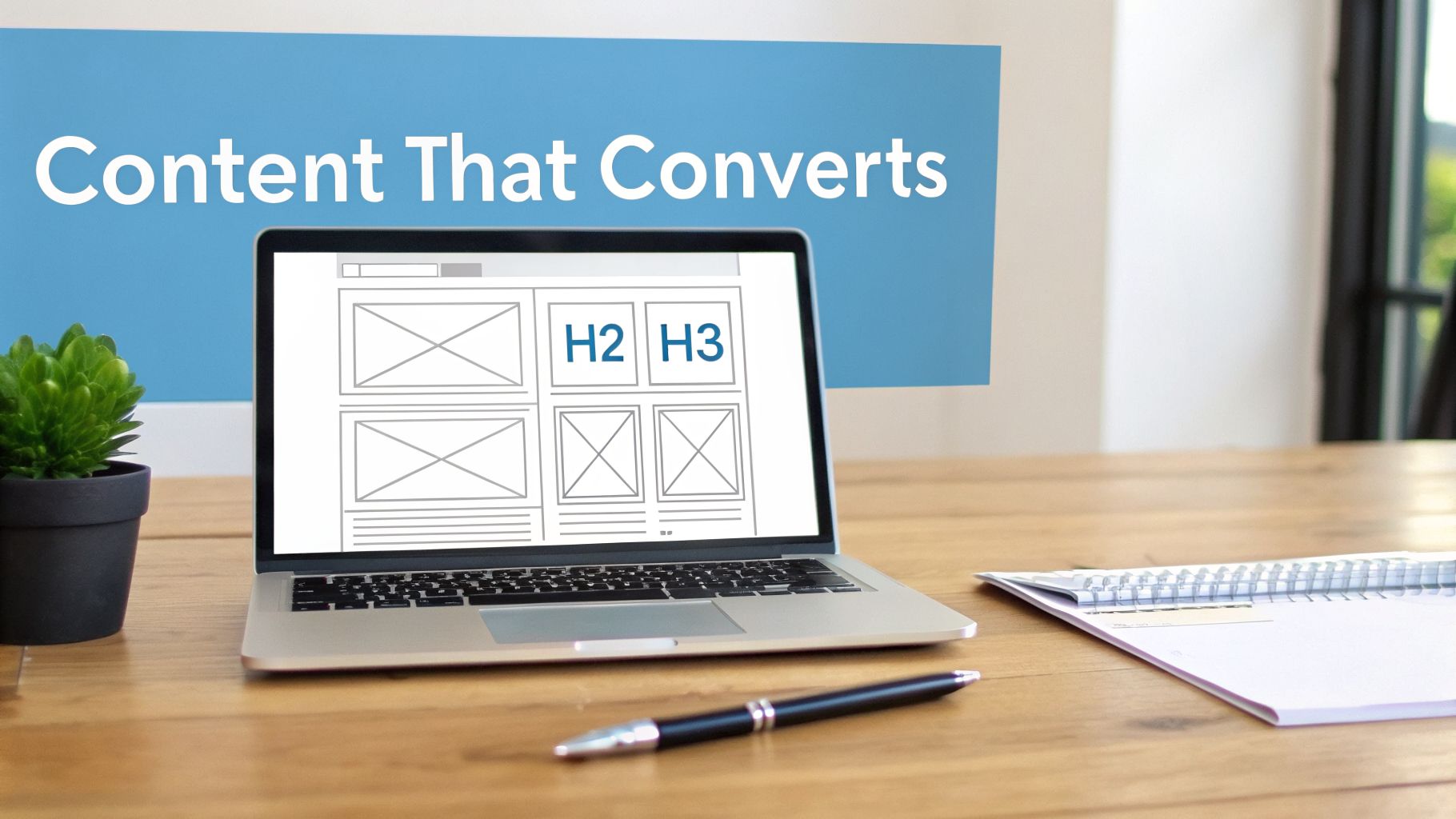
Using clear headings (H2s and H3s) is non-negotiable. It breaks up your content, making it easily scannable for busy decision-makers while also giving search engines a clear roadmap of your page's topics.
Your main page title (H1) should state the service, plain and simple. Use H2s for the major benefits or components of that service. Then, you can use H3s to drill down into specific features or answer common questions. This creates a logical flow that answers a visitor's questions as they move down the page.
A well-structured page mirrors a good sales conversation. You start with the main problem, discuss the solution, address specific concerns, and then guide the prospect toward the next step. To get this right, you need to know what content is already working. A great starting point is performing an SEO content audit.
Finally, let's talk about a powerful tool most MSPs overlook: structured data, often called schema markup. This is code you add to your website that gives search engines explicit, detailed information about your services. You're translating your page content into a language Google understands perfectly.
By adding service schema, you can tell Google things like:
Why does this matter? Because it helps you earn rich snippets in search results. These are enhanced listings that might show star ratings or FAQs directly on the search page. For an MSP, this is a massive competitive advantage. It makes your listing more prominent, builds instant credibility, and helps you stand out from a sea of plain blue links.
You’ve gotten your technical SEO in order and created solid, expert-driven content. Now it’s time to show Google you're a real authority. In the world of search engines, authority is just another word for trust and credibility, and it's something you have to earn.
For an MSP, earning that authority comes down to two things: building backlinks from other respected players in the tech space and dominating local SEO to own your service area. One proves your industry expertise, while the other puts you directly in front of local clients who need you right now.
Think of it this way: high-quality backlinks tell Google you're a recognized voice in the national IT conversation. At the same time, a sharp local SEO strategy ensures that when a business owner in your town has an emergency, your MSP is the first one they find.
Let's get one thing straight: the old days of hoarding hundreds of low-quality links are long gone. That strategy is more likely to get you penalized than ranked. Today, the game is all about earning a handful of highly relevant, authoritative links.
A single backlink from a major tech publication, a cybersecurity blog your clients read, or a key vendor partner is infinitely more valuable than 100 links from generic online directories. These are powerful endorsements, signaling to search engines that your expertise is valued by others. For more details on ranking factors, you can check out this article on search ranking factors on Linkbuilding HQ.
So, how do you land these game-changing links?
While backlinks build your broad authority, local SEO is what brings in immediate, ready-to-buy leads. When a local business has a network meltdown, they aren't looking for a national provider. They're on their phone searching for "IT support near me" or "managed services provider in [Your City]."
For most MSPs, local search is the primary battleground. Dominating your service area is one of the most direct ways to turn your website into a consistent lead-generation engine. This is where your Google Business Profile (GBP) becomes your single most important digital asset.
An incomplete GBP sends a message of unprofessionalism. It's the digital equivalent of a flickering sign. Treat it with the same attention you give your website.
Here’s what a rock-solid profile must include:
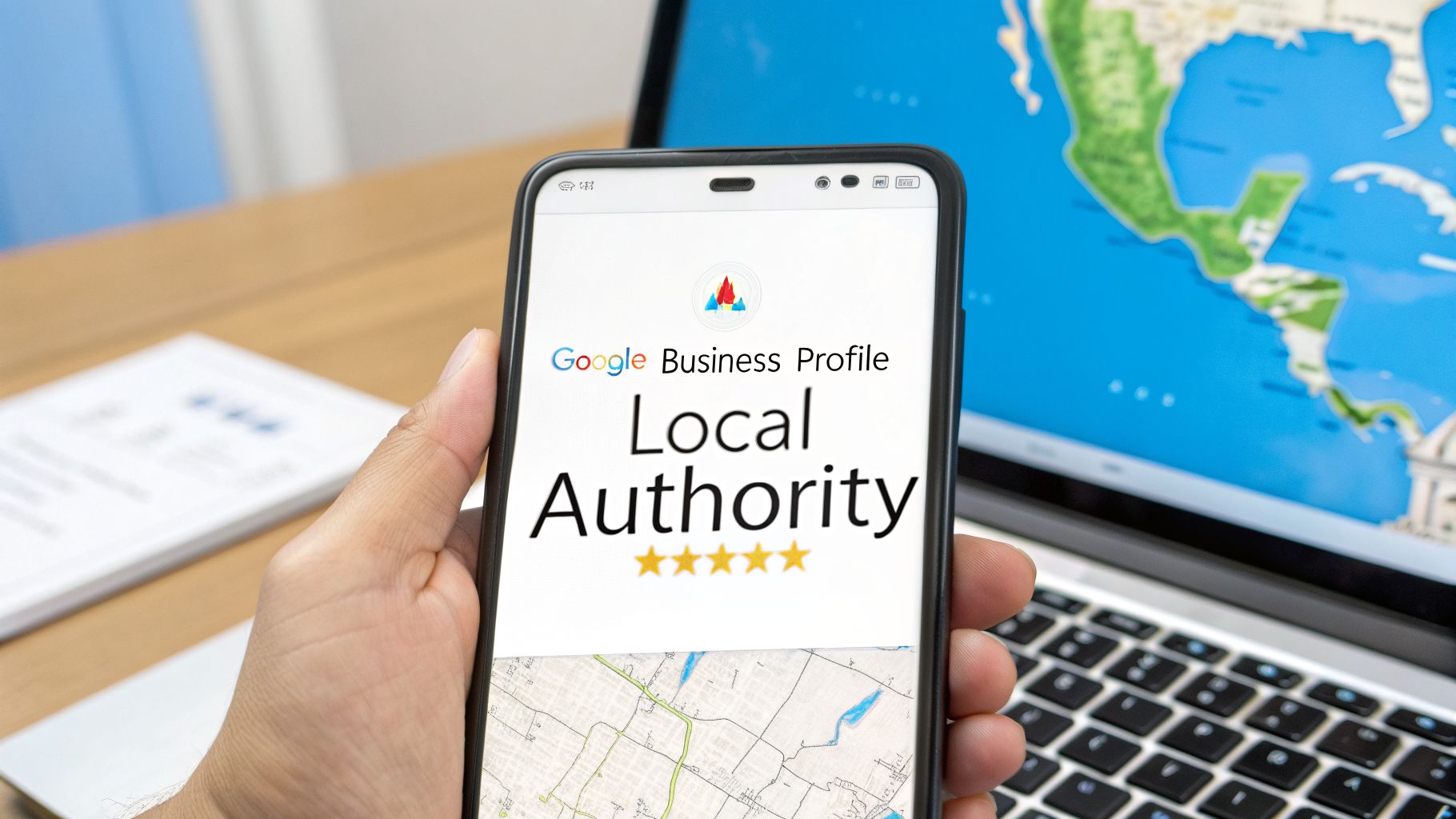
The way your future clients look for IT services is changing. Fast. Tools like Google’s AI Overviews are now generating direct answers right at the top of the search results. For any MSP that wants to stay ahead, ignoring this massive shift simply isn't an option.
This new reality means we need to think beyond traditional SEO. It's time to embrace what's called Answer Engine Optimization (AEO). The objective isn't just about ranking number one anymore, it's about becoming the trusted, citable source for those AI-generated answers. This is where your deep, real-world expertise becomes your most powerful marketing tool.
The entire game of AEO centers on Google's E-E-A-T framework: Experience, Expertise, Authoritativeness, and Trustworthiness. In plain English, AI is programmed to pull its answers from sources that are undeniably credible and have proven, hands-on experience. For an MSP, this is a golden opportunity.
You already have the expertise. The real work is showcasing it on your website in a way that search engines can easily understand and trust. When an AI model is tasked with answering a query like, "What's the best way to secure remote employee devices?", it scours the web for content that's clear, factual, and written by a legitimate authority.
Becoming a trusted source for AI isn't about some new-age algorithm trick. It's about communicating your deep, hands-on knowledge so clearly that both a human business owner and an AI model can understand and rely on it. You need to create content that puts your specialized knowledge on display.
Here's the interesting part: optimizing for AI actually forces you to create more human content. The key is to write for people first, because AI is trained to reward content that is genuinely helpful and easy to follow.
Think about the specific, practical questions your clients ask you every single day. Those are the exact phrases other business owners are typing into Google and asking AI assistants. Your entire content strategy should revolve around answering them.
Here are a few content formats that work exceptionally well:
This approach positions you as a helpful expert and makes your content a prime candidate for being featured in an AI-generated summary. This principle is a lot like what we covered in our guide on how to optimize for featured snippets.
The way you structure your content is just as critical as what you write. AI models prefer information that is logically organized and dead simple to parse. This is where clear headings, bullet points, and short, concise paragraphs become essential.
Always start your articles by directly addressing the user's primary question. Use subheadings (H2s and H3s) to break the topic down into logical sections. Use bullet points or numbered lists to present steps or benefits in a format that's easy to scan. This serves your human readers better and also makes it incredibly easy for AI to extract key information.
The data shows why this is non-negotiable. Nearly 60% of searches now end with zero clicks because the user gets their answer directly from the search results page. Being the cited source in that answer is the new goal. Sites cited in AI Overviews can see a significant boost in clicks, and you can find more of these insights into AI SEO statistics on semrush.com.
Even with a solid playbook, you probably still have some questions about what SEO really looks like for a Managed Service Provider. Let’s get straight to the point and tackle the most common ones we hear from MSP owners every day.
These are the practical, bottom-line questions that come up when you're deciding where to put your marketing dollars to actually grow your business.
This is always the first question, and the honest answer is that SEO is a marathon, not a sprint. It’s a long-term strategy. While you can often spot some small, encouraging wins within 3 to 4 months, especially after clearing up technical site problems, the real, lasting impact takes time.
Significant, business-driving results, like a steady stream of qualified inbound leads, typically require 6 to 12 months of consistent, focused effort. Sustainable growth is built on a foundation of continuous content creation and methodical authority-building over time.
It's easy to get lost in a sea of data. My advice? Focus on the metrics that directly tie back to business growth, not vanity numbers. Chasing rankings for keywords that don’t bring in clients is a classic mistake and a huge waste of resources.
For any MSP, these are the key performance indicators you should be watching:
Don't get fixated on broad traffic numbers alone. A small increase in converting traffic from a specific, high-intent search term is far more valuable than a massive jump in traffic from irrelevant queries.
For almost every single Managed Service Provider out there, the answer is clear: local SEO should be your top priority. Your best clients are businesses located within a specific service area. Trying to compete on a national level for generic IT terms is incredibly difficult and, for an MSP, rarely profitable.
Winning is all about dominating your local search results. When a business owner in your town searches for "IT support near me," you absolutely need to be the first and most credible name they see. This targeted approach delivers a much higher and faster return on your investment. Focusing on your local market is the most direct path to improve website rankings for the searches that actually generate leads.
Ready to stop guessing and start building a predictable lead generation engine with SEO? We help Managed Service Providers build custom SEO programs designed to make you the go-to IT authority in your service area. If you want a strategy to get more leads and scale your MSP, let's talk. Schedule your free consultation with us today.
See how targeted SEO delivers measurable impact for managed service providers. Explore our proven strategies and real-world outcomes.