

At its core, Google Tag Manager consulting is all about getting expert help to properly set up and manage the web of tracking codes on your website. For a growing MSP, it’s the key to unlocking full control over your marketing analytics.
This means no more bugging a developer for every small change, giving you the power to accurately measure which marketing efforts are actually bringing in qualified leads.

Let's get right to it. Think of Google Tag Manager (GTM) as a central command center for all your website’s tracking scripts, or "tags." It’s a single dashboard where you can add, edit, and manage everything from your LinkedIn Insight Tag to your Google Ads conversion pixels.
For a Managed Service Provider, this kind of agility is a massive advantage. Instead of waiting weeks for a developer to deploy a new tracking code, you can do it yourself in minutes. This speed puts you in the driver's seat, allowing you to react quickly to new opportunities and measure campaign performance from day one.
To put it in perspective, let’s look at the common headaches GTM solves.
| Problem Without GTM | Solution With GTM |
|---|---|
| Developer Dependency: Marketing needs a developer to add or update any tracking code, causing delays. | Marketing Autonomy: The marketing team can manage tags independently, freeing up developers for critical work. |
| Slow Website: Dozens of individual scripts hard:coded into the site can drastically slow down page load times. | Improved Performance: All scripts are managed in one "container," which can improve site speed, a huge win for SEO. |
| Data Chaos: It's difficult to know what scripts are running, where they came from, or if they're even working. | Centralized Control: A clear, unified dashboard shows every tag on your site, boosting security and organization. |
| Inaccurate Tracking: Scripts can break or conflict with each other, leading to unreliable marketing data. | Reliable Data: Built:in testing and version control ensure your tracking is consistent and accurate. |
Simply put, GTM gives you a clean, organized, and powerful way to handle your marketing tech stack.
Without a tool like GTM, your website's code can quickly become a tangled mess of tracking scripts. Each new marketing platform adds another snippet directly to your site's backend, which not only slows it down but also creates endless opportunities for things to break.
GTM fixes this by acting as a single, lightweight container. You install just one GTM snippet on your site, and every other tag is managed inside the GTM interface. This is a game:changer.
The industry has certainly taken notice. Google Tag Manager is used by 48.1% of all websites and holds a staggering 95% market share in the tag management space. For MSPs, this means GTM isn't just another tool, it's the undisputed standard for managing the technical side of digital marketing.
A well:managed GTM container is the foundation of a data:driven marketing strategy. It's the difference between guessing what works and knowing what drives qualified leads for your managed services.
Ultimately, mastering GTM is about gaining clarity. It empowers you to precisely track every valuable action a potential client takes, from downloading a cybersecurity whitepaper to submitting a "Request a Quote" form. This data is the key to proving marketing ROI and making smart decisions that fuel predictable growth. It’s a foundational piece of a much larger puzzle, working hand-in-hand with disciplines like those in our guide on what is technical SEO.

It’s a fair question: How does a behind-the-scenes tool like Google Tag Manager actually help you sign more clients? On the surface, GTM seems like a purely technical utility. But in reality, its impact on your MSP’s growth, from lead generation to search rankings, is direct and powerful.
A professionally configured GTM account is an MSP’s secret weapon for SEO. The most immediate win is a faster website. Instead of having countless individual tracking scripts bogging down your site, GTM neatly bundles them into a single, efficient request.
This one change can dramatically improve your page load times, which directly impacts your Core Web Vitals. Since Google uses these speed scores as a major ranking factor, a faster website almost always translates to better visibility in search results.
Standard website analytics tells you how many people showed up. That’s a start, but it doesn't tell you what they actually did. This is where a proper GTM implementation completely changes the game for an MSP.
With GTM, you can track the specific actions that signal a high-quality lead is browsing your site. Think of it as placing a tiny sensor on every critical button, form, and link. A Google Tag Manager consulting expert helps you set up tracking for the events that truly matter to your business.
Suddenly, you can get concrete answers to your most important questions:
This depth of insight moves you from guessing to knowing. It gives you hard data on which marketing channels and content are attracting your ideal clients, not just generating empty traffic. For more ideas on what to track, check out our guide on how to track SEO performance.
Inaccurate data leads to bad decisions, period. A common issue we see with MSP websites is "tag spaghetti," a tangled mess of old, broken, or duplicate tracking codes that make analytics reports completely unreliable. A GTM consultant’s first order of business is to untangle that mess, ensuring the data you base decisions on is clean and correct.
A clean GTM container means you can trust your numbers. When your data shows a campaign is working, you can confidently double down on that investment to generate even more leads.
This obsession with clean data is more critical than ever. The latest evolution, Server:Side Google Tag Manager, boosts site speed even further by moving scripts off the user's browser and onto your own cloud server. This also strengthens your first:party data collection, a crucial adaptation as privacy regulations continue to tighten.
At the end of the day, the biggest win from a well:managed GTM setup is the ability to prove marketing’s value. When you can accurately trace a new client's journey from a Google search to a form submission and, finally, to a signed contract in your CRM, the entire sales funnel becomes crystal clear.
This end:to:end visibility lets you calculate a precise Return on Investment (ROI) for every single marketing campaign. You’ll finally know exactly what it costs to acquire a new managed services client through your SEO efforts, paid ads, or content marketing.
This data:driven clarity allows you to stop wasting money and start investing intelligently, putting your budget where it will produce the most predictable growth. It’s how you transform marketing from a cost center into a reliable engine for your business.
Bringing in a consultant to handle your Google Tag Manager setup shouldn't feel like you’re handing over the keys without knowing where the car is going. As an MSP owner, you need to feel confident in your investment. A proper GTM engagement isn't a one:off fix; it's a structured project designed to bring order to your marketing data chaos.
This isn’t about just installing some code. It’s a collaborative process to build a reliable analytics foundation you can actually use for growth. Let's pull back the curtain on what a typical project looks like from start to finish.
Everything starts with a deep dive into what you already have. The first order of business is a technical audit of your website and your current GTM container, assuming one exists. This is more than a quick look: it's a meticulous check:up to find out what’s working, what's broken, and what’s causing you to miss out on valuable data.
During this phase, a good consultant is hunting for common problems that plague MSP websites, like:
This audit provides a clear, documented baseline of every issue. It’s the starting point for building a clean, dependable analytics system.
With the technical cleanup mapped out, the focus shifts to strategy. Honestly, this is the most important part of any Google Tag Manager consulting project. Here, the consultant works directly with you to create a measurement plan.
Think of this document as the architectural blueprint for your entire analytics system. It’s what connects your MSP’s business goals to the specific data points you'll be collecting.
A measurement plan answers one simple but powerful question: "What actions on our website tell us that our marketing is actually generating qualified leads for our core services?"
This plan outlines every single user interaction you need to track, from a prospect clicking the "Request a Quote" button to them downloading a whitepaper on your vCIO services. It defines exactly what a "conversion" means for your business, getting your entire team on the same page. A solid measurement plan is how you turn a simple website into a powerful lead-generation engine, capable of producing the kind of results seen in case studies focused on scaling MSP online visibility.
Once the blueprint is approved, the hands:on work begins. The consultant gets into your GTM container and starts methodically building out the strategy. This is a precise, multi:step process.
First, they’ll put in the foundational tags. This means properly setting up Google Analytics 4, the Google Ads conversion linker, and essential social media pixels like the LinkedIn Insight Tag.
Next comes the custom event tracking based on your measurement plan. This is where the real value is created. The consultant will build out specific triggers and tags to monitor every interaction that matters to you, including:
Finally, they’ll handle the crucial integrations. For most MSPs, a game:changer is connecting website data directly into their CRM. This vital link lets you see the full customer journey, from their very first click on an ad all the way to becoming a paying client, giving you a true, accurate cost:per:acquisition.
So, you’re thinking about bringing in a Google Tag Manager consultant. How do you actually measure the return on that investment? It all comes down to two things: the concrete assets you get back and the clear performance metrics that show your marketing is now running on all cylinders.
A proper GTM engagement isn't about fuzzy promises of "better data." It's about getting specific, documented resources that empower your team and seeing measurable upticks in performance. You should be able to draw a straight line from the project to your MSP’s pipeline.
This process isn't random; it follows a proven, three:step path. A good consultant will always start with a deep:dive audit, move to strategic planning, and finish with hands:on implementation.
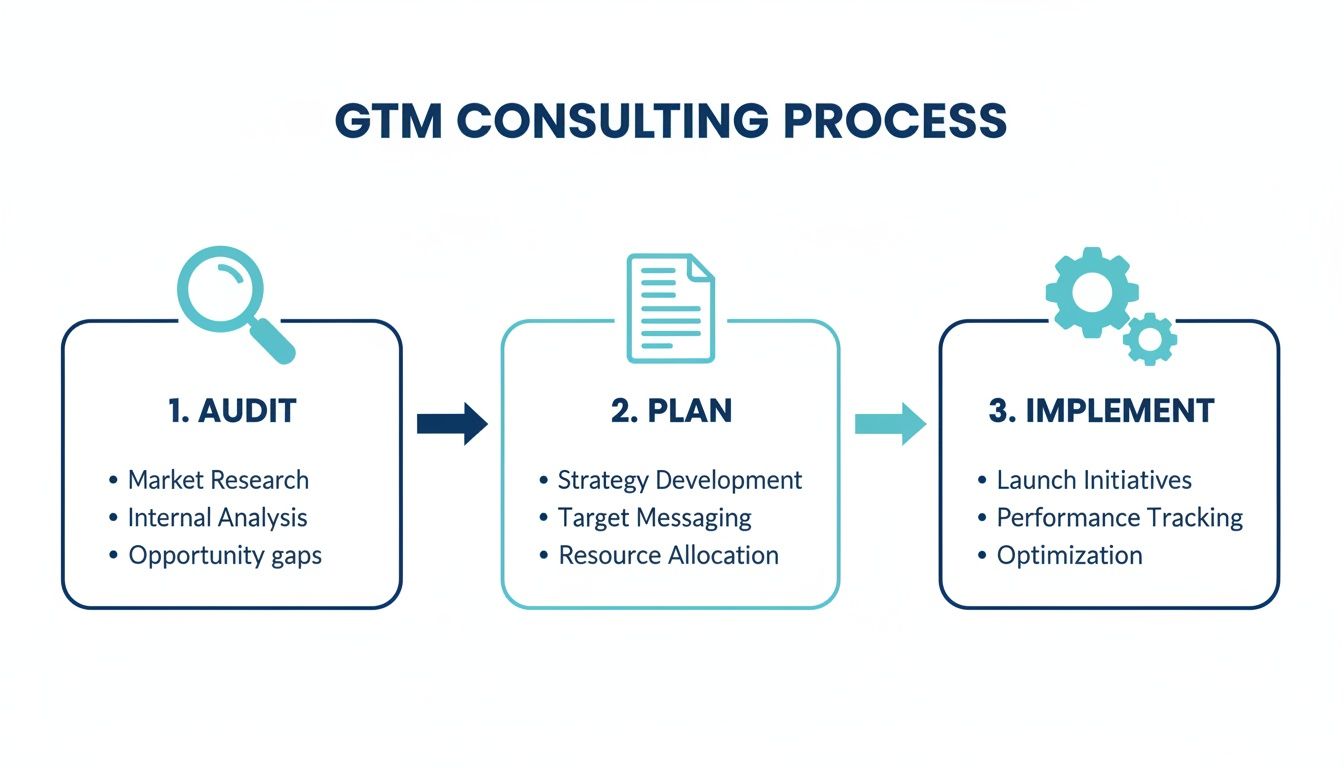
This structured approach is non-negotiable. It ensures every tag and trigger is built on a solid foundation, giving you a clean, effective, and future:proof setup.
When the project wraps up, what should you have in your hands? The deliverables are the tangible proof of work: the assets you’ll own and use to manage your analytics from here on out.
Here’s what you should expect from any GTM consultant worth their salt:
A GTM consulting project shouldn’t end with a final invoice. It should leave your team armed with clean data and the clarity to make smarter marketing decisions immediately.
The table below outlines what these deliverables look like in practice and how their success is measured, tying every technical output directly to a business result for your MSP.
| Deliverable | Success KPI | Business Impact |
|---|---|---|
| GTM Audit Report | 95%+ of rogue/broken tags identified and flagged for removal. | Immediate improvement in site speed and a stronger security posture. |
| Measurement Plan | 100% of primary business goals mapped to specific trackable events. | Ensures all data collected is actionable and aligned with revenue goals. |
| Configured GTM Container | GTM container passes all validation tests (e.g., Google Tag Assistant). | Reliable, accurate data collection that you can trust for decision:making. |
| Custom Analytics Dashboard | Reduction in time:to:insight from hours to minutes for the marketing team. | Faster, data:backed decisions on budget allocation and campaign optimization. |
| Team Training & Hand-off | Team can independently add or modify basic tags post-project. | Reduces long:term reliance on consultants and builds in:house capability. |
Ultimately, these deliverables work together to give you a system that not only works but is also manageable for the long haul.
With your new, clean setup running, how do you prove it’s working? The right Key Performance Indicators (KPIs) will show you precisely how the project is paying off. We’re not just tracking random metrics; we're measuring real:world results.
A GTM project should deliver tangible wins in both your website's performance and your business intelligence. Here’s what to watch:
Let's be honest, not all consultants are created equal. Hiring the wrong partner for your Google Tag Manager setup can quickly turn into a nightmare of bad data and messy code: a costly mistake that you'll end up paying someone else to fix down the line.
You're not just looking for someone who can install a few tags. You need a genuine expert who sees GTM for what it is: the foundation of a strategic measurement system. So, how do you spot the real deal? Here are the critical questions to ask any potential Google Tag Manager consulting partner to make sure they’re the right fit for your MSP.
First things first: do they actually understand your business? A generalist marketer might be a GTM whiz, but what do they know about vCIOs, SOC 2 compliance, or the nuances of selling a managed security service? If a consultant can't grasp the fundamentals of your MSP or cybersecurity firm, they can't possibly build a tracking system that measures what really drives your growth.
You need to ask them directly about their experience with B2B technology companies, especially in the managed services or cybersecurity space. A true expert will immediately start talking about business outcomes, not just vanity metrics.
A consultant obsessed with "page views" or "time on site" is a huge red flag for an MSP. The right partner will pivot the conversation to tracking demo requests, form fills for service guides, and other high:intent, bottom:of:the:funnel actions.
This is the question that separates the strategists from the button:pushers. A weak consultant will be eager to jump straight into your GTM container and start tinkering. A great consultant, on the other hand, will insist on developing a strategic measurement plan before a single tag is touched.
Ask them to walk you through their process, step-by-step. They should describe a collaborative effort, one where they partner with you to:
If their answer is a vague "we'll get in there and clean things up," they lack the strategic mindset you need. A documented plan isn't a nice-to-have; it's non-negotiable.
The world of digital analytics is in constant motion. You need a partner who isn’t just managing today’s setup but is actively looking around the corner for what’s next. Test their forward:thinking by asking about two crucial topics: server:side tagging and data privacy.
Server:side GTM is quickly becoming the gold standard for improving data accuracy and site performance. A knowledgeable consultant should be able to break down its benefits in plain English and advise you on when (and if) it makes sense for your MSP to make the switch.
Likewise, they need to be an expert on data privacy. Ask them how they ensure compliance and what their strategy is for a future with fewer third:party cookies. Their responses will tell you everything you need to know about their depth of expertise. Finding a Google Tag Manager consulting firm that is prepared for the future ensures you have a partner you can grow with for years to come.
Before you invest in any new service, you need straight answers. We get it. If you're an MSP owner exploring Google Tag Manager consulting, you probably have some of the same questions we hear all the time. Let's tackle them head:on.
There's no single answer here, as it really comes down to what we're working with. For a smaller MSP with a clean, straightforward website, we might only need a week or two to get everything audited, cleaned up, and running smoothly.
On the other hand, if your site is larger, has a tangled mess of old tags in its existing GTM container, or needs complex tracking for a CRM integration, expect the project to take a month or more. That initial audit is what allows us to give you a firm, realistic timeline.
You can definitely get your feet wet with GTM on your own. Setting up a basic tag to fire Google Analytics is fairly simple, and there are tons of tutorials out there that cover the basics.
The real challenge isn’t starting, it’s mastering. Moving beyond simple pageview tracking to build a sophisticated measurement strategy that accurately captures lead form submissions, button clicks, and user journeys is where the complexity skyrockets. This is precisely where an experienced consultant earns their keep. They navigate the advanced setups that prevent data errors, ensuring your analytics foundation is both reliable and built to grow with your business.
This is a classic point of confusion, but the distinction is critical. The two platforms are partners, each with a very different job.
Google Tag Manager (GTM) is the toolbox. It’s a container that holds all your tracking codes (tags) and lets you deploy them on your site without having to constantly bother your web developer.
Google Analytics (GA4) is the reporting dashboard. It's the destination where all the data collected by your tags gets sent, organized, and analyzed.
Here’s a simple analogy: GTM is the delivery truck that you load up with packages (your data). Google Analytics is the warehouse where those packages arrive, get sorted, and are put on shelves so you can see what you have.
The cost of Google Tag Manager consulting can range quite a bit depending on the project's depth. A one:off audit to diagnose problems and perform a basic cleanup might run a few thousand dollars.
A comprehensive engagement that includes crafting a full measurement plan, implementing dozens of new tags, and building custom performance dashboards will naturally be a larger investment. Most consultants offer either project:based pricing or a monthly retainer for ongoing support. The real question is how to weigh that cost against the immense value of having accurate data that finally allows you to calculate the true ROI of your marketing spend.
Ready to stop guessing and start making data-driven decisions that fuel predictable growth for your MSP? At MSP SEO Agency, we build the analytics foundation you need to measure what matters and prove your marketing ROI. Contact us today for a full consultation.
See how targeted SEO delivers measurable impact for managed service providers. Explore our proven strategies and real-world outcomes.