

At its core, structured data is a standardized format of code you add to your website. It’s designed to do one thing very well: translate your website’s content into a language that search engines like Google and AI assistants can immediately understand.
Think of it as giving Google a cheat sheet for your MSP, so it does not have to guess what you are all about.

Imagine your website is a highly detailed business proposal. Without structured data, you are handing that entire document to a search engine and asking it to read every word to figure out what you do. It’s slow, and the machine might misinterpret key details.
Now, imagine attaching a one-page executive summary to the front. This summary has perfectly labeled sections: "Services Offered," "Service Area," "Client Ratings," and "Contact Info." That’s exactly what structured data does.
For an MSP owner, this is not just a bit of technical housekeeping; it is a direct pipeline to better leads. When a CFO in your city searches for "managed cybersecurity services," Google does not just see another IT company. It sees a clear, organized profile confirming you provide that exact service, are located nearby, and have excellent reviews. This clarity is how you win those high-intent clicks and pull ahead of competitors who are just a wall of text.
This special code, often called schema markup, provides explicit context. It is the difference between Google seeing the text "5-star review" on your page and understanding that it is a formal "rating" for a specific "service" you provided.
This level of detail is a cornerstone of any serious MSP marketing strategy and works hand-in-hand with other technical optimizations. In fact, you can see how it fits into the broader ecosystem by reading our guide on what is technical SEO.
The benefits for your business are tangible and tie directly to your bottom line:
Structured data is not about gaming the system. It is about giving search engines a clear, organized roadmap of your expertise so they can confidently recommend you to your ideal customers.
To really drive this home, let’s simplify these core ideas and show how they directly affect a growing MSP.
Here’s a quick breakdown of the core ideas behind structured data and why they matter for your MSP's marketing.
| Concept | Simple Analogy | Business Impact for Your MSP |
|---|---|---|
| Structured Data | Adding clear labels to boxes in your office storeroom. | Helps Google instantly find, understand, and categorize your services. |
| Schema.org | The official, standardized list of approved labels. | Ensures your labels are universally understood by all search engines. |
| Rich Results | The decorated, eye-catching listings you see in search results. | Makes your MSP listing stand out from the competition and boosts click-through rates. |
Ultimately, understanding what structured data is in SEO is the first step in turning your website from a simple digital brochure into a powerful, intelligent asset that consistently generates qualified leads.
Let's be honest: search has changed. Google is not just a list of ten blue links anymore. It is an answer engine, and that shift is everything for MSPs trying to grow their business. Getting to the number one spot is no longer the only goal. The real win is becoming the answer when a potential client asks a question.
This is where structured data becomes your secret weapon for lead generation. Think of it as the technical translator that turns your services, expertise, and credibility into a language that search engines and AI can instantly understand and trust. It’s how you get your MSP featured where high-intent buyers are looking.
In the old days of SEO, the entire game was about getting a user to click from the search results to your website. Today, search engines and AI tools are designed to give people answers right on the results page, using features like rich results and AI Overviews. This means users can see your hours, services, and reviews without ever visiting your site.
For an MSP, this changes everything. The objective is no longer just to rank, but to have your expertise and value presented directly to a prospect at their moment of need. When someone searches for "cybersecurity audit for small business," you want Google to show off your five-star rating and service details, not just a bland link to your homepage. Structured data makes that happen.
The new goal of SEO is not just to attract clicks, but to win the "answer." Structured data is how you prove to Google and AI that your MSP has the most authoritative and relevant solution.
This move toward direct answers has sped up dramatically. The introduction of AI Overviews has shaken up the SEO world, with 2 billion monthly users now seeing them in their Google results globally. This is a massive change from how people used to search. For MSPs and cybersecurity firms, it's both a challenge and a huge opportunity.
Fewer clicks might sound bad, but the traffic that does come from an AI citation converts at 23x higher rates than traditional organic search. While your overall traffic volume might dip, the quality of the visitors who land on your site will be exponentially better. These are qualified prospects who are much closer to making a purchase. You can dig into more of this data on how AI is impacting SEO statistics over at seomator.com.
This new reality means we have to rethink how we measure success. A drop in total website traffic is not a red flag if the visitors you are getting are pre-qualified and ready to talk business. Structured data acts as a powerful filter, making sure the information search engines show about your MSP is compelling and accurate.
Here’s how this directly fuels your lead generation:
LocalBusiness schema is absolutely critical. It’s what gets you into the map pack and local finder for searches like "IT support near me," putting you right in front of ready-to-buy customers in your service area.Ultimately, not using structured data today means you’re invisible in the most valuable real estate on the modern search results page. You’re essentially letting your competitors become the default answer for your ideal clients.
So, what’s actually happening when you add structured data to your MSP’s website? You’re essentially giving search engines a direct line to your business intelligence. This information feeds directly into systems like Google’s Knowledge Graph, which is far more than just a database. Think of it as a massive, interconnected brain that does not just store facts but truly understands the relationships between them.
Without this special code, Google just sees another "IT company." But with structured data, you give it the specific details it needs. It can now distinguish you as a "Managed Service Provider" that specializes in "HIPAA compliance for healthcare providers," serves a specific "city," and holds a "4.9-star aggregate rating."
This shift from simple keyword matching to deep contextual understanding is the new reality of SEO.
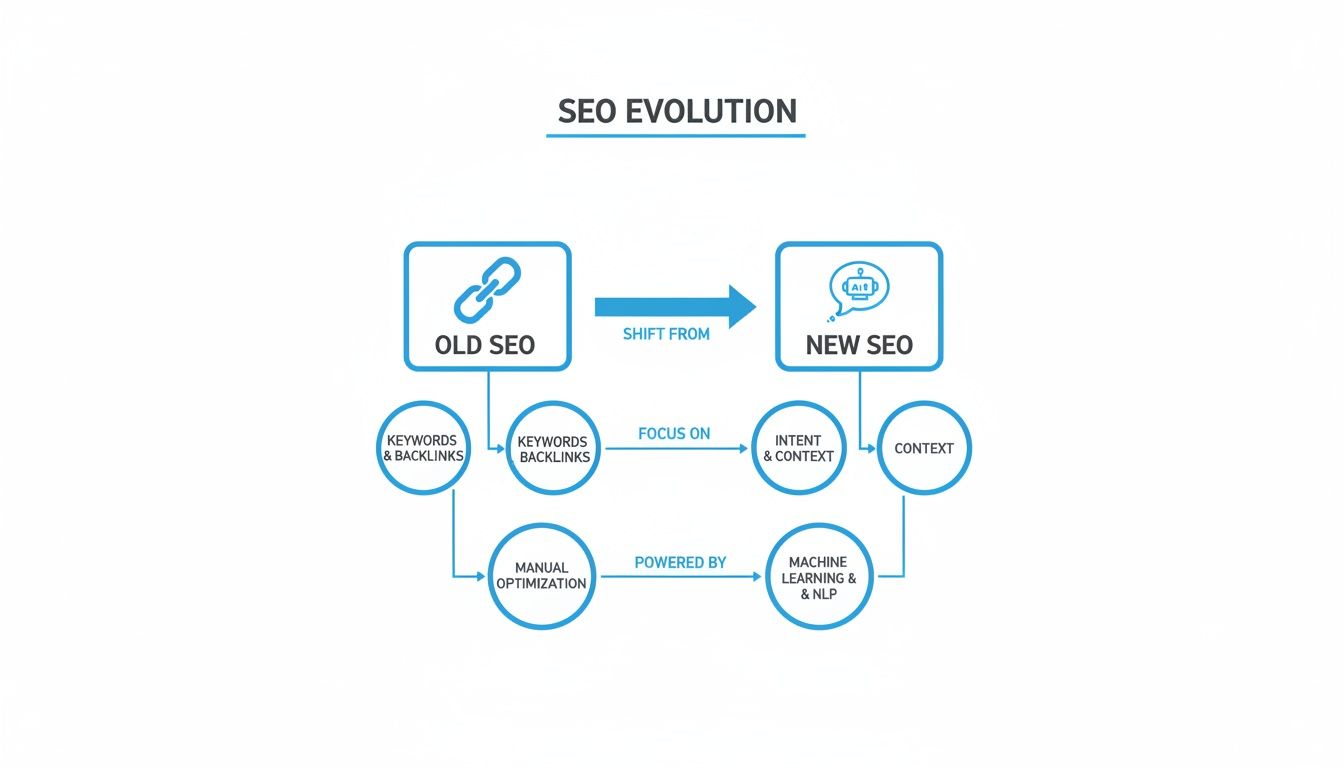
As you can see, the game has changed. Success is no longer just about keywords and links; it’s about providing clear, machine-readable context for AI. And that’s exactly where structured data shines.
I always tell my clients to think of a search engine as a librarian. A decade ago, that librarian was working in a library with millions of books but no card catalog. They would have to wander the shelves, reading titles and covers, just hoping to find what you needed. The process was slow and often wildly inaccurate.
Structured data is the modern equivalent of a perfectly organized digital card catalog. Each "card", your schema markup, tells the librarian (Google) exactly what your "book" (your webpage) is about, who wrote it, and where to find key information inside.
Now, when someone asks for "the best managed firewall services," the librarian can walk directly to the right shelf and pull your content instantly. This is the difference between being lost in the stacks and being featured at the front desk.
This organizational clarity has become the primary food source for AI models like Google's AI Overviews, ChatGPT, and Gemini. These systems crave well-structured, factual data to generate their answers. When your MSP's website is a trusted, organized source, you’re far more likely to be cited as the authority.
This is why structured data is so foundational to modern SEO. Research shows that large language models (LLMs) grounded in knowledge graphs can achieve 300% higher accuracy compared to those working with unstructured text alone. For MSPs, this means schema is non-negotiable for ensuring AI can accurately understand and recommend your cybersecurity services. The data backs this up: 72% of first-page search results now use schema, and pages with rich results see click-through rate increases of 20-40%. You can dig deeper into these numbers and what they mean for SERP visibility in the detailed guide from almcorp.com.
This direct pipeline to AI has a powerful effect on your business growth.
By translating your expertise into a machine-readable format, you ensure both search engines and AI see your MSP as the clear, correct choice. Our guide on AI SEO strategies explains how to build on this foundation for even greater impact.

Alright, now that we've covered the "what" and "why" of structured data, let's get into the good stuff: the specific schema types that will actually move the needle for your MSP or cybersecurity firm.
The good news is you do not need to boil the ocean here. A strategic focus on a few core schema types will deliver the lion's share of the results, directly supporting your goal of generating high-quality leads. This is your checklist for making sure your website is speaking Google's language in a way that drives business.
First things first, you have to tell Google exactly who you are. The Organization schema is the foundational layer for your entire brand presence online. Think of it as your official, machine-readable business card.
This is where you lock in details like your official name, logo, website URL, and contact info. Getting this right helps Google generate that branded Knowledge Panel you sometimes see on the right side of search results. It’s the source of truth that ensures your brand is represented accurately and consistently everywhere, which is the first step toward building trust with a potential client.
If you rely on clients in your city or region, the LocalBusiness schema is your most valuable player. This markup is specifically designed to get you featured in the all-important Google Map Pack for local searches like "IT support near me" or "cybersecurity firm in Dallas."
This schema tells Google your physical address, service area, phone number, and business hours. When a decision-maker in your territory searches for a local provider, this is what puts you on their map, literally. For any MSP with a local service model, this is completely non-negotiable.
Without
LocalBusinessschema, you are essentially invisible to the most qualified local prospects. They are searching for a provider in their area, and Google will not know to show them your business.
By implementing it correctly, you give Google the verified data it needs to feature your business prominently, driving calls and inquiries from prospects who are nearby and ready to talk.
While LocalBusiness tells search engines where you operate, Service schema tells them what you actually sell. This is your opportunity to go way beyond a generic "IT services" label and showcase the specific, high-value solutions you provide.
You can, and should, create distinct Service schema for each of your core offerings. For example:
This level of detail is a game-changer for attracting clients with high-intent. When a COO searches for "managed detection and response providers," Google can use your Service schema to see that you're a perfect match. This often leads to a more detailed and relevant search result, which in turn boosts your click-through rate with prospects who already know what they need.
Finally, FAQPage schema is a fantastic tool for demonstrating your expertise and taking up more prime real estate on the search results page. By marking up the question-and-answer sections on your key service pages, you can earn rich results that show your Q&As in a dropdown format directly in the search listings.
This strategy accomplishes two key things. First, it instantly answers a user's question, positioning your firm as a helpful authority before they even click. Second, it makes your search result physically larger and more engaging, pushing your competitors further down the page. Answering common questions like "What is included in managed IT services?" right in the SERP builds immediate trust and gives users a compelling reason to click on your link instead of someone else's.
Getting structured data on your website might sound like a job for a full-time developer, but it does not have to be. Let's walk through a straightforward workflow you can follow to get this done right, even if you’re not the one writing the code.
The game has changed. Implementing structured data is not just a nice bonus anymore; it is a core requirement for getting noticed. Consider that 60% of Google searches do not even lead to a website click, so your information has to appear right there on the results page. On top of that, with 37% of users now starting their search journey with AI tools, having neatly organized data is more critical than ever. You can see more on these trends in the latest SEO statistics from searchlogistics.com.
First things first, you need to create the code snippet. The good news is you can put your coding manual away. There are some fantastic, free tools out there that handle all the complex parts for you.
They work like a simple web form:
LocalBusiness for your main office or Service for a specific offering.That’s it. What seems like a highly technical job becomes a simple fill-in-the-blanks process that anyone on your marketing team can manage.
With your code snippet copied, the next step is to place it on the right pages of your website. You’ve got a few different ways to do this, and most do not involve touching your site's core theme files.
Your main options are usually a WordPress plugin, a built-in feature on your website platform (like Squarespace or Wix), or through Google Tag Manager. We almost always recommend using Google Tag Manager because it keeps all your marketing and tracking scripts in one place, totally separate from your website's actual code.
This separation is a lifesaver. It prevents scripts from conflicting with each other and makes it easy for a marketing partner to add or update schema without needing full developer access. Our team actually handles this entire process as part of our technical and on-site SEO service for MSPs, making sure it’s done perfectly from the start.
This is the one step you absolutely cannot skip. Never just assume your structured data is working. You need to test it to confirm Google can read it correctly and that there are not any errors holding you back from earning those rich results.
Fortunately, Google gives us free tools to make this incredibly simple.
Running your pages through these tools takes the guesswork out of the equation. You can see exactly what search engines see, fix any issues, and get a preview of how your brand will stand out in the search results.
We have walked through a lot of ground, from what structured data is to the exact schema that helps an MSP stand out. The big takeaway? This is not some technical footnote for your web developer anymore. It is a core part of how modern MSPs generate leads.
It’s about shifting focus from just getting clicks to attracting high-intent prospects who are actively looking to solve a problem. Think of structured data as your way of cutting through the search engine noise, presenting your MSP as the clear, authoritative choice the moment a potential client needs you.
In a world where search engines rely heavily on AI, your ability to speak their language is just as crucial as your marketing copy. Your competitors are either already doing this, or they are being left behind. It is no longer enough to have a great-looking website; it has to be perfectly organized for machines to understand and recommend.
This is how you get found by the CFO searching for a new cybersecurity partner or the operations manager who desperately needs co-managed IT. You stop just ranking for keywords and start becoming the verified answer.
The core message is this: Your expertise deserves to be seen. Structured data ensures that when a client has a problem, search engines confidently point them directly to your solution.
It’s one thing to talk about structured data, but it’s another thing entirely to see the opportunities on your own site. You are probably wondering how your website stacks up or which schema would actually move the needle for your business. The only way to know for sure is to look at the data.
Guesswork will not cut it. You need a clear picture of your current SEO performance and a deep understanding of what your competitors are doing right. This is the foundation for a real strategy, one that delivers a predictable stream of qualified leads for your MSP.
We want to help you take that next step. Stop wondering and start knowing. Book a complimentary SEO audit with our team, and we will dig into your website to uncover your biggest structured data opportunities. We will show you exactly how you measure up against your top competitors and give you actionable insights to start winning more of the high-value leads you’re looking for.
Book Your Complimentary SEO Audit Today
Even with a solid plan, a few questions always pop up when MSPs start digging into structured data. Let's tackle some of the most common ones we hear.
That’s a fair question, but the short answer is no, it does not have to be. It is definitely a technical task, but you do not need to be a coding wizard to get started. Many modern website builders and SEO plugins have features that handle a lot of the heavy lifting for you.
Of course, if your site is complex or you simply want to know it's done right the first time, bringing in a specialized SEO partner is a smart move. That way, you know it is handled perfectly while you focus on what you do best: running your business.
The timeline can vary. We have seen Google show rich results just a few days after crawling an updated page. In other cases, it might take a few weeks for the changes to fully register and appear in search.
The most important thing is getting the implementation right from the start. Once your code is live and validated, it is mostly a waiting game as search engines process all that new, helpful information.
Absolutely. In fact, you could argue it is even more important for a local MSP. Your biggest challenge is often just getting noticed in a sea of local competitors.
This is where LocalBusiness schema becomes your secret weapon. It gives Google all the signals it needs to feature you prominently in local pack results and on Google Maps. It's one of the most direct ways to connect with potential clients in your immediate area who are searching for exactly the services you offer.
At MSP SEO Agency, our entire focus is on helping managed service providers turn their websites into reliable lead-generation machines. We dive into the technical side of SEO, from structured data to building your site's authority, so you can attract a predictable stream of qualified clients.
Ready to see where your site stands?
See how targeted SEO delivers measurable impact for managed service providers. Explore our proven strategies and real-world outcomes.