
A website optimization consultant is the specialist who turns your MSP's website from a static digital brochure into a reliable source of qualified leads. They dig into the technical and strategic layers of your site, the stuff that goes far beyond surface-level design, to make sure you’re attracting and converting the right kind of clients.

Let’s be honest. You have a website, but is it actually working for you? For most Managed Service Providers, the site exists, but it’s not bringing in business. It looks professional, but the phone isn't ringing and the contact form is empty.
This is an incredibly common, and expensive, problem. You've invested time and money into a site that has become a passive asset. It’s not the powerful marketing tool it was supposed to be, and it certainly isn't a growth engine for your MSP.
In a crowded market, just having a nice-looking "brochure" site isn't enough anymore. If your website isn't technically sound and built around how local businesses actually search for IT services, it will simply get lost in the noise. The result: unpredictable sales cycles and a constant struggle to find new clients.
This is exactly where a website optimization consultant comes in. Their job isn’t to fiddle with colors and fonts. It’s to fundamentally re-engineer your site's foundation so that search engines like Google understand what you do, who you serve, and why you're the best choice.
A website without optimization is like a sales rep with no phone and no car. They might be the best at what they do, but they have no way to reach potential customers. The consultant provides the tools and the map to get them in front of the right people.
An underperforming website does more than just sit there. It actively loses you money in missed opportunities every single day. Every time a business owner in your city searches for "managed IT services near me" and finds your competitor first, that's a potential high-value contract gone for good.
A consultant gets to the root of why this is happening. The culprits are almost always the same:
Ultimately, bringing in a website optimization consultant is about transforming a sunk cost into a profitable investment. They implement the technical fixes and strategic content needed to finally equip your digital salesperson to do its job: bring you a steady stream of qualified leads.
So, what does a website optimization consultant really do? It’s a fair question, especially when you might already have a marketing person or a web designer on staff. Why bring in someone else?
Think of it this way: a consultant functions less like a designer and more like a network architect for your digital presence. They’re not just focused on making your site look good; they’re engineering it to perform. Their entire purpose is to build a system that achieves a single, critical outcome: generating qualified leads for your MSP.
The entire process starts with a comprehensive audit. This is something you’ll immediately understand: it’s the exact same approach you take when assessing a new client’s IT infrastructure. You wouldn't just glance at their desktops; you’d get into their servers, check their network security, and verify their backup systems. A website optimization consultant does the same for your digital footprint.
This isn’t some quick, automated scan. It’s a meticulous investigation to figure out precisely why your site isn't performing and where the opportunities are hiding. The consultant digs into the code, analyzes your top competitors, and maps out the exact journey a prospect takes from a Google search to your contact form. You can get a much clearer picture of this process in our guide on how to conduct a detailed SEO audit.
This initial deep dive gives you the blueprint for all future work. It clearly identifies the weak points that are costing you leads and lays out a prioritized plan to fix them.
Once the audit is complete, the real work begins. A consultant’s efforts aren't a series of random tweaks; they’re part of a coordinated strategy to establish your MSP as the go-to authority in your local market. They are systematically building the foundation for sustainable, long-term lead generation.
A consultant’s core responsibilities will typically include:
Technical SEO: This is the absolute bedrock. They ensure search engines can efficiently crawl, index, and understand what your site is about. This means fixing broken links, improving site speed, and sorting out complex indexing issues that can make your site practically invisible to Google.
Site Architecture Improvement: They organize your website's pages into a logical structure that makes perfect sense to both visitors and search engines. A clean architecture helps a potential client easily find information on your managed cybersecurity or cloud migration services, boosting both user experience and search rankings.
Core Web Vitals Optimization: They dial in your site's performance to meet Google's specific metrics for loading speed, interactivity, and visual stability (Core Web Vitals). A site that provides a smooth, fast experience is often rewarded with better visibility in search results.
Schema Markup Implementation: This is like giving search engines a cheat sheet for your website. By adding specific code (Schema), a consultant helps Google understand the context of your content, defining your services, service areas, and business details so they can be displayed prominently in search results.
Content and Backlink Strategy: The consultant develops a plan to create content that directly answers the questions your ideal clients are asking. At the same time, they work to earn high-quality backlinks from other reputable websites, which signals to Google that your MSP is a trusted authority worth ranking.
The demand for this expertise is exploding. The global Search Engine Optimization services market is projected to hit $108.28 billion by 2026, showing a powerful compound annual growth rate of 16.8%. This surge underscores just how critical expert optimization has become for any business that wants to be found online.
In the end, a website optimization consultant handles the specialized, technical work required to turn your website from a simple online brochure into a predictable and profitable marketing engine. They translate all those technical adjustments into what really matters: more demo requests and more signed contracts for your MSP.
When you bring in a website optimization consultant, you’re not just buying a report and hoping for the best. You're investing in a clear, methodical process designed to transform your website from a digital brochure into a genuine growth engine for your MSP. The whole engagement moves logically, starting with a deep diagnostic dive and progressing to a strategic, prioritized plan of attack.
It all starts with a comprehensive audit. A real pro doesn't just plug your URL into an automated tool and email you a PDF. They get their hands dirty, digging into every corner of your site to uncover what’s really holding you back. This is where they’ll spot the hidden roadblocks like sluggish page speeds that kill visitor patience, a clunky mobile experience that alienates more than half your audience, or a confusing site structure that keeps Google from understanding and ranking your most important service pages.
After pinpointing the problems, the next phase is all about building the solution. This is where expertise really shines through, as a good consultant develops a custom roadmap, not some cookie-cutter template. They prioritize every action based on its potential impact versus the effort required, focusing on the changes that will drive the most significant business results, fast.
This strategic plan is typically built on three core pillars:
High-Impact Technical Fixes: First things first, the consultant tackles the foundational problems found in the audit. This might mean optimizing your oversized images to slash load times, repairing broken internal links that frustrate users, or implementing schema markup to give Google crystal-clear signals about your MSP services. Think of these as the quick wins that can deliver an immediate performance boost.
A Niche-Specific Content Plan: With the technical foundation stabilized, the focus shifts to attracting the right clients. Instead of writing generic blog posts about "the benefits of the cloud," the plan gets specific. It targets high-intent, long-tail searches your ideal customers are actually typing into Google, like "IT support for dental offices" or "managed cybersecurity for law firms." This approach ensures the traffic you generate consists of qualified prospects who are actively seeking the solutions you provide.
An Authority-Building Backlink Strategy: Finally, the consultant maps out a strategy to earn backlinks from reputable websites. In Google's eyes, links from other respected tech and local business sites are powerful votes of confidence that signal your MSP is a trusted authority. This step is absolutely crucial for climbing the ranks and outperforming your established competitors.
This workflow shows how a consultant moves from the initial discovery phase to executing both technical and user-focused improvements.
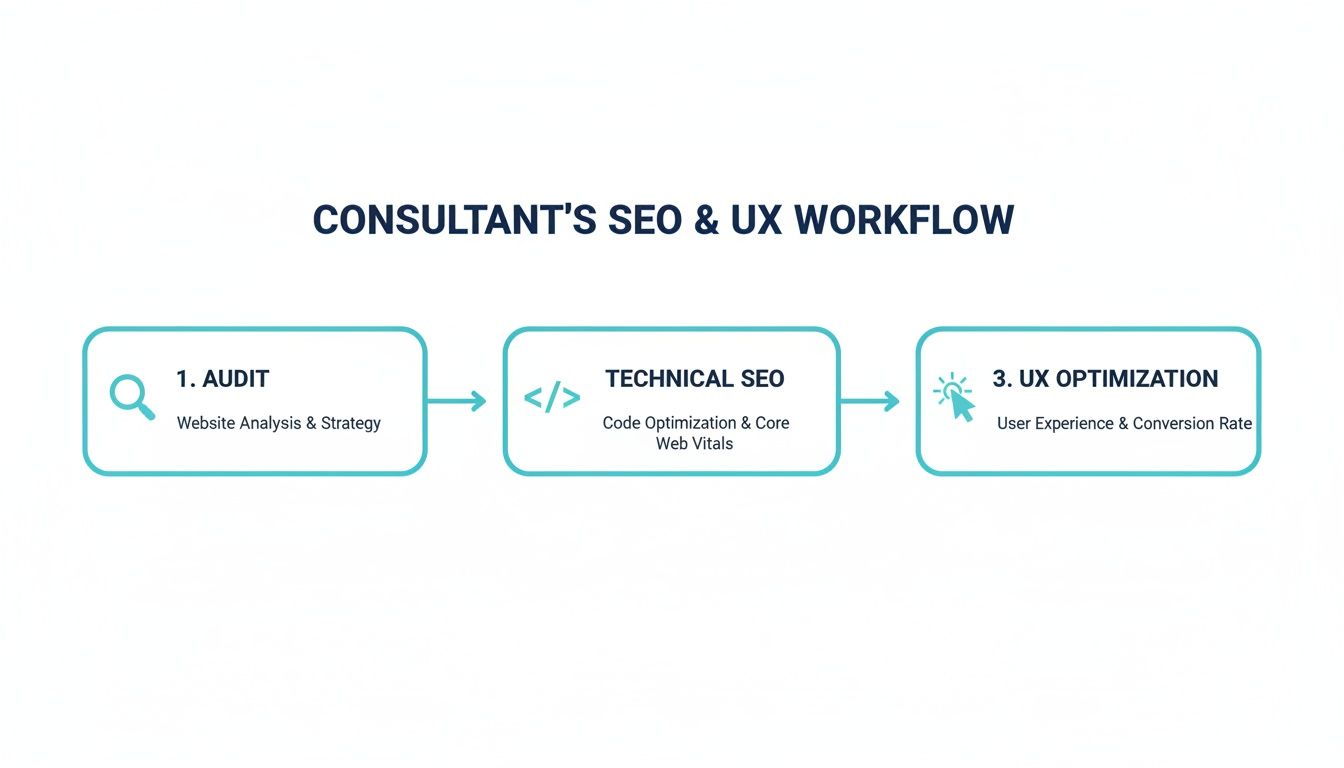
As you can see, successful optimization isn't about doing one thing well. It's a balanced approach that shores up your site's technical health before enhancing the content and user experience.
So, how do all these technical fixes and content strategies actually lead to more business for your MSP? The connection is incredibly direct. By systematically removing performance roadblocks and creating hyper-relevant content, you make it easy for your ideal clients to find you, trust your expertise, and take the next step.
Think of it this way: The audit is the X-ray that reveals the fractures. The strategy is the detailed treatment plan. The execution is the careful work that sets the bone and ensures a full recovery, which, in this case, is a healthy, consistent flow of new client opportunities.
To make this crystal clear, the table below shows how a consultant's specific actions directly produce the business results every MSP owner is after.
This table illustrates the tangible results an MSP can expect from a targeted website optimization engagement.
| Website Issue | Consultant's Action | Expected Business Outcome |
|---|---|---|
| Service pages have vague, generic titles and content. | Pages are rewritten to target specific keywords like "Co-Managed IT for Healthcare." | Higher rankings for valuable local searches and a steady stream of highly relevant traffic. |
| The website takes over 6 seconds to load on mobile. | Images are compressed, code is streamlined, and server response time is improved via a Content Delivery Network (CDN). | A significantly lower bounce rate and more visitors who stay long enough to explore your services. |
| The contact form is buried at the bottom of a single page. | A clear "Request a Quote" button is added to the main navigation and on all service pages. | A 25% or greater increase in qualified lead submissions and demo requests. |
By following this proven playbook, a website optimization consultant systematically removes the obstacles standing between your MSP and its next high-value client. The result isn't just a prettier or faster website; it's a predictable and powerful engine for sustainable business growth.

The way potential clients find your MSP is changing faster than ever. For years, the game was straightforward: get your website to rank on the first page of Google. Now, the goalposts have moved. It's about becoming the direct, authoritative source for AI-powered tools like ChatGPT, Gemini, and Google’s own AI Overviews.
This is a fundamental shift from traditional Search Engine Optimization (SEO) to what we now call Answer Engine Optimization (AEO). It’s no longer enough to simply chase keywords. You have to structure your website's content so that AI models see your MSP as the definitive, most trustworthy expert in your field.
A good website optimization consultant gets this new reality. Their job is to take your deep expertise, on everything from cybersecurity compliance and co-managed IT to cloud migrations, and package it in a way that AI can easily digest and cite.
Think about it. When a local business owner asks an AI, "What IT support do I need for HIPAA compliance?" you want the answer it generates to be pulled directly from your content. That's the new front page.
This takes a specific set of advanced tactics. The aim is to build what's known as "entity relevance" around your business. In plain English, this means proving to AI that your MSP isn't just a business, but a true subject matter expert on the services you offer and the industries you serve.
This isn't some far-off trend; it's happening right now. A recent study revealed that a staggering 86% of SEO professionals are already using artificial intelligence in their work, and 65% of businesses are seeing clear performance gains from it. For MSPs, getting ahead of this curve is a matter of survival and visibility.
So, how does a consultant make this happen? They focus on a few key strategies.
Advanced Schema Markup: This is like a secret language for search engines. A consultant uses this structured data (code) to explicitly label your services, service areas, and expertise. It's a direct line of communication that tells Google’s AI exactly what you do and who you do it for, leaving no room for interpretation.
Detailed FAQ and Knowledge Base Content: They'll help you create comprehensive FAQ pages and in-depth articles that answer the precise questions your ideal clients are typing into search bars and AI chats. This content is formatted for easy parsing by AI, making your site a go-to source for answers. You can explore this further in our guide to AI SEO strategies for MSPs.
Building Topical Authority: Instead of a single page on "cybersecurity," a consultant helps you build out a whole cluster of related content. Think supporting articles on phishing prevention, endpoint detection, and incident response. This interconnected web of information proves your deep knowledge on the subject.
By focusing on AEO, a skilled website optimization consultant isn't just tweaking your site for today's search results. They are fundamentally positioning your MSP to capture leads from the next wave of information discovery. As more and more users turn to AI for recommendations, being the source of the answer will be the single most valuable position an MSP can hold.
Choosing a partner to handle your website's performance is a major decision. The wrong choice means wasted time, a squandered budget, and the same old lead generation problems you started with. A lot of SEO professionals are out there, but very few truly understand the specific needs of a B2B service business like an MSP. Finding a specialist isn't just a good idea, it's essential.
Your goal is to find a true partner, not just a vendor who sends you automated reports once a month. You need a website optimization consultant who takes the time to grasp your business model, the high value of your clients, and the technical nuts and bolts of the services you provide.
When you start talking to potential consultants, you need to ask the right questions. Generic questions get you generic, canned answers. Your focus should be on digging into their real-world experience with businesses like yours and their approach to proving actual business value.
Here are the key questions you should have on your list for every candidate:
Can you show me results you have achieved for other B2B service companies? Ask for specific case studies or examples, particularly from businesses with a long sales cycle like an MSP. Their success with a local plumber or an e-commerce store simply isn't relevant to you.
How do you measure ROI beyond just rankings and traffic? A great consultant will immediately start talking about qualified leads, demo requests, and cost per acquisition. They should be able to connect the dots between their work and your bottom line.
What is your process for understanding our specific services and target clients? Look for someone who comes prepared with insightful questions about your ideal customer profile, your service offerings, and the competitive landscape you operate in.
How do you approach content strategy for a technical business like an MSP? They should be talking about building your authority and creating content that answers very specific client pain points, not just churning out generic blog posts to hit a quota.
What is your communication and reporting style? You want a partner who provides clear, jargon-free updates focused on progress toward your business goals, not just a laundry list of technical tasks they checked off.
The right consultant understands that for an MSP, success isn't about a thousand random clicks. It's about getting a handful of highly qualified leads from businesses that are a perfect fit for your services.
Once you've found a few candidates who seem to know their stuff, the conversation will naturally turn to pricing. It’s important to understand the different models out there so you can choose the one that aligns best with your MSP’s budget and growth goals.
The market for these services is incredibly broad, which can actually work to your advantage. A recent SEO agency growth study revealed that 70% of agencies still generate under $50,000 in monthly recurring revenue. On top of that, 48% cited fierce competition as their biggest barrier to raising prices. You can explore more of these findings on agency growth trends at Sitechecker.pro.
What this data tells us is that hiring a cheap generalist is a huge risk. Instead, your focus should be on finding a specialist who can confidently justify their investment with tangible, business-oriented results.
Here are the three most common pricing structures you’ll run into:
Monthly Retainer: This is the most common model, and for good reason. You pay a fixed fee each month for ongoing services like technical monitoring, content creation, link building, and reporting. It's predictable, which is great for budgeting, and it’s designed for long-term, sustained growth.
Project-Based Fee: This is perfect for a one-time, specific engagement, like a comprehensive website audit and technical cleanup. You pay a single, upfront fee for a clearly defined scope of work. It’s also an excellent way to test out a consultant’s skills before committing to a long-term retainer.
Performance-Based Model: This model ties the consultant's payment directly to specific results, such as hitting a target for qualified leads or a top-three ranking for a key service page. While it sounds attractive, these agreements can be complex to structure and often come with a much higher potential cost if the goals are met.
For most MSPs, a monthly retainer with a proven website optimization consultant offers the best balance of consistent effort and predictable cost. This approach ensures your website methodically becomes a reliable, lead-generating asset for your business.
Alright, we've covered a lot of ground. You've seen the difference between a website that’s just a digital business card and one that actively works to fill your sales pipeline. The big question is, what’s the next move?
It’s not about guessing or making random changes and hoping for the best. The first real, concrete step toward getting more leads is to get a professional diagnosis. You need a comprehensive SEO audit, and I don't mean a flimsy, automated report full of jargon. I’m talking about a strategic game plan built by an expert.
A proper audit cuts through the uncertainty. It gives you a clear, prioritized action plan that shows you exactly where the biggest opportunities are hiding on your website. It’s the difference between flying blind and having a GPS to your destination.
Think of it as a top-to-bottom inspection of your online presence. A specialist will dig into:
Don't let your website sit there as a passive marketing expense for another quarter. Every day that passes is another day of missed opportunities, with potential revenue walking right over to your competitors who are taking their online strategy seriously. It’s time to turn that expense into your most valuable sales asset.
The gap between a thriving MSP and one that's struggling often comes down to one decision: keep guessing, or get a professional diagnosis. An audit delivers the clarity you need to finally move forward with confidence.
Investing in a professional audit from a website optimization consultant is the most direct path to building a reliable lead-generation engine. Stop losing clients to the competition and start building a predictable, successful future for your MSP.
Even after seeing the potential, it's natural for MSP owners to have some final questions. It’s a big step to bring in an outside expert, and you need to be confident in your decision. Let’s tackle some of the most common questions we hear from MSPs who are in your exact position.
That's the big question, isn't it? While quick technical wins like improving your site speed can give us some positive signals within a few weeks, real, measurable growth takes a bit more time.
Generally, you should expect to see a noticeable increase in qualified, organic leads within 4 to 6 months. SEO is a long-term strategy, not a quick fix. We're building an asset for your business that will pay dividends for years.
The first couple of months are all about building a rock-solid foundation. We'll be doing deep technical clean-up, overhauling your service pages, and launching a content strategy that actually speaks to your ideal clients. A good consultant will be transparent about this, showing you progress on leading indicators like keyword rankings and traffic growth long before the lead forms start flooding in.
So, what’s the real difference between a specialized consultant and a full-service agency? Think of it like a general practitioner versus a specialist surgeon. A general digital marketing agency is the GP: they do a bit of everything, from social media and email to paid ads. They are, by design, generalists.
A website optimization consultant is the specialist. We have one job and one job only: to turn your website into a machine that attracts high-value clients through organic search. We go incredibly deep into the areas that actually move the needle for search performance:
For an MSP, where a single new client can be worth tens of thousands of dollars, you don't need a generalist. You need a specialist who knows exactly how to attract those high-value decision-makers.
The approach is worlds apart. Any consultant who tells you SEO is all the same is waving a massive red flag. Ecommerce SEO is a numbers game: it's about getting thousands of clicks for thousands of product keywords, aiming for a quick, transactional sale. It's all about volume.
MSP SEO is the complete opposite. It's a low-volume, high-value game focused on building authority and trust. We don't care about getting thousands of clicks. We care about getting a handful of clicks from the right CEOs and IT directors who desperately need your help.
This means we’re targeting very specific, high-intent keywords like "cybersecurity compliance for financial firms" or "co-managed IT for healthcare providers." The content has to be deeply educational and insightful, not just another sales pitch. We're not trying to make a quick online sale; we're trying to earn a steady flow of qualified sales appointments with your ideal clients.
This is where the investment really shines. The ROI from expert website optimization is measured by the lifetime value of the new clients you win. While every market is different, a successful project should deliver a return that is many times your initial investment.
Let's run the numbers. If your monthly investment is $5,000, and our work brings you just one new managed services client with an annual contract value of $60,000, the ROI is immediate and substantial.
A true professional will help you track everything from the first click on your website to the signed contract. This isn't about vague promises; it's about providing a clear, transparent view of how your investment is directly fueling your bottom line.
Your website has the potential to be your most powerful lead-generation tool. Stop letting it underperform. At MSP SEO Agency, we specialize in turning MSP websites into predictable growth engines. Book a call with us today to get a clear, actionable plan for dominating your local market.
See how targeted SEO delivers measurable impact for managed service providers. Explore our proven strategies and real-world outcomes.