

Imagine a competitor hiring someone to actively sabotage your business. This isn't happening in the real world, but online. That’s exactly what a negative SEO attack is: a deliberate act of digital sabotage designed to wreck your search engine rankings, slash your organic traffic, and ultimately send your leads to a rival.

These attacks use malicious, unethical tactics to make your MSP's website look untrustworthy to search engines like Google. As your site climbs the rankings and starts capturing valuable traffic, it ironically becomes a more prominent target for these underhanded strategies.
The attacker’s goal is simple: knock your site down the search results so they can take your spot. This is a direct threat to your lead generation, as the visibility you worked so hard to build can disappear almost overnight.
Your website isn't just a digital storefront; it's a powerful engine for growing your MSP. Every time you invest in SEO and see those rankings climb, you're claiming valuable digital territory, territory that a competitor wants for themselves.
In a strange way, an attack is often proof that your marketing is working. When you start to dominate the search results for profitable keywords, less scrupulous competitors may resort to sabotage rather than competing fairly.
This isn't just a problem for huge corporations. MSPs of all sizes are vulnerable, especially those in competitive local markets. The more successful your online presence becomes, the greater the risk that someone will try to tear it down.
Negative SEO attacks can show up in several ways. Each one exploits a different aspect of how search engines evaluate and rank websites. Knowing what to look for is the first critical step in protecting your MSP's digital assets.
These are the most frequent types of negative SEO attacks you might encounter:
By familiarizing yourself with these common attack vectors, you can move from a reactive stance to a proactive one. Recognizing the signs early is key to defending your rankings and preserving your lead flow.
To build a solid defense against negative SEO attacks, you first have to understand how they work. While the tactics can get technical, the core idea is surprisingly simple. Attackers are trying to make your MSP website guilty by association, deliberately confusing search engines and tanking your hard-earned reputation.
Most of these digital ambushes fall into a few key categories. By learning to recognize their signatures, you can start protecting your MSP’s most valuable marketing asset: its primary source of online leads.
Let's dive into the most common tactics you're likely to see.
Imagine someone paying thousands of shady people to point at your business, telling everyone you're one of them. That's a malicious backlink attack in a nutshell. Attackers generate a massive number of links pointing to your site, but they all come from low-quality, spammy, or outright toxic domains.
These bad-faith links typically come from places like:
The goal here is to make your backlink profile look manipulative and untrustworthy to Google. A sudden, unnatural spike in these toxic links can easily trigger an algorithmic penalty, causing your rankings to plummet.
Another common tactic is simple digital plagiarism. An attacker will systematically copy, or "scrape," your original content like blog posts and service pages. Then they republish it across hundreds, sometimes thousands, of other websites.
This creates a huge duplicate content problem for search engines. Suddenly, they see multiple versions of the same text and struggle to figure out which one is the original.
When your expert content appears on countless low-quality sites, it dilutes your authority. Google may become confused about who the true author is. It might even penalize your site for the duplication, even though you are the victim.
Not all negative SEO attacks target your website’s code or backlink profile. Some go straight for your brand’s reputation where it hurts the most: public review platforms. This usually involves a sudden, coordinated flood of fake one-star reviews on your Google Business Profile, Clutch, or other industry review sites.
These fraudulent reviews are designed to do two things at once. First, they immediately tarnish your public image and scare away potential clients doing their research. A business with a sudden storm of terrible reviews just doesn't look trustworthy.
Second, a nosedive in your star rating can directly harm your visibility in local search results. Google's algorithm favors businesses with strong, positive customer feedback. A targeted review bomb can push you down in the local map pack, making you invisible to prospects in your service area.
It's easy to dismiss negative SEO attacks as a fringe issue, something that only happens in the dark corners of the web. But when you see the actual damage these campaigns inflict, the threat becomes very real. This is active sabotage that has knocked out businesses of all sizes.
For an MSP, the consequences are what matter most. Imagine explaining to your team why website traffic suddenly tanked and the lead-generation pipeline has run dry. Let’s look at a couple of real-world examples to see just how destructive these attacks can be.
If you think negative SEO is a small-time problem, the attack on Forbes should be a serious wake-up call. This case proves that even massive brands with huge authority are not safe.
A few years ago, Forbes was hit with a classic, brute-force negative SEO campaign. An attacker hammered the domain with thousands of spammy, low-quality backlinks. The goal was simple: make Forbes’s backlink profile look so toxic that Google's algorithms would have to penalize it.
That screenshot tells the whole story. You can see the dramatic, unnatural spike in new referring domains, a tell-tale sign of a link bomb attack. As a detailed analysis from Nightwatch shows, the attack cost Forbes valuable rankings and traffic.
Think about that for a moment. If a media giant like Forbes can get hit, what does that mean for your growing MSP? It’s a clear signal that a strong online presence is a valuable asset, and some competitors are willing to fight dirty to undermine it.
While the Forbes case shows the sheer scale these attacks can reach, the story of a smaller digital agency brings the threat much closer to home. Their experience is the exact nightmare scenario for any service-based business that depends on its website for growth.
The team noticed an alarming trend: a sudden and sustained drop in organic traffic. Within just six weeks, they had lost 18% of their visitors. After digging into Google Search Console and Semrush, they found the culprit. Their site was being carpet-bombed with thousands of toxic backlinks from spam farms and irrelevant directories.
Getting back on track was a slow, manual grind. They had to perform a meticulous audit of every single new backlink, compile a massive disavow file to tell Google which links to ignore, and then formally ask for reconsideration. It was a painful, resource-intensive process.
This example is especially relevant for MSPs. It highlights how a negative SEO attack directly hits the bottom line. Every week of suppressed rankings translates directly into lost leads and stalled growth.
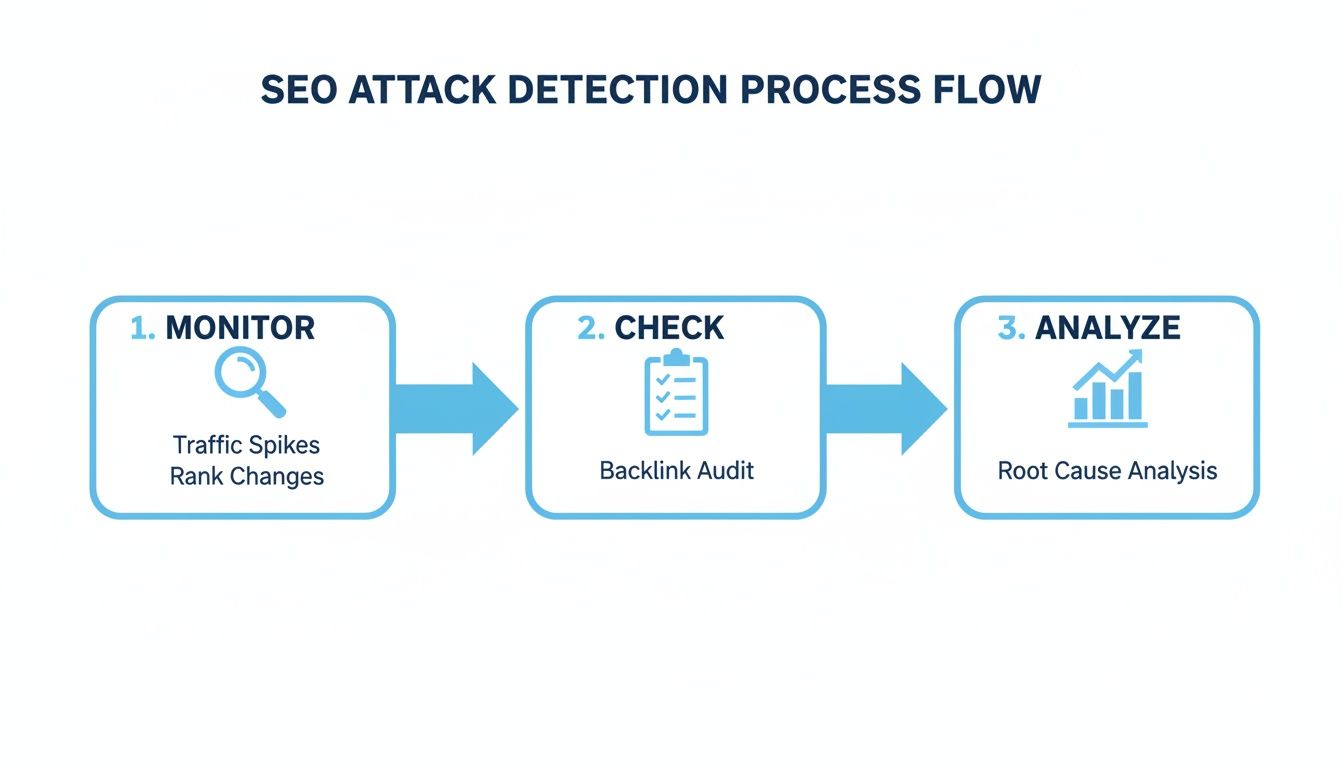
Spotting a negative SEO attack is like finding a small leak in a server room. The sooner you catch it, the less damage you have to fix. For an MSP, where every lead from your website is critical, staying vigilant is essential to protecting your bottom line.
The goal is to build simple, repeatable monitoring habits instead of waiting for your rankings to tank. By keeping a close eye on a few key metrics, you can spot the signs of an attack long before it becomes a full-blown crisis.
You don't have to be an SEO pro to guard your site, but you do need to know where to look. Thankfully, much of the data you need is available for free straight from Google. Paid tools can give you deeper, more immediate insights.
Your most important tool is Google Search Console. Consider it your direct line to Google. It's often the very first place you’ll see official red flags, like manual action penalties or warnings about unnatural links.
Beyond that, tools like Semrush or Ahrefs are incredibly valuable for keeping tabs on your backlink profile. They can send alerts about suspicious, sudden spikes in new links, which is the classic signature of a link spam attack.
A negative SEO attack is rarely a silent affair. It almost always leaves behind a trail of digital breadcrumbs. Your job is to recognize what those breadcrumbs look like so you can take action right away.
Here are the key warning signs you can't afford to miss:
Consistent monitoring is the most powerful weapon you have against negative SEO. It turns a potential disaster into a manageable problem by letting you respond before the real damage is done.
To make this manageable, weave it into your weekly routine. This simple checklist can be handled in just a few minutes each week, but it provides a surprisingly strong defense. It's a small investment of time that can save you from months of painful recovery.
Here’s a practical checklist you can start using this week:
By running through this list regularly, you’re building an early warning system for your business. For an even deeper look, it’s worth conducting a full audit to establish a clear baseline. You can learn more in our guide on how to conduct an SEO audit.
That gut-punch feeling when you realize your MSP's site is under attack is unmistakable. But the worst thing you can do is panic. A methodical, step-by-step response is your most powerful weapon to contain the damage from negative SEO attacks and kickstart the recovery.
This isn't about guesswork; it's about executing a proven playbook. The goal is simple: clean up the mess and send strong, clear signals to search engines that you're taking back control.
Toxic backlinks are the most common tool in the attacker's shed. Your first job is to find and neutralize them. This process tells Google, "Hey, we didn't ask for these links, and we don't endorse them. Please don't hold them against us."
domain:spammywebsite.com. Using the domain: command tells Google to ignore every link from that entire website.A word of caution: be surgical here. Disavowing the wrong link can do more harm than good, so stick to disavowing only the most blatantly toxic domains. It helps to understand what is technical SEO and how all the pieces work together.
Beyond bad links, attackers love to scrape your content or flood your profiles with fake reviews. Thankfully, there are established channels to fight back.
If you find another site has plagiarized your content, go straight to Google's Copyright Removal tool. You’ll file a formal DMCA takedown request by providing the URL of the page stealing your work and the URL of your original piece.
When it comes to fake negative reviews, speed is essential. A sudden influx of one-star ratings can immediately damage your reputation and hurt your local search rankings. For phony reviews on your Google Business Profile, go to your profile, find the review, and flag it as inappropriate. Give a short, direct reason why it violates Google's policies, like "spam."

Once you’ve cleaned up the mess from a negative SEO attack, the real work begins. Your focus has to pivot from putting out fires to building a fireproof structure. The only way to truly beat these attacks long-term is to make your digital presence so resilient that malicious activity just bounces off.
This means you have to start treating SEO as more than just a marketing line item. It’s business insurance for your lead generation pipeline.
Think of your website's authority like a fortress. Every positive SEO action you take reinforces its walls, making your site so strong that attackers decide it’s not worth their time or money to even try.
A strong, diverse, and authoritative backlink profile is the foundation of that fortress. A site with just a few dozen backlinks is fragile. A sudden barrage of 1,000 toxic links can easily overwhelm its authority and trigger a penalty. Now, imagine a site with 1,000 legitimate, high-quality backlinks. That same attack barely makes a dent.
Your mission is to earn links that signal genuine trust to Google. Focus on getting backlinks from places like:
A healthy backlink profile is your number one shield against negative SEO attacks. Our guide on link building best practices lays out a detailed roadmap for MSPs.
Basic website security is no longer just an IT best practice; it's a critical part of SEO defense. If your site gets compromised, an attacker can commit SEO vandalism, like injecting spammy links or changing content. The damage to your rankings and reputation can be immense.
Securing your site with HTTPS is table stakes. It encrypts the connection between your users and your server. Beyond that, you must be relentless about keeping your content management system (CMS), plugins, and themes updated. These updates contain critical security patches that close the very loopholes attackers look for.
Finally, you need to own your niche. When you consistently publish high-quality, genuinely helpful articles, guides, and case studies on cybersecurity, cloud strategy, and IT management, you build topical authority. This sends a powerful signal to Google that you are a definitive, expert source for the MSP industry.
A site with deep topical authority is more trusted by search engines. It's also less vulnerable to the confusing signals sent by a negative SEO campaign. When Google already recognizes you as an expert, it’s far more likely to see a flood of spammy links or scraped content for what it is: noise.
It's natural to have a few more questions about negative SEO attacks. I get it. When you're facing a threat this disruptive, you want clarity. Let’s tackle some of the most common concerns I hear from MSP owners.
I get this question all the time. While it’s true that Google’s algorithm is much smarter now and can often ignore a few stray, spammy links, a targeted attack is a different beast. We’re not talking about a couple of links; we’re talking about thousands of toxic links hitting your site all at once.
That sudden flood of low-quality signals can absolutely trip algorithmic filters or trigger a manual penalty. For a local MSP where every qualified lead is gold, even a slight dip in your search rankings translates directly into lost business.
Honestly, the timeline for recovery hinges on how severe the attack was and how quickly you acted. Once you’ve disavowed the toxic domains, you could see things start to turn around in a few weeks. But a full recovery can sometimes take several months as you wait for Google to re-evaluate everything.
Keep in mind, if a manual penalty was issued, the clock is no longer in your hands. You're waiting on a human reviewer at Google to look over your cleanup efforts. This is exactly why early detection and constant monitoring are so crucial.
Yes, absolutely. Any business with an online presence is on the radar, regardless of its age or size. While established MSPs with high-value rankings are often targeted by direct competitors, many negative SEO attacks are automated and indiscriminate. As your new MSP starts to gain traction, you will attract competitive attention.
If I had to boil it all down to one thing, it's a two-pronged strategy: consistent monitoring coupled with building a powerful, authoritative backlink profile.
A strong link profile is like a fortress for your website. It builds so much authority that your site becomes far more resilient and is much less likely to be derailed by a negative SEO attack.
Protecting your MSP from these kinds of digital threats is an ongoing battle, but it’s not one you have to fight alone. At the MSP SEO Agency, we specialize in building powerful, defensible SEO strategies that don’t just drive leads but also shield your business from attacks. Schedule a discovery call with us today to see how we can help fortify your online presence.
See how targeted SEO delivers measurable impact for managed service providers. Explore our proven strategies and real-world outcomes.