Let's cut right to the chase. Low-funnel marketing is all about focusing your time and money where it counts most: on prospects who need an IT solution right now. These aren't businesses casually wondering what data backup is. They're the ones whose server just crashed or who are staring down a compliance deadline.
Picture this: a potential client's network goes down in the middle of a workday. Panic sets in. They are not Googling “what is a managed service provider?” That’s a top-of-funnel, awareness-stage search for another day.
Instead, they're frantically typing “emergency IT support near me” or “MSP for law firm in [City]” into the search bar. That urgent, solution-focused search is the low funnel. It’s where decisions get made and deals get closed.
For any MSP, getting this right is a complete game-changer. It means shifting your strategy away from broad, educational content and toward specific, action-oriented tactics. You're no longer just planting seeds; you're there to harvest the leads who are ready to buy. It’s about being the immediate, obvious, and most credible answer for a business in pain.
Before we go deeper, it helps to see how this fits into the bigger picture. The marketing funnel visualizes a client’s journey from initial awareness to making a purchase.
Here’s a quick breakdown of what that journey looks like from an MSP client's perspective.
| Funnel Stage | Client Mindset | MSP Marketing Goal |
|---|---|---|
| Top of Funnel (ToFu) | "I have a symptom, but I'm not sure what the problem is. What are my options?" | Attract and educate a wide audience with blog posts, videos, and social media content about common IT problems. |
| Middle of Funnel (MoFu) | "I understand the problem now. Who can solve it? How do different solutions compare?" | Nurture leads and build trust with guides, webinars, and email sequences that compare MSP service models. |
| Bottom of Funnel (BoFu) | "I know what I need and I'm ready to choose a provider. Who is the best fit for me?" | Convert high-intent prospects into clients with targeted SEO, landing pages, and consultations that highlight your expertise. |
This guide is zeroed in on that critical Bottom of Funnel (BoFu) stage, where your marketing efforts can deliver the most immediate returns for your MSP.
The biggest advantage of low-funnel marketing is pure efficiency. You stop spending your budget trying to convince someone they have a problem. Instead, you connect with prospects who are actively looking for your help. This delivers some serious benefits for your MSP.
This isn't just a niche strategy, it's a mainstream shift. As economic pressures mount, businesses are demanding more immediate ROI from their marketing. In fact, recent analysis shows the percentage of marketers prioritizing performance-focused campaigns has climbed from 35% to 42%. You can read the full report on lower-funnel marketing trends to see how others are adapting.
A strong low-funnel strategy makes sure your MSP shows up at the exact moment a prospect is ready to pull the trigger. By optimizing for these "ready-to-buy" moments, you build a predictable and profitable pipeline for new business. This is the most direct path to growth in a crowded market.
So, how does a prospect who's finally ready to buy actually find you? The key is understanding exactly where they look in those final, critical moments of decision-making. Low-funnel marketing isn't about one tactic. It's about showing up consistently and authoritatively across the handful of platforms where these high-intent searches take place.
Let's walk through a real-world scenario. The managing partner at a local law firm has had it with their current IT provider's slow response times. They're done. Their first move won't be browsing a blog; it's a specific, urgent Google search like "cybersecurity services for law firms in Chicago" or "MSP compliance support for healthcare." They aren't just looking around, they're actively building a shortlist.
This is the exact moment your low-funnel strategy needs to shine. The goal is to be the most credible and obvious choice across several channels at once.
When that partner starts searching, they are not just looking for one website. They're on a rapid-fire mission to validate their options. A well-oiled low-funnel machine ensures you’re there at every step.
SEO-Optimized Service Pages: Your website’s page for “IT Services for Law Firms” has to rank near the top. More importantly, the second they land on it, the content must speak directly to their pains, like data privacy, e-discovery, and regulatory compliance.
Google Business Profile (GBP): As they scan the search results, your Google Business Profile pops up in the local map pack. It shows your location, hours, and crucially, your reviews. A listing with dozens of glowing, 5-star reviews from other local businesses is powerful, instant social proof.
Targeted Search Ads: A paid ad placed right at the top of the page for that exact keyword guarantees you get seen first. The ad copy needs to reinforce your expertise, promising a solution tailored to their industry's specific problems.
These channels don’t work in isolation. They create a powerful confirmation loop. The prospect sees your paid ad, then your organic ranking, and then your stellar reviews in the map pack. This trifecta builds tremendous trust before they have even clicked through to your site.
This is all about focusing your resources where they have the most impact: on leads who are already looking to make a purchase.
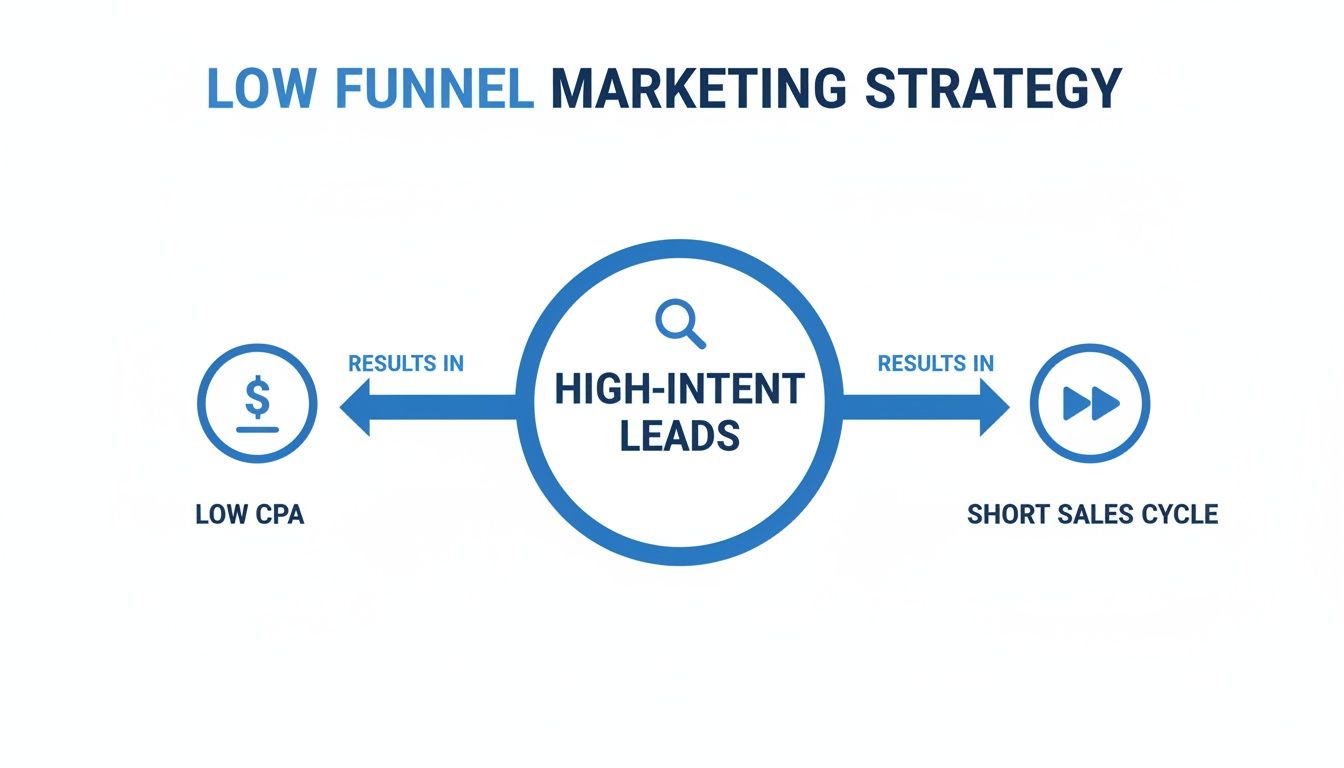
As you can see, zeroing in on prospects in the buying phase has a direct and immediate effect on your bottom line. It shortens the sales cycle and lowers what it costs to acquire a new client.
Once that prospect is on your website, the journey is far from over. They’ll likely check out a case study featuring another law firm you helped, then bounce over to your pricing or service tiers page. Each piece of content they touch is another low-funnel touchpoint, designed to answer their final questions and dissolve any lingering hesitation.
The whole idea is to be unavoidable, but in a helpful way. When a client is ready to solve their problem, your MSP should appear as the most logical, trustworthy, and expert choice everywhere they turn.
This approach pays dividends. Because you're providing a clear solution at the exact moment of need, these leads are far more valuable. In fact, nurtured leads at the bottom of the funnel are known to produce a 47% higher average order value. By aligning your SEO, local presence, and paid ads, you ensure your MSP is the one they call when they finally decide to act.

When it comes to SEO for MSPs, it’s easy to get lost chasing vanity metrics like overall traffic. The real goal of low-funnel marketing, however, isn’t about casting the widest net; it's about catching the right fish. We’re talking about prospects who have finished their research and are now actively looking for a provider to hire.
Your SEO strategy has to be laser-focused on meeting them at that critical moment. This means a fundamental shift away from broad, informational keywords toward specific, high-intent phrases that signal someone is ready to buy. That's where the opportunities for real revenue growth are hiding.
The entire low-funnel SEO playbook starts with your keyword selection. You need to get inside the head of a business owner who has a problem and is looking for an immediate solution. What would they type into Google? It’s not "what is cloud backup." It's phrases that show they're comparing providers and costs.
Think "managed IT services pricing" or "outsourced helpdesk Boston." These are buying signals. When you see searches like this, you know the person is in the final stages of making a decision.
Simply stuffing these terms onto a page won't cut it. Your service pages need to be meticulously optimized to directly answer the searcher's query, lay out exactly what your service provides, and make the next step crystal clear.
For MSPs, local SEO is an absolute powerhouse. A huge number of high-intent searches are location-based, like "IT support near me" or "cybersecurity firm in [Your City]." Showing up in Google’s local map pack for these terms is the digital equivalent of putting a billboard right in front of a prospect who's ready to make a call.
To get that prime placement, your Google Business Profile needs to be flawless. Accurate contact info, glowing reviews, and the right service categories are a must. When you combine this with location-specific content on your website, you send a powerful message to Google that you're the trusted authority in your service area.
Getting that high-intent visitor to your website is just the first step. Once they land on your service page, you have a very short window to convince them you're the right choice. A confusing or unprofessional page will send a ready-to-buy lead straight to your competitor.
This is where your internal processes also come into play. After your SEO brings in a qualified prospect, you need an efficient way to engage them. Modern tools like AI-powered chatbots with built-in CRM lead capture capabilities are perfect for turning that initial interest into a concrete sales opportunity without any delay.
A high-converting service page isn't an accident; it’s engineered. Every element must work together to answer final questions, build confidence, and remove any friction.
Here’s what your page absolutely needs:
When you pair surgically precise SEO with conversion-focused page design, your website stops being a passive online brochure. It becomes an active, reliable lead-generation engine that consistently brings qualified, ready-to-buy clients to your MSP.

When a prospect is on the verge of signing a contract, the conversation changes. The time for general, educational content is over. They know what managed IT is. Now, they need to know why you’re the right MSP to provide it.
This is where your low-funnel marketing content comes into play. Its job is to give your sales team the tools to erase any last-minute doubts. Think of it as the final, confident push they need to feel secure and smart about choosing you.
Your most potent sales weapon at this stage is a good case study. I’m not talking about a dry summary of services. I’m talking about success stories that let a potential client see their own future in your work.
Don't just say you offer "HIPAA-compliant IT solutions." Instead, tell the story of the local healthcare clinic you helped through a nightmare audit. Detail their specific fears and challenges, the exact solutions you put in place, and the tangible outcome, like passing the audit flawlessly and boosting their network security by 40%.
A great case study always follows a simple, powerful narrative: Here was the problem, here's how we solved it, and here are the results. It's a formula that lets a prospect instantly grasp your value.
When you tell these stories, your abstract services become concrete proof. Suddenly, you're not just another MSP. You're the one who gets it. This is how you build real trust and establish authority in your market.
Case studies are a fantastic start, but they’re just one piece of the puzzle. To really seal the deal, you need to surround prospects with a chorus of proof that reinforces their decision. This is where testimonials, reviews, and direct comparisons come in.
Here are some content types that build trust with MSP decision-makers:
Don't underestimate how much this material matters. For B2B tech companies, content influences a staggering 67% of the purchase decision before a prospect ever talks to a salesperson.
To see if this content is actually doing its job, you need proper conversion tracking in place. The data doesn't lie. By the time a lead gets on the phone, they've already been swayed by the proof you’ve put online. It's a clear signal that investing in this kind of content will pay dividends for years to come.
If you're not tracking the right metrics in your low funnel marketing, you're essentially flying blind. It's incredibly easy to get distracted by flashy "vanity metrics" like website traffic or social media likes, but those numbers don't pay the bills.
To really understand if your marketing is working, you have to focus on the Key Performance Indicators (KPIs) that draw a straight line from your efforts to your revenue. This is all about measuring what actually grows your MSP. We need to get past the surface-level data and dig into the numbers that prove profitability and efficiency. By tracking the right things, you can stop guessing and start making informed decisions that scale your business.
To get a clear, honest picture of your low funnel's health, a few core metrics tell the whole story. These KPIs reveal how effectively you're turning interested prospects into paying clients. They move well beyond simple lead counts to show the real business impact of your marketing spend.
Here are the essentials every MSP should be watching:
Monitoring these numbers gives you a powerful diagnostic tool. Is your CPA creeping up? Your ad targeting might be off. Is the sales cycle dragging on? You might need better sales enablement content, like case studies or detailed service comparisons.
For an even deeper dive into the search-specific side of things, our guide on how to track SEO performance for your MSP can give you a more granular view.
Of course, tracking these individual metrics is just part of the story. You also need to connect them directly to your business's bottom line.
The ultimate measure of success is always Return on Investment (ROI). This is what tells you if your low funnel marketing is a cost center or a true profit engine for your MSP.
The formula itself is straightforward:
ROI = (Revenue from Marketing - Marketing Investment) / Marketing Investment
For instance, if you spend $5,000 on a highly targeted Google Ads campaign that brings in $25,000 in new annual contract value, your ROI is a very healthy 400%. Tracking ROI for individual activities, like a specific landing page, a webinar, or an ad campaign, helps you double down on what works and confidently cut what doesn’t.
Documenting and optimizing this entire process is where the magic happens. We've seen that businesses that actively implement and track their sales funnels generate 2.3x more ROI. And in the fast-paced MSP world, speed is everything. In fact, a staggering 50% of buyers choose the vendor that responds to them first, making an efficient, well-measured funnel absolutely essential.
Knowing your numbers removes the guesswork. It allows you to build a predictable, repeatable path to growth for your MSP.
To help you get started, we've put together a quick-reference table of the most important low-funnel metrics. Think of this as your dashboard for measuring what truly matters for your MSP's growth.
| KPI | What It Measures | Why It Matters For An MSP |
|---|---|---|
| Cost Per Acquisition (CPA) | The total cost to acquire one new paying client. | Helps you understand the profitability of your marketing channels and ensure you're not overspending to win new business. |
| Lead-to-Close Ratio | The percentage of qualified leads that convert into signed contracts. | A low ratio can indicate problems with lead quality or your sales process, signaling a need for refinement. |
| Sales Cycle Length | The average time from initial lead contact to a closed deal. | A shorter cycle means faster revenue and a more efficient sales team. Tracking this helps identify bottlenecks. |
| Marketing Originated MQLs | The number of Marketing Qualified Leads generated directly from marketing efforts. | Measures the effectiveness of your SEO and digital marketing in generating high-intent leads for sales. |
| Conversion Rate by Channel | The percentage of visitors who take a desired action (e.g., form fill), by source. | Shows which channels (Organic, Paid, Direct) are delivering the most valuable traffic, guiding budget allocation. |
| Return on Investment (ROI) | The total revenue generated from marketing activities minus the cost. | The ultimate measure of success, proving whether your marketing is a profit center or a cost. |
By keeping a close eye on these KPIs, you’ll have a constant pulse on the health of your sales pipeline and can make the strategic adjustments needed to drive consistent growth.
Alright, let's move from the "what" to the "how." A great low-funnel marketing strategy doesn't just materialize out of thin air. It’s built on a clear, methodical plan.
This playbook is your step-by-step guide to either launch a new low-funnel effort or sharpen your existing one. Think of it as a roadmap for turning prospects who are actively looking for an IT solution into long-term, loyal clients.
The first month is all about building a solid foundation. These initial steps are designed to make sure your website and core content are ready to convert the high-intent traffic you're about to attract. Get this part right, and everything you do later becomes exponentially more effective.
Your first move is to run a deep audit of your existing low-funnel assets.
With a strong foundation in place, it's time to ramp things up. Now, we'll focus on actively engaging prospects who have already shown interest in your MSP. These actions are all about staying top-of-mind and building the social proof that pushes leads across the finish line.
This phase is about two things: amplification and proof.
The goal here is simple: prove you’re the best choice. Nurtured leads, like the ones you target at this stage, are known to produce a 47% higher order value because they’ve had time to see your value and build trust.
Here’s how you build that trust systemically:
By following this playbook, you’ll create a reliable engine for attracting and converting high-intent leads, driving predictable growth for your MSP.
We get a lot of questions from MSP owners trying to wrap their heads around low-funnel marketing. Let's clear up a few of the most common ones with some straight-to-the-point answers.
That’s a great question, and the answer is: it’s both. SEO is unique because it’s not confined to just one part of the marketing funnel.
For low-funnel marketing, though, SEO is an absolute powerhouse. When you’re optimizing for specific, high-intent phrases like “managed IT services pricing” or “cybersecurity support for healthcare,” you’re meeting prospects at the very moment they’re looking to make a decision.
This is a world away from top-funnel SEO, which might target broad educational queries like “what is a firewall.” While both have their place, low-funnel SEO is all about capturing leads who are ready to buy. It's about being the definitive answer when the search itself is a cry for help.
While you should absolutely track metrics like Cost Per Acquisition (CPA) and your Lead-to-Close Ratio, the one number that tells the whole story is your Return on Investment (ROI).
Why? Because ROI connects your marketing dollars directly to the revenue they generate. A low CPA is nice, but if those cheap leads turn into small clients with low lifetime value, you are not actually growing profitably. ROI forces you to look at the big picture and confirms your strategy isn't just creating noise, it's building your bottom line. It's the ultimate measure of success for your MSP.
This is a common question, and the timeline really depends on the tactics you're using.
The smartest move is a blended approach. Use paid ads for quick wins while your long-term SEO foundation is being built. This gives you both immediate leads and sustainable growth.
Yes, absolutely. In fact, this is where smaller MSPs can punch well above their weight. You don't have to outspend the big guys on massive brand awareness campaigns. Your advantage is focus.
Instead of boiling the ocean, you can zero in on a specific vertical or a tight geographic area. By completely owning local SEO for searches like “IT support for dental offices in [Your Town],” you become the obvious choice. This allows you to pour your budget where it will have the greatest impact, turning your size into an asset. You can be more nimble and connect with local clients in a way the giants simply can't.
Ready to stop chasing unqualified leads and start attracting clients who are ready to buy? At MSP SEO Agency, we build high-performance low-funnel marketing strategies that deliver predictable growth for Managed Service Providers. Learn how we can fill your sales pipeline with high-intent leads.
See how targeted SEO delivers measurable impact for managed service providers. Explore our proven strategies and real-world outcomes.